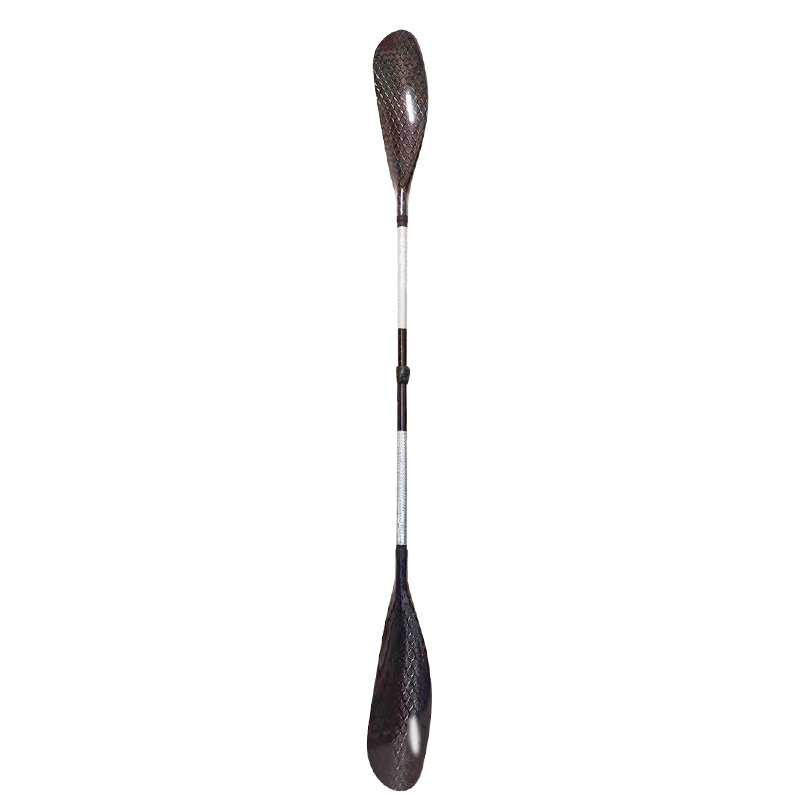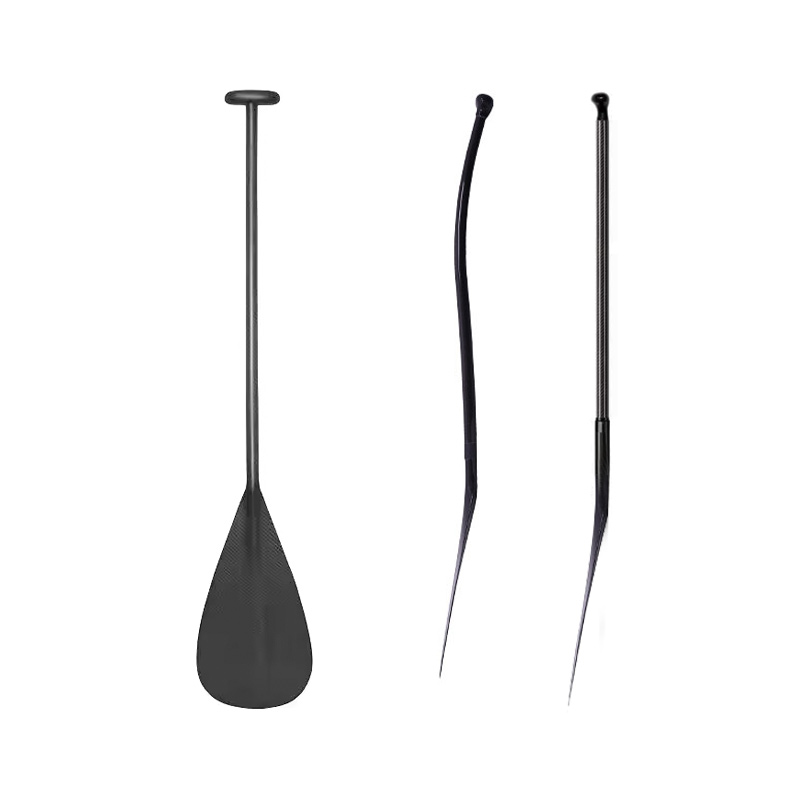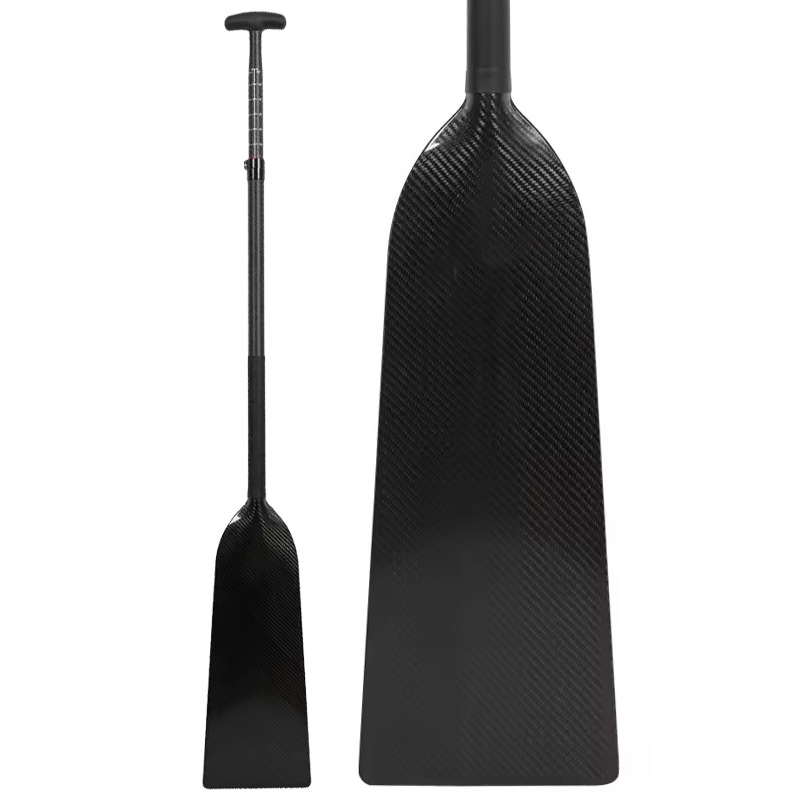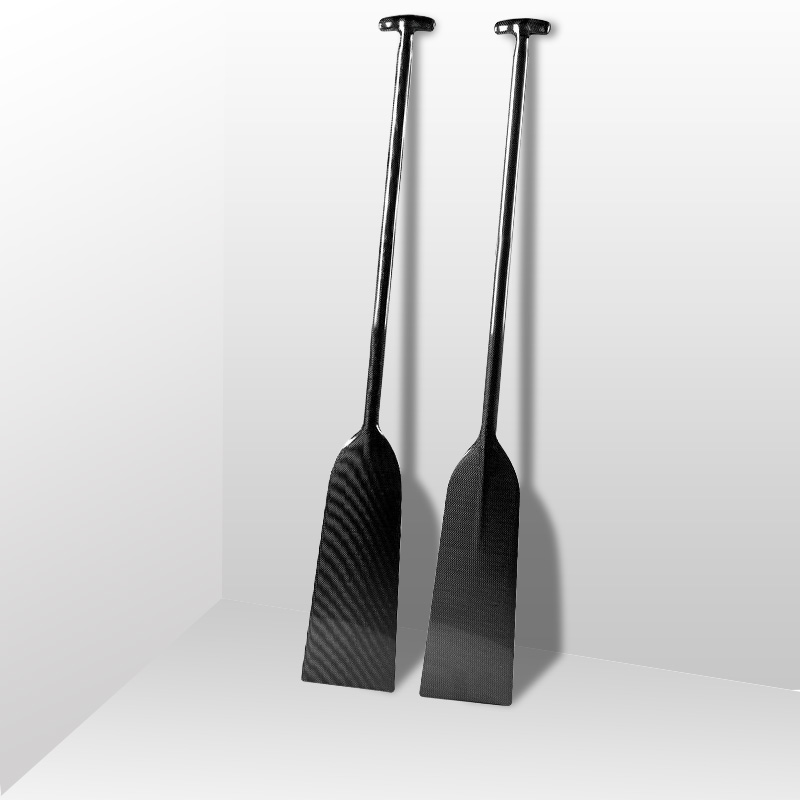
Paddle shaft flex is the controlled amount a shaft bends under load. A stiffer shaft transfers force quickly and feels direct; a more flexible shaft spreads the load over more of the stroke and can feel smoother. Neither is automatically better. The right choice depends on the paddler, paddle length, blade area, cadence, discipline and the way stiffness was measured.
This guide explains how to choose paddle shaft flex for SUP, kayak and canoe use—and, for brands and buyers, how to turn a vague request such as “medium flex” into a testable OEM specification.
Editorial note: Unitysurf manufactures composite paddles and other water-sports products. This article separates established composite principles from brand-specific flex scales; it does not present one company’s rating as an industry standard.
What Is Paddle Shaft Flex?
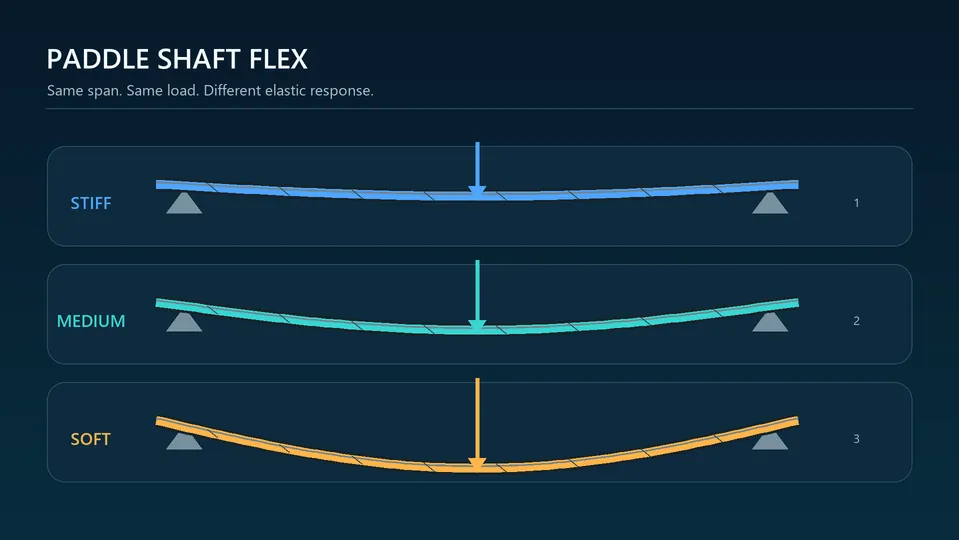
Paddle shaft flex describes elastic bending: the shaft deflects while force is applied and returns toward its original shape when the force is removed. Stiffness is the resistance to that bending. In the same test, the shaft with less deflection is stiffer; the shaft with more deflection has more flex.
Flex is not the same as strength. A shaft can be designed to flex noticeably yet carry a high load without damage. Conversely, a very stiff, light shaft may have little margin against impact, local crushing or a poorly designed joint. Four terms should therefore be kept separate:
- Flex or deflection: how far the shaft bends at a stated load and span.
- Bending stiffness: how strongly the shaft resists that bending.
- Torsional stiffness: how strongly it resists twisting around its axis.
- Strength: the load it can withstand before a defined form of failure.
This distinction matters when comparing carbon paddles. “100% carbon” identifies a broad material family, not a flex response. Fiber grade, orientation, wall thickness, diameter, taper, resin system and joints can make two carbon shafts feel very different.
Stiff vs Flexible Paddle Shaft: Quick Comparison
| Characteristic | Stiffer shaft | More flexible shaft |
|---|---|---|
| Feel at the catch | Immediate and direct | Progressive and smoother |
| Force transfer | Fast response with less visible bend | Load builds over a longer part of the stroke |
| High-cadence response | Often preferred for rapid acceleration | May feel delayed if too soft for the paddler |
| Long-session feel | Can feel harsh if mismatched | Can soften peak loading, subject to technique and fit |
| Feedback | More immediate blade feedback | More damped sensation |
| Common mismatch signal | Harsh catch, early fatigue or discomfort | Vague catch, excessive lag or difficulty accelerating |
These are tendencies, not promises. Paddle weight, swing weight, blade design and technique may influence the experience as much as shaft flex. A stiff shaft with a small blade can feel easier than a softer shaft paired with an oversized blade.
How Is Paddle Shaft Flex Measured?
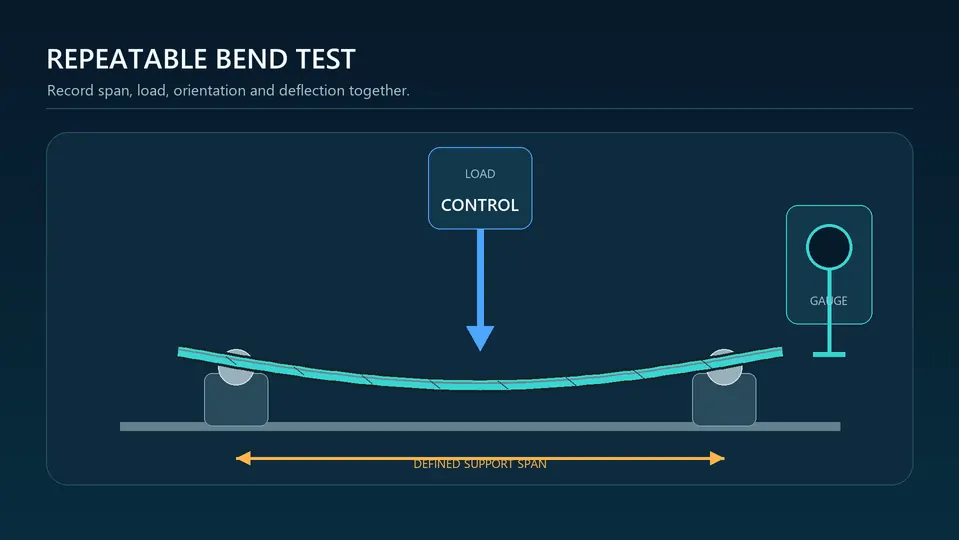
A practical comparison uses a controlled bending test. The shaft is supported at two points, a known load is applied at a defined location, and deflection is measured. Black Project, for example, describes a method using supports 150 cm apart and a 50 kg center load. That is useful within its own system, but the resulting number should not be compared directly with a rating produced at another span, load or shaft length.
Why the test conditions must travel with the number
Deflection changes when any of the following changes:
- distance between supports;
- magnitude, direction and location of the load;
- overall shaft length and tested section;
- handle, blade, ferrule or adjustment hardware installed during the test;
- shaft orientation when the cross-section is oval or asymmetric;
- temperature, conditioning and number of pre-load cycles;
- whether the reported value is first-cycle, stabilized or permanent deflection.
There is no single consumer flex number that can be assumed equivalent across all paddle brands. A useful specification is not “flex 70”; it is “70 mm center deflection at the agreed load, span, orientation and assembly condition,” together with a tolerance.
Do not test only one point
One load point is convenient for production checks, but a development team learns more from a load–deflection curve. Record deflection at several loads during loading and unloading. This reveals whether the response is linear, whether the shaft returns consistently and whether permanent set is developing. For adjustable or multi-piece paddles, repeat the test with the joint in the highest-stress region and check play before and after cycling.
How to Choose Paddle Shaft Flex
Start with the intended use, then adjust for the paddler and the complete paddle system. The decision should never be made from body weight alone.
1. Paddler mass and applied force
A heavier or more powerful paddler generally loads a shaft more. If two paddlers use the same length and blade, the stronger load case may justify a stiffer layup. But technique matters: a smooth paddler can generate high boat speed without the same abrupt catch load as a paddler who pulls suddenly with the arms.
2. Paddle length
A longer unsupported length normally produces more deflection under the same load. That is why a layup that feels balanced at one finished length may feel too soft when simply extended. OEM testing should cover the shortest and longest sellable configurations, especially for adjustable SUP paddles.
3. Blade area and catch behavior
A large or strongly loaded blade can increase peak shaft load. A smaller blade, clean entry and higher cadence can change the desired response. Specify blade area and representative blade geometry when validating a shaft; do not approve the shaft as an isolated tube and assume every blade will feel the same.
4. Cadence and stroke duration
Sprint and technical maneuvers reward immediate response, while touring and endurance paddling often prioritize a smooth repeatable stroke. Aqua Bound describes stiffer shafts for short power demands and more flexible designs for long hours on the water. Treat that as a design principle to validate with the intended user group, not as a universal prescription.
5. Previous discomfort and technique
If a paddler experiences recurring shoulder, elbow or wrist discomfort, equipment fit deserves review alongside technique, training load and clinical advice. A slightly more flexible shaft may feel less abrupt, but it is not a medical treatment. Blade size, grip diameter, paddle length and stroke mechanics should be checked at the same time.
Paddle Shaft Flex by Discipline
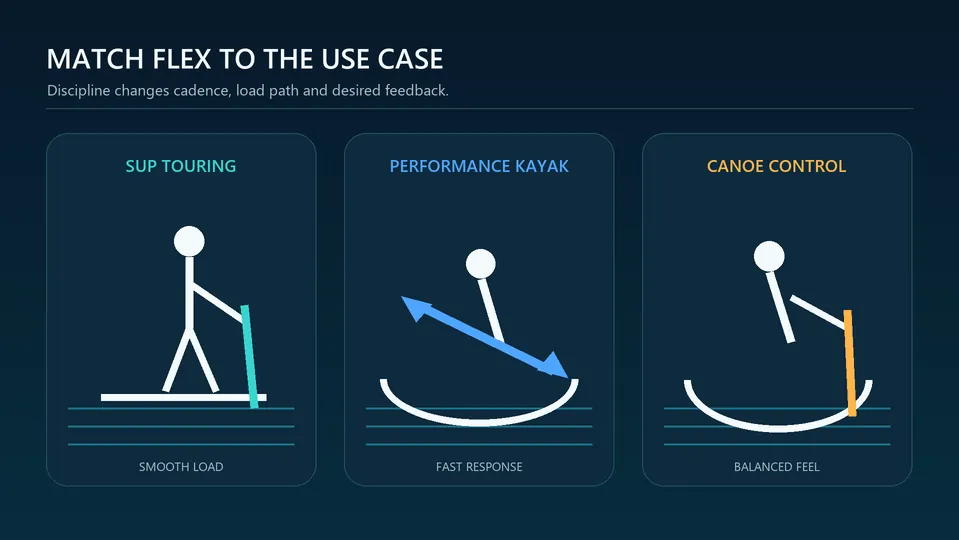
| Use case | Typical priority | Starting direction | Validate before approval |
|---|---|---|---|
| SUP sprint / technical racing | Acceleration and cadence | Medium-stiff to stiff | Catch harshness, cadence, start acceleration |
| SUP touring / fitness | Repeatable comfort and efficiency | Medium to moderately flexible | Long-session fatigue, tracking, adjustment length |
| SUP surf / foil | Control and quick bracing | Medium, tuned to blade and rider | Bracing, recovery, impact and joint durability |
| Performance kayak / whitewater | Fast response and control | Medium-stiff to stiff | Torsion, impact, ferrule play, emergency strokes |
| Touring kayak | Low fatigue over many cycles | Medium to moderately flexible | Swing weight, ferrule feel, sustained paddling |
| Canoe touring | Smooth power and control strokes | Medium | Grip comfort, correction strokes, blade/shaft transition |
| Dragon boat / team racing | Consistent cadence and repeatability | Medium-stiff, athlete-dependent | Team size range, synchronized load, fatigue cycling |
These starting directions help narrow prototypes; they are not pass/fail limits. A brand serving youth, rental, elite racing and expedition users may need several flex classes rather than one “all-purpose” shaft.
How Carbon Construction Controls Paddle Shaft Stiffness
Carbon paddle shaft flex is engineered through the laminate and geometry together. Simply increasing the carbon percentage does not define the result.
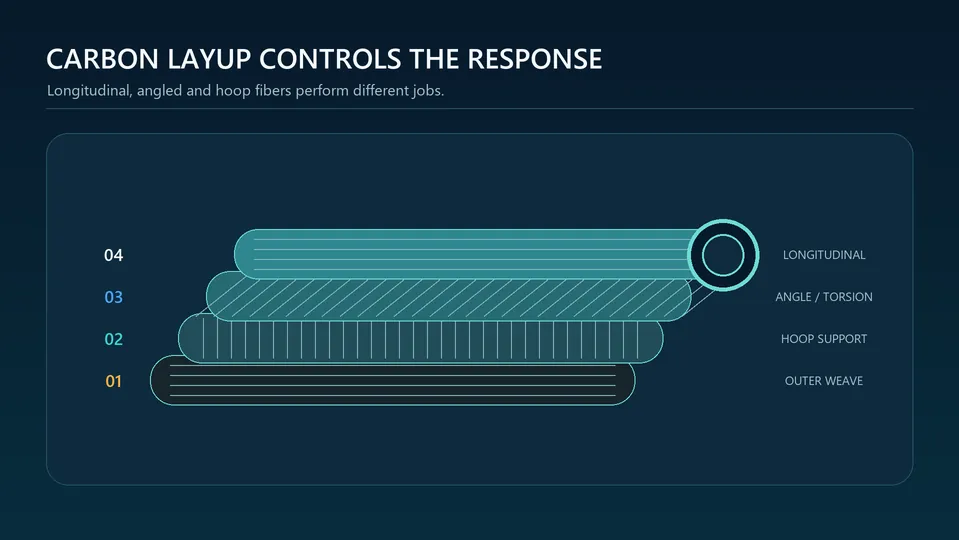
Fiber direction
- Longitudinal fibers contribute strongly to bending stiffness along the shaft.
- Angled fibers help manage torsion and distribute combined loads.
- Hoop-oriented fibers support tube stability and resistance to local splitting or crushing.
A durable design balances these jobs. Maximizing only longitudinal stiffness can leave the tube poorly suited to torsion, clamp pressure or impact.
Fiber grade and laminate thickness
Higher-modulus fiber can increase stiffness at a given geometry, but the finished part still depends on fiber volume, resin content, cure quality and layer sequence. More layers or a thicker wall can also increase stiffness and weight. Material names should therefore be paired with finished-part tests.
Diameter, taper and cross-section
Small changes in tube diameter can materially change bending behavior. Taper can place stiffness where load is highest while preserving a more forgiving feel near the upper hand. Oval or indexed sections may improve orientation feedback and can create direction-dependent stiffness, which must be tested in more than one orientation.
Ferrules and adjustment systems
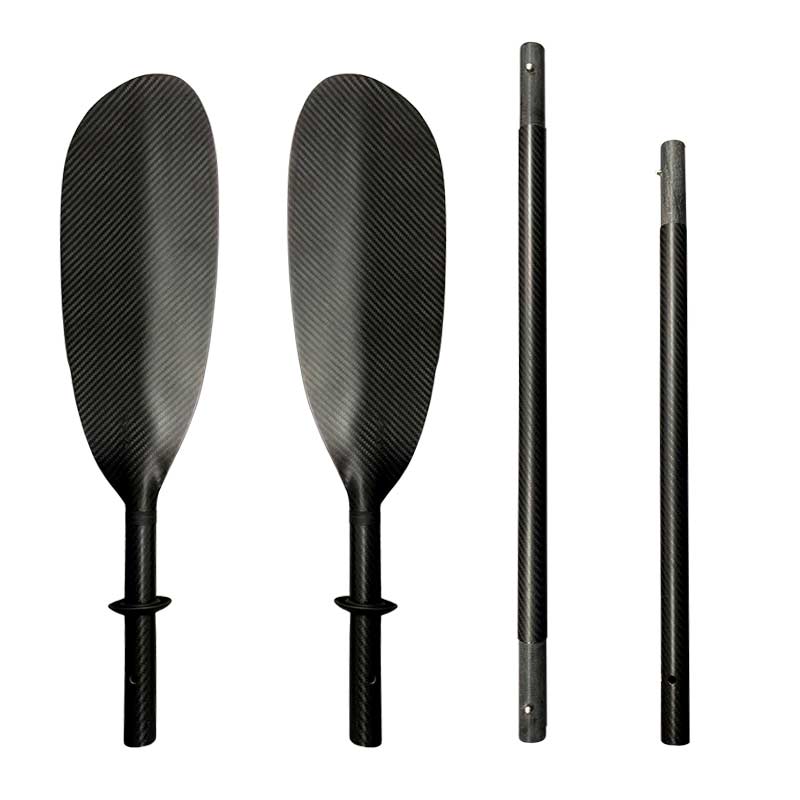
A joint changes the load path. It may add local stiffness and weight while introducing clearance, stress concentration or wear. For a two- or three-piece kayak paddle, record both whole-paddle flex and joint play. The existing guide to kayak paddle parts explains how the shaft, ferrule and blade work as one system.
OEM Paddle Shaft Specification: A Practical Checklist
For an OEM project, replace subjective adjectives with controlled targets. A development brief should include:
- Reference product and user: discipline, skill level, paddler range and target retail position.
- Finished geometry: minimum and maximum length, outside diameter, grip zone, taper and cross-section.
- Complete assembly: blade area, handle, ferrule, adjustment range and adhesive or assembly method.
- Bending test: support span, load steps, loading point, orientation, preload and allowed deflection band.
- Torsion test: gauge length, torque, angular displacement limit and joint condition.
- Recovery: maximum permanent set after unloading and the measurement time.
- Fatigue: cycle count, load range, rate and post-test inspection criteria.
- Strength and misuse cases: proof load, local clamp/crush check and impact plan appropriate to the product.
- Environment: wet conditioning, temperature range, salt exposure and UV expectations where relevant.
- Cosmetic and dimensional limits: weight, balance, straightness, finish and marking location.
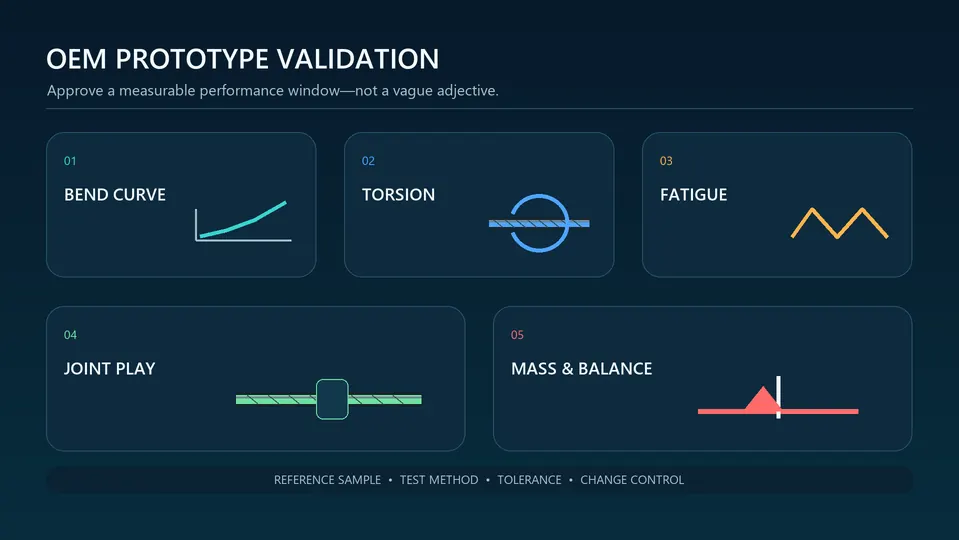
Example prototype acceptance table
| Check | Method to define | Example acceptance logic |
|---|---|---|
| Bending response | Specified span and multiple load steps | Curve stays inside the approved prototype band |
| Permanent set | Measure after unloading at a stated time | No visible damage; set below agreed limit |
| Torsional response | Specified torque and gauge length | Angle remains within approved band |
| Joint play | Before and after cyclic testing | No perceptible or measured increase beyond tolerance |
| Fatigue | Agreed load range and cycle count | No cracking, delamination, loosening or functional loss |
| Mass and balance | Finished paddle, conditioned consistently | Within drawing tolerance and sample baseline |
The approved “golden sample” should be retained with its test data. Production checks can then use a faster single-load method correlated to the development curve. If the material, layup, supplier, cure cycle, shaft length or joint changes, revalidation should be defined rather than assumed.
Common Paddle Shaft Flex Specification Mistakes
- Using only “soft,” “medium” or “stiff”: the terms have no transferable numerical meaning.
- Copying a competitor’s flex number: the fixture and load may be different.
- Testing a bare tube only: the finished blade, handle and ferrule change the system.
- Ignoring finished length: one layup can feel different across a broad adjustable range.
- Approving from one static pull: it says little about recovery, fatigue or joint wear.
- Chasing minimum weight without a use case: low mass is valuable only when stiffness, strength and durability remain appropriate.
- Changing several variables at once: prototype learning becomes ambiguous. Change one major factor per iteration where practical.
How to Compare Paddle Shaft Flex Without a Lab
A consumer should not improvise a heavy-load test: a slipping weight or damaged composite tube can cause injury. Instead, compare paddles of the same finished length and similar blade area on the water. Use the same route and alternate paddles while fresh.
- Warm up and use a consistent stroke.
- Compare the catch, mid-stroke load and release—not just static hand flex.
- Try easy touring cadence, several controlled accelerations and representative steering or bracing strokes.
- Note whether the paddle feels harsh, balanced, delayed or unstable.
- Recheck after a longer interval, because a five-stroke impression may not predict one-hour comfort.
For a purchasing team, a supplier’s controlled fixture and data are more useful than manually bending two shafts in a showroom.
Questions to Ask a Carbon Paddle Manufacturer
- What exact method defines each paddle shaft flex class?
- Are bending stiffness, torsional stiffness and strength tested separately?
- Is the result measured on a bare shaft or the finished paddle?
- How is consistency checked across production batches?
- What changes when the paddle is longer, adjustable or multi-piece?
- Can the layup, diameter, taper and flex be tuned without compromising the required durability?
- What prototype, fatigue and field-validation records will accompany approval?
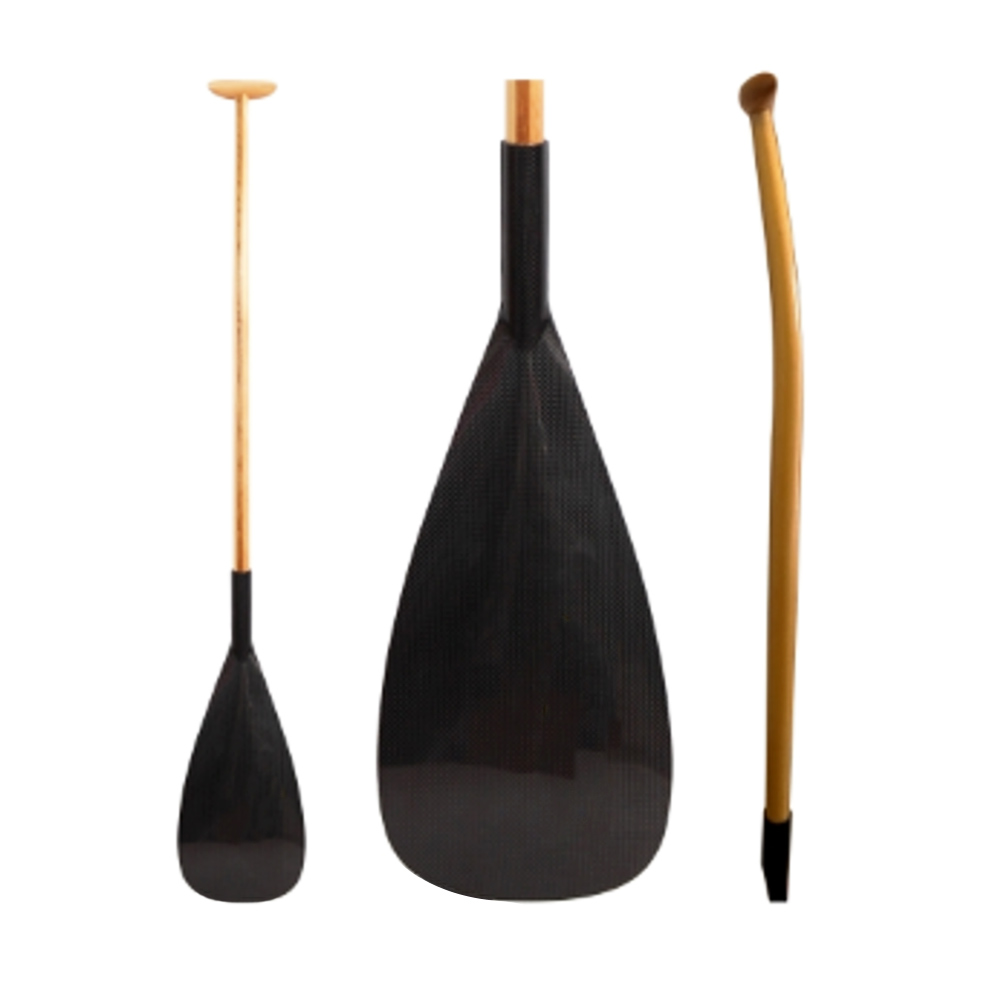
Unitysurf offers OEM and ODM development across composite paddle categories, including custom canoe paddles. Brands can use the checklist above to prepare a clearer RFQ before requesting a prototype discussion.
Frequently Asked Questions
Is a stiff paddle shaft more efficient?
It can feel more direct and transfer force quickly, but “more efficient” depends on the whole system and the user. If stiffness causes an abrupt catch, reduced cadence or early fatigue, it may not improve real-world performance. Blade size, paddle length, mass and technique must be considered together.
Is a flexible paddle shaft weaker?
Not necessarily. Flex and failure strength are different properties. A correctly designed shaft can have controlled elastic flex and high strength. Ask for both stiffness and strength test conditions rather than judging durability from flex alone.
What paddle shaft flex is best for beginners?
A moderate, predictable flex is a sensible starting point for many beginners, paired with an appropriate blade size and length. Very stiff or very soft extremes can make technique feedback harder to interpret. The paddler’s body size, discipline and comfort still matter.
Does carbon fiber always make a paddle shaft stiffer?
No. Carbon fiber gives designers a wide stiffness-to-weight design range, but the result depends on fiber grade, orientation, wall thickness, diameter, taper and resin processing. Carbon shafts can be deliberately tuned from relatively forgiving to very stiff.
Can two brands’ flex ratings be compared directly?
Only when the test method and assembly conditions are equivalent. Compare the support span, load, load position, shaft length, orientation and reported unit. Without those details, the numbers may describe different tests.
Should a SUP paddle and kayak paddle use the same flex?
Not by default. They differ in shaft length, blade arrangement, stroke mechanics and joint design. Use discipline-specific prototypes and test the complete paddle. For kayak setup decisions beyond stiffness, see the kayak paddle feather angle guide.
Final Recommendation
Choose paddle shaft flex as a system property, not a marketing adjective. Paddlers should match the feel to their discipline, length, blade and sustainable stroke. Brands should define a repeatable bend method, torsional response, recovery, fatigue and tolerances before approving production. That approach produces a carbon paddle shaft that can be compared, reproduced and improved—rather than one that is merely called “medium flex.”
Sources and Further Reading
- Black Project: How to Measure SUP Paddle Shaft Stiffness — an example of a disclosed brand-specific deflection method.
- Black Project: How Paddler Height and Weight Affect Shaft Flex Choice — selection factors and flex categories.
- Aqua Bound: How We Design Kayak and SUP Paddle Shafts — material, shaft-shape and field-validation considerations.
- Materials Modelling for Improving Kayak Paddle-Shaft Simulation Performance — engineering literature on paddle-shaft material modelling.