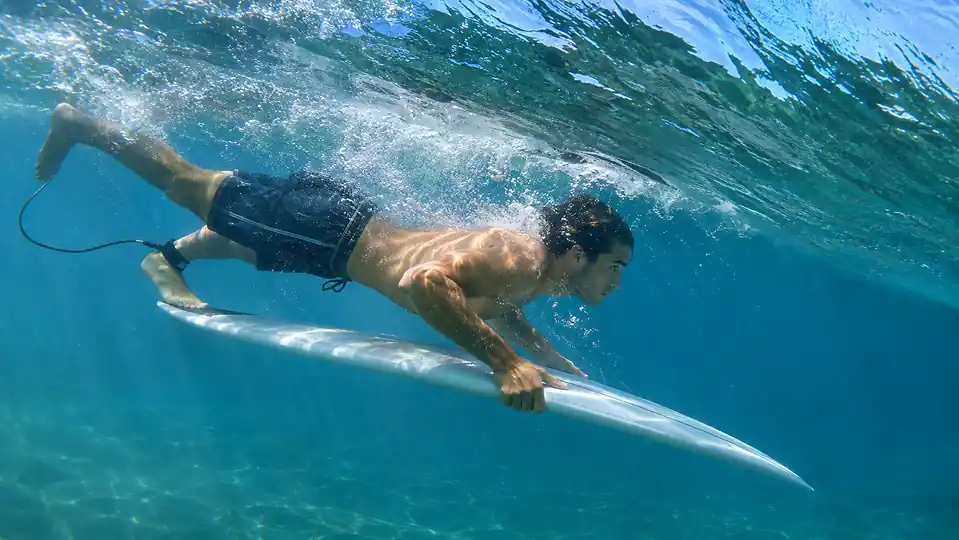
Learning how to duck dive a surfboard means learning one continuous movement: keep speed toward the wave, sink the nose, drive the tail down, streamline your body beneath the turbulence, then guide the board back toward the surface. The technique works best on a board you can physically submerge. High-volume mid-lengths, soft-tops and longboards may require a partial dive, push-through or turtle roll instead.
The movement in one sentence
Paddle until the last useful moment, push the front of the board below the wave’s energy, sink the tail with one foot or knee, pull your body close to the board, and let the board’s buoyancy bring you up only after the strongest turbulence has passed.
If you are asking how to duck dive a surfboard for the first time, begin with board suitability and small, controlled water—not with the largest whitewater you can find.
First Decide Whether You Should Duck Dive This Wave
Technique begins before your hands move. From the beach, watch where waves break, where surfers are paddling out, how quickly sets arrive and whether a channel is actually safe. The shortest line is not always the safest line. Read our detailed guide on how to read waves before treating the impact zone as a practice area.
Check the forecast, tide, local flags and lifeguard advice. Surf with another person, use a suitable leash, and choose conditions within your swimming and surfing ability. The RNLI surfing safety guidance specifically recommends checking weather and tides, knowing your limits, being aware of rip currents, surfing with a mate and wearing a leash.
Do not use an unfamiliar rip current as a shortcut
A current flowing seaward can look like an easy paddle-out channel, but rip strength and direction can change. The US National Weather Service advises checking local conditions and speaking with lifeguards. If you do not understand the spot and its exit routes, do not enter simply because other surfers appear to be using moving water.
Check whether your board can be submerged
There is no universal liter limit for a duck dive. The result depends on total volume, where that volume sits, rail and nose shape, board length, your mass, arm reach, strength and timing. A compact board with volume concentrated under the chest can feel different from a longer board with the same stated liters.
In safe, calm water, try pressing the nose down while keeping the board straight. If you cannot sink enough of the board without losing control, forcing the full maneuver in breaking surf is unlikely to help. Use an alternative technique and keep the board that supports your actual surfing level; do not move to an unsuitable low-volume board only to make paddle-outs easier.
How to Duck Dive a Surfboard in Seven Connected Steps
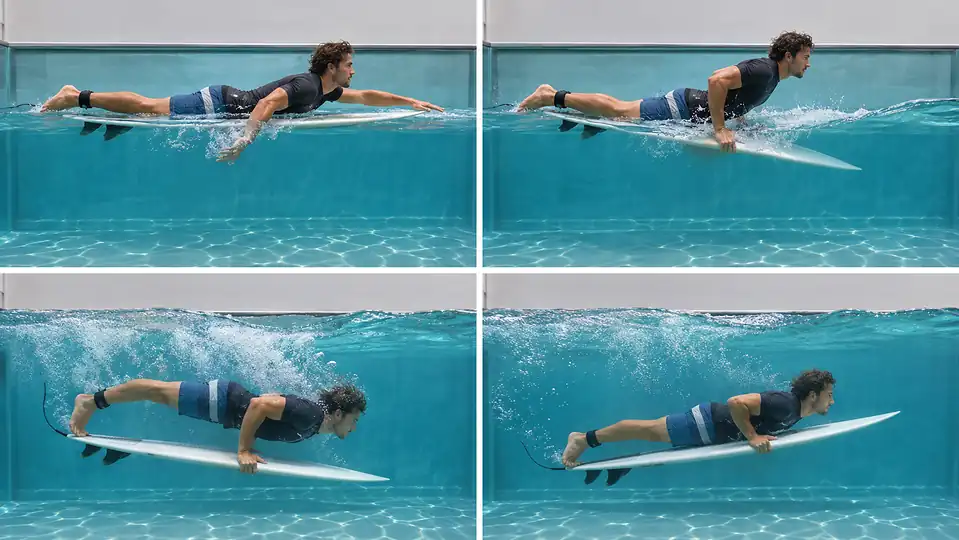
1. Choose a clear line and commit to forward speed
Look ahead and slightly to both sides. Make sure no swimmer or surfer is directly behind you, and avoid crossing another rider’s path. Point the nose generally perpendicular to the approaching energy. A large sideways angle exposes more rail and makes it easier for the wave to twist the board.
Paddle with purpose. Stopping early leaves the board nearly stationary at the exact moment you need momentum. Your final strokes should keep the board tracking; the duck dive begins after those strokes, not several seconds before the wave reaches you.
2. Place your hands where you can control the rails
Move both hands to the rails around the upper-chest area. Hands too close to the nose can make the tail rise without creating a useful downward path. Hands too far back make it difficult to sink the front. Keep your grip symmetrical so the board does not roll or yaw.
3. Push the nose down with straight, controlled arms
Lift your chest slightly, then press the board forward and down using your shoulders and upper body. Aim for a smooth diagonal path, not a vertical shove. The goal is to place the front of the board below the strongest moving surface water while keeping the nose pointed along your escape line.
4. Drive the tail below the surface
Once the nose is descending, press the tail with the ball of your rear foot. This usually provides more reach and a deeper, straighter tail sink than a knee. A knee can be quicker on small waves or short boards, but concentrated pressure may dent some decks. Use a controlled contact point and consider the construction of the board; our article on surfboard structure and lamination explains why local loads matter.
5. Bring your body close and follow the board
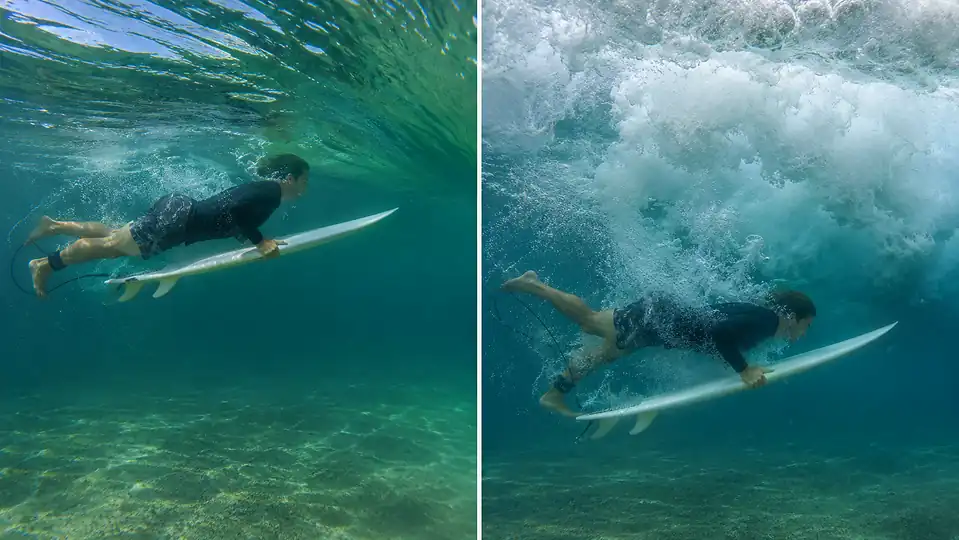
As the tail sinks, extend the pushing leg and let your torso follow the board underwater. Keep the board close rather than leaving your chest high above it. A compact, aligned shape gives the wave less area to grab and helps prevent the board from being pulled sideways.
6. Hold depth until the main turbulence passes
Do not rush upward simply because the nose is underwater. If you redirect too early, you may surface directly into the whitewater and be pushed back. The correct hold time is not a fixed count; it depends on wave thickness, speed, your depth and whether the wave has broken.
7. Guide the nose upward and resume paddling
After the strongest energy passes, pull the nose slightly toward your chest and allow the board’s buoyancy to help it rise. Keep control of both rails, settle your chest onto the deck, check the next wave and paddle immediately. A technically good dive can still lose ground if you pause after resurfacing.
Timing Changes Between an Unbroken Wave and Whitewater
| Situation | Main objective | Timing cue | Common error |
|---|---|---|---|
| Unbroken swell | Pass beneath the rising face without diving unnecessarily deep | Begin as the face reaches you and still has a clean surface | Starting too early and resurfacing on the wave face |
| Soft whitewater | Place the board below the foamy surface layer | Use the approaching foam edge and your board speed rather than a fixed distance | Stopping the paddle and getting hit before the nose sinks |
| Powerful whitewater | Reach useful depth while keeping a secure, straight board | Start early enough for both nose and tail to submerge before impact | Diving late, bending arms and leaving the tail at the surface |
| Wave already pitching on you | Avoid an uncontrolled collision or endangering others | This is often a route-choice or conditions problem, not a cue to force a deeper dive | Treating a late emergency maneuver as normal practice |
Coaching pages such as the Surf Technique duck dive tutorial and OMBE’s technique guide also emphasize timing, continued paddling and board control. The useful principle is consistent, but the exact start point changes with the wave and surfer.
Board Volume Changes the Method, Not Your Worth as a Surfer
Shortboards and compact fish shapes are often easier to submerge than wide soft-tops, thick mid-lengths or longboards, but labels alone do not settle the question. Volume distribution and rail shape matter, and so does the surfer. A board that is easy for one person may remain difficult for another.
| Board situation | Likely approach | What to test safely |
|---|---|---|
| Board submerges fully and stays straight | Full duck dive | Timing, tail depth and controlled resurfacing |
| Nose sinks but tail remains very buoyant | Partial dive for small waves; turtle roll for stronger whitewater | Foot position, board alignment and whether the alternative keeps control better |
| High-volume soft-top or longboard | Usually turtle roll or controlled push-through in small foam | Secure rail grip and board position without placing others at risk |
| Board is technically submersible but technique collapses under load | Return to calm-water and small-wave drills | One variable at a time: hand position, nose depth, tail pressure or timing |
The best learning board is the one that lets you catch waves, paddle efficiently and progress safely—not necessarily the smallest board you can force underwater. For construction and buoyancy context, see the foam surfboard guide.
When a Turtle Roll Is the Better Choice
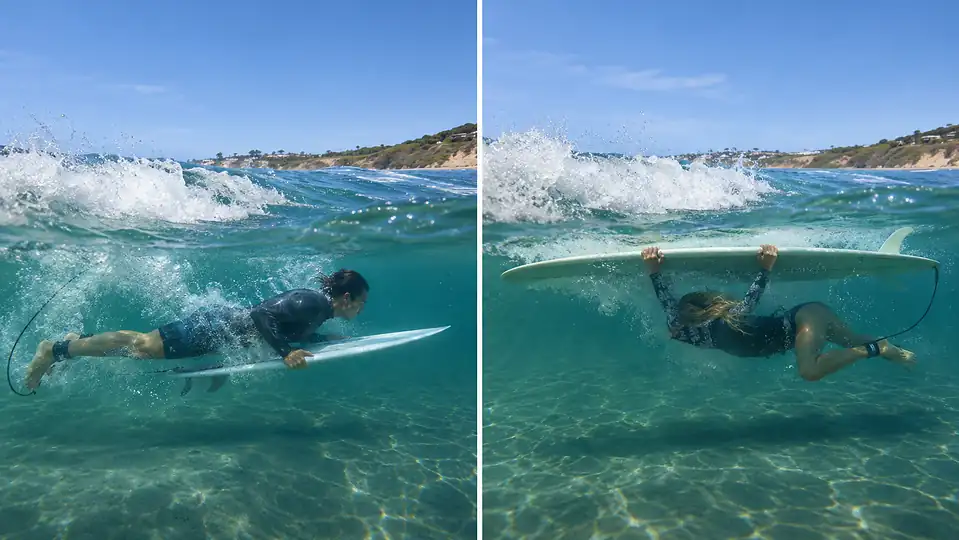
A turtle roll keeps a buoyant board with you by turning the board upside down before the whitewater arrives and holding the rails while the wave passes. It is commonly used with longboards and high-volume beginner boards that resist a full duck dive.
The choice is not about status. A controlled turtle roll is more useful than a failed dive that exposes the entire deck to the wave. Practice the roll in suitable small surf with qualified instruction, because hand position, body clearance, leash management and the presence of other surfers still matter.
Use the Result to Diagnose the Mistake
| What happens | Likely cause | Next-session correction |
|---|---|---|
| The wave catches the nose before it sinks | Late start or loss of paddle speed | Keep paddling and begin the push slightly earlier |
| The nose dives but the board is pulled backward | Tail stayed high or body remained above the board | Add controlled tail pressure and follow the board underwater |
| You surface into the foam | Started too early or redirected upward too soon | Use the wave edge as the cue and hold the streamlined phase longer |
| The board turns sideways | Uneven hands, angled approach or one-sided tail pressure | Square the board, match hand positions and press along the centerline |
| You pass the wave but stop moving | Slow entry or delayed paddling after resurfacing | Link the dive directly to the next three controlled strokes |
| The board will not submerge even in calm water | Board/rider mismatch for this maneuver | Use a turtle roll or seek coaching before changing boards |
Practice the Sequence Without Turning It Into a Breath-Hold Contest
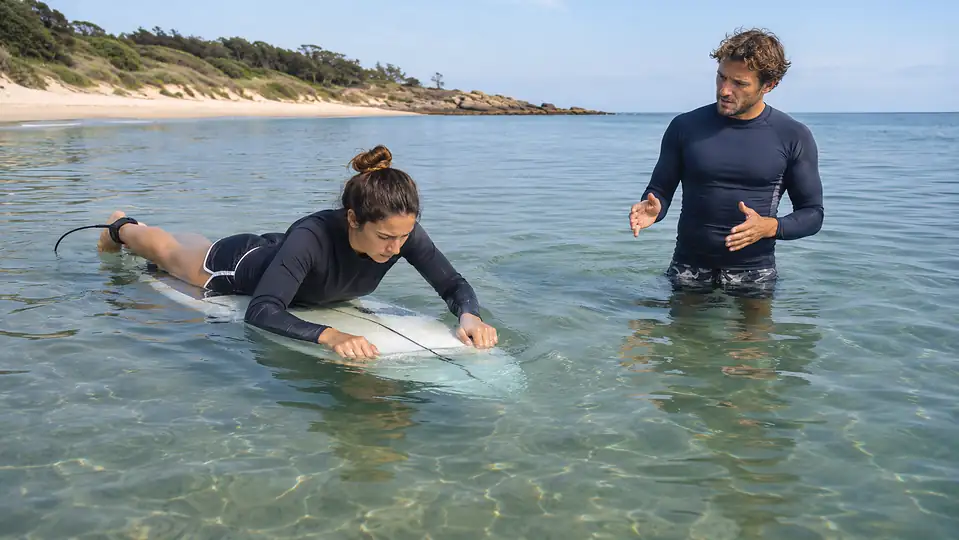
When you practice how to duck dive a surfboard, learn one component at a time in calm, clear, permitted water with another capable person present. Do not practice prolonged underwater breath-holding alone. The aim is repeatable board control, not maximum time underwater.
- Dry positioning: on sand or a padded surface, rehearse the hand position and rear-foot reach without grinding fins or the board.
- Calm-water nose press: confirm that the board sinks straight and your hands remain even.
- Nose-to-tail sequence: add rear-foot or knee pressure and bring your chest toward the board.
- Small unbroken swell: practice the timing with low consequence and plenty of space.
- Soft whitewater: keep paddling into the approach, then link the full dive to immediate strokes.
- Video or coach feedback: check whether the problem is timing, depth or alignment instead of changing everything at once.
Know When Not to Force the Maneuver
- Shallow reef or rocks: a steep nose-down path can strike the bottom. Use local knowledge and qualified guidance; do not practice blind.
- Crowded impact zone: change line or wait for space. A leash is not permission to release the board near others.
- Conditions beyond your ability: repeated failed dives, exhaustion or panic are reasons to leave the water, not instructions to try harder.
- Damaged board or leash: inspect the deck, rails, leash plug and leash before re-entering. Use our surfboard repair guide to recognize damage that needs proper attention.
- Unknown local hazards: ask a lifeguard or experienced local instructor about currents, reef, shorebreak and permitted areas.
Board control also affects other surfers. Review Unitysurf’s guides to surfing safety and surfing etiquette before practicing in a busy lineup.
Your Pre-Paddle Checklist
A safe session focused on how to duck dive a surfboard should still begin with the same forecast, equipment and exit checks as any other surf session.
- Forecast, tide, flags and lifeguard advice checked
- Entry, exit and safe waiting area identified
- Leash, board, fins and wetsuit inspected
- Board is appropriate for the planned maneuver
- No surfer or swimmer is directly behind your practice line
- You know whether the next response is a duck dive, partial dive, turtle roll or exit
- You still have enough energy to return to shore safely
Common Questions About Duck Diving
How deep should a duck dive go?
Deep enough to place the board and body below the most energetic surface turbulence, but no deeper than the conditions require. A small unbroken swell may need only a shallow path; broken whitewater usually needs more depth and earlier tail control.
Should I use my knee or foot on the tail?
A foot generally provides more extension and can drive the tail deeper. A knee may be quicker for smaller waves or certain body proportions. Whichever you use, keep pressure controlled and centered; concentrated knee loading can mark or dent some decks.
Can I duck dive a longboard?
Some strong, skilled surfers can partially submerge certain longboards in limited conditions, but most longboard paddle-outs are better served by a controlled turtle roll or route choice. Do not reduce board size solely to pass whitewater if that board makes your actual surfing worse.
Why do I keep getting washed backward?
The most common possibilities are insufficient entry speed, starting too late, leaving the tail near the surface, keeping the body above the board or resurfacing before the turbulence passes. Change one factor at a time in smaller surf.
A Good Duck Dive Preserves Options
Knowing how to duck dive a surfboard is not about overpowering every wave. It is about arriving with speed, placing the board beneath the active surface layer, staying aligned and returning to paddling without losing control. Just as important, a skilled surfer recognizes when the board, water depth, crowd or wave energy calls for a turtle roll, another route or no paddle-out at all.
Continue building the surrounding skills with the intermediate surfing guide, or explore Unitysurf’s water-sports board range.
Safety scope: This article is educational and cannot assess a beach, wave, board or individual ability. Learn in suitable conditions with a qualified local instructor, follow lifeguard instructions, and leave the water if conditions or fatigue exceed your control.