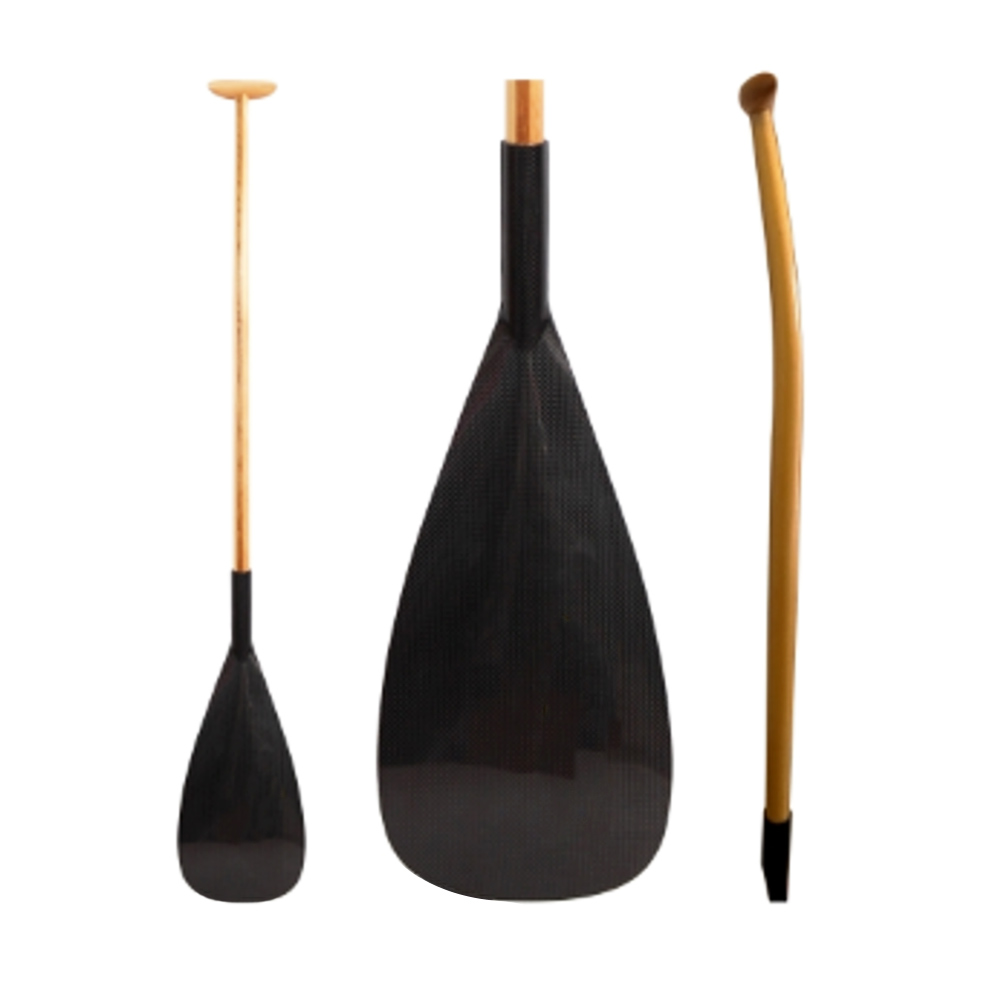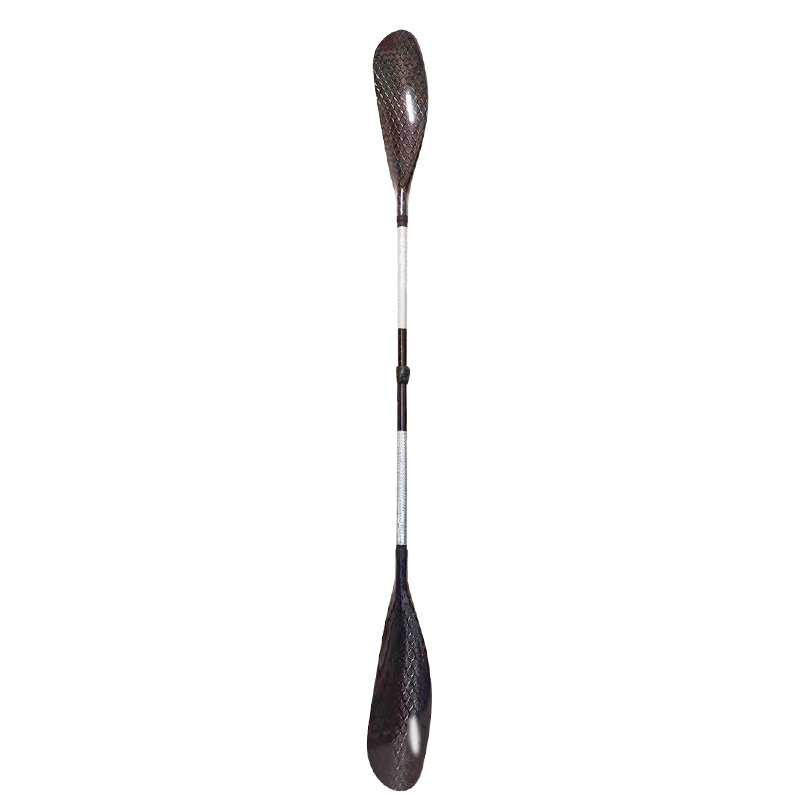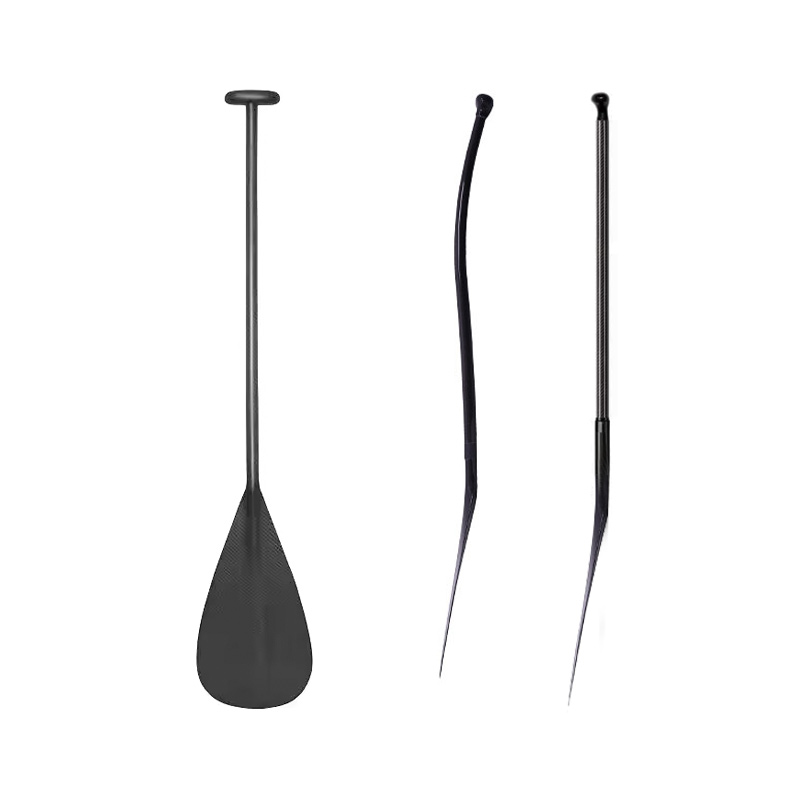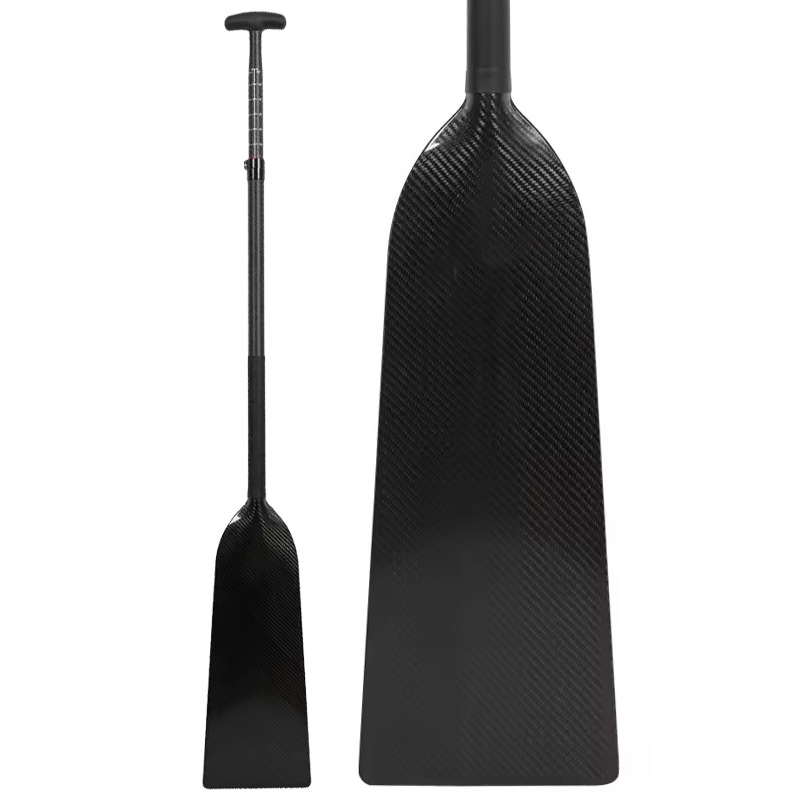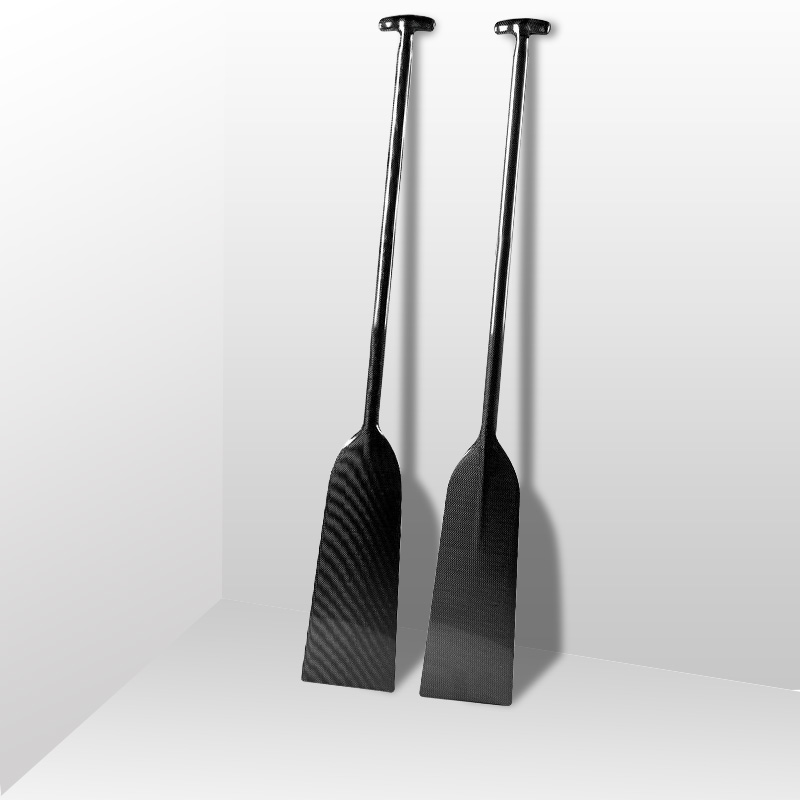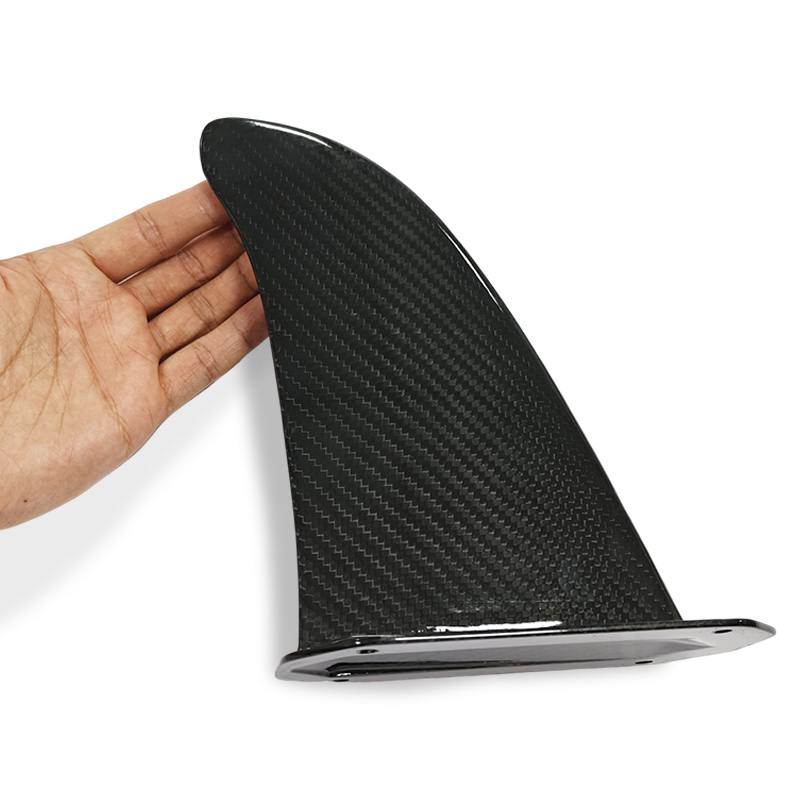
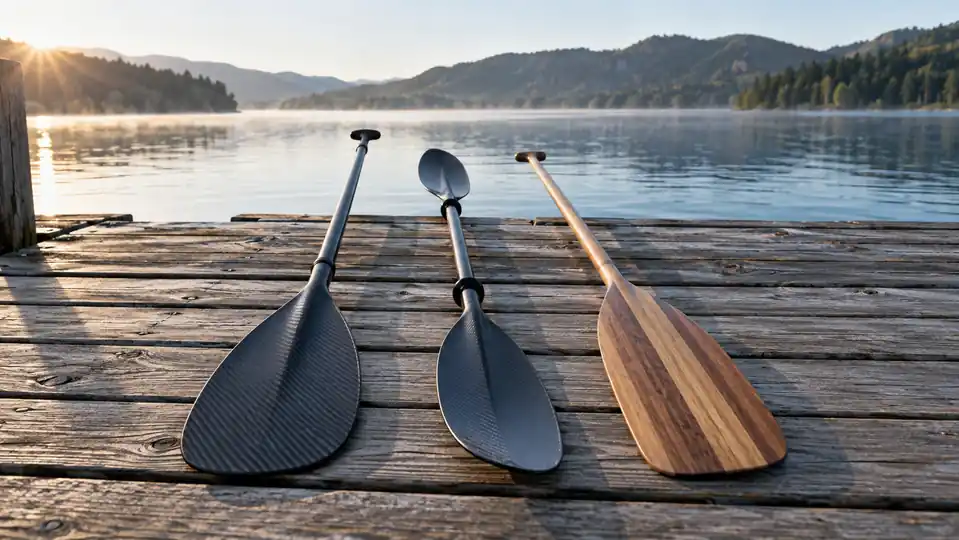
The best paddle blade size is the smallest effective area that gives you a clean catch and enough acceleration at your intended cadence—without forcing you to shorten the stroke, pull with the arms, or overload the shoulders. A larger blade can feel powerful for a few strokes, but it also increases resistance. A smaller blade usually makes it easier to maintain cadence and technique over distance.
This paddle blade size guide gives SUP, kayak and canoe paddlers a common decision framework. It also explains why a printed area number is only a starting point: outline, aspect ratio, blade angle, construction, shaft flex, paddler technique and water conditions all change how a blade loads.
Quick answer: should you choose a small, medium or large paddle blade?
| Blade choice | Usually suits | Likely benefit | Main risk |
|---|---|---|---|
| Smaller area | Higher cadence, distance, smaller paddlers, developing technique, sensitive shoulders | Smoother loading and easier repetition | May lack immediate acceleration or support if taken too far |
| Medium area | General touring, mixed conditions, all-round use | Broad operating range and easier product fit | May not be optimized for sprinting or very long endurance use |
| Larger area | Short powerful efforts, bigger/stronger paddlers, surf acceleration, bracing or loaded craft | More water resistance per stroke | Lower sustainable cadence and higher joint/shaft load |
These are directional—not universal—recommendations. Do not transfer a SUP blade-area number directly to a kayak or canoe paddle. Each sport uses different leverage, immersion, cadence and blade geometry. Compare blades within the same category and test the complete paddle.
What does paddle blade size actually mean?
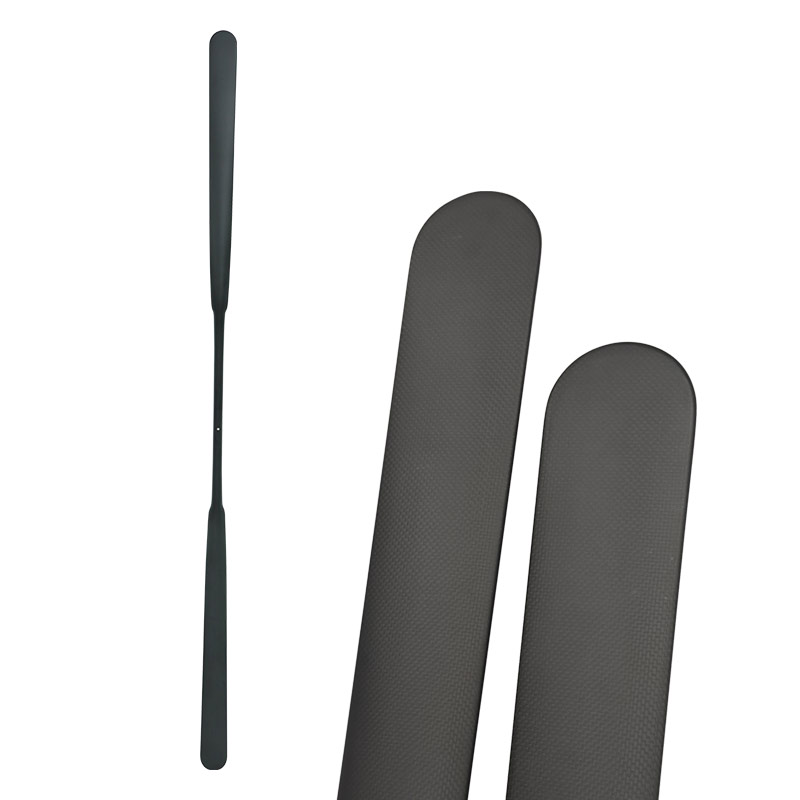
Manufacturers commonly describe blade size with projected surface area, often in square inches or square centimeters. Area is useful, but two blades with the same nominal area may feel different because their area is distributed differently.
Area, length, width and aspect ratio
- Projected area is the two-dimensional area of the blade outline. Ask how it was measured when comparing suppliers.
- Blade length affects how quickly the full area becomes immersed and where the load develops.
- Maximum width influences the early catch, maneuverability and clearance beside a board or hull.
- Aspect ratio describes how long and narrow—or short and broad—the planform is. Equal-area blades can therefore have different catch and release behavior.
- Area distribution matters. A broad tip, parallel edges, teardrop outline or long tapered blade does not load the same way.
Blade offset, dihedral, spoon, edge thickness and face geometry further influence stability and water flow. That is why buying only from a square-inch number can be misleading.
How blade area changes the stroke
A paddle blade does not create free power. Increasing the effective area increases the resistance the paddler must manage during the catch and power phase. The result depends on technique and speed:
- A larger blade can deliver strong acceleration when the paddler can connect the legs, torso and shaft without slipping or collapsing the stroke.
- A smaller blade can reduce peak loading and let the paddler repeat technically clean strokes at a faster cadence.
- If the blade is too large, the body often compensates by bending the elbows early, shortening the power phase or slowing cadence.
- If the blade is too small, the paddler may increase cadence excessively, lose bracing confidence or struggle to accelerate a heavy craft.
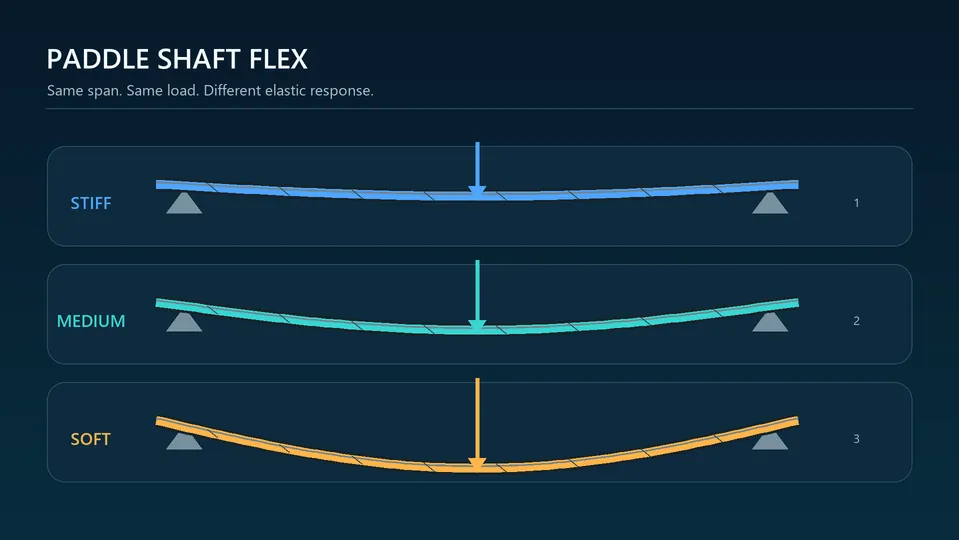
Blade area must also match the shaft. A stiff shaft transmits a sharper load, while a more flexible shaft can spread that load over more of the stroke. See the separate paddle shaft flex guide before changing both variables at once.
SUP paddle blade size: prioritize sustainable cadence
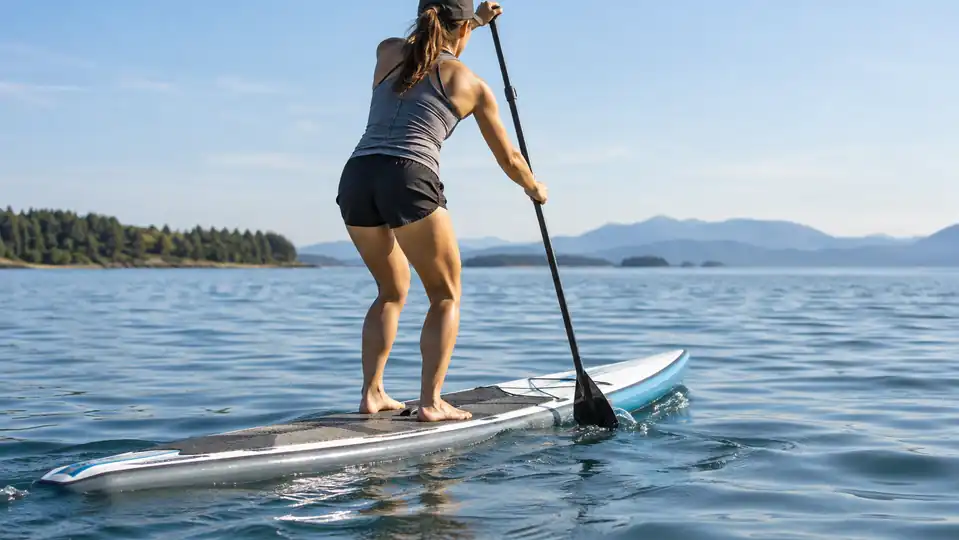
SUP paddlers use a long single-bladed lever while standing above the water. Board width, discipline and cadence therefore matter as much as body weight.
Choose relatively smaller when
- your priority is touring, distance racing or repeated high-cadence strokes;
- you are lighter, less powerful, returning from a shoulder problem or still refining torso-driven technique;
- you use a narrow race board and want a clean, close shaft path;
- your current blade makes you pause, pull with bent arms or lose posture after several minutes.
Choose relatively larger when
- you need short-burst acceleration for surf, starts or step-back turns;
- you are moving a larger board, cargo or another person and can maintain sound mechanics;
- you value immediate support and leverage more than maximum sustainable cadence;
- testing shows the extra load does not reduce stroke quality or cause joint discomfort.
For an OEM program, define more than “small/medium/large.” Specify projected area, outline coordinates or approved master sample, blade angle, face geometry, edge requirements and target weight. Unity Sports’ stand-up paddle manufacturing page provides the relevant product context.
Kayak paddle blade size: match stroke angle and trip duration
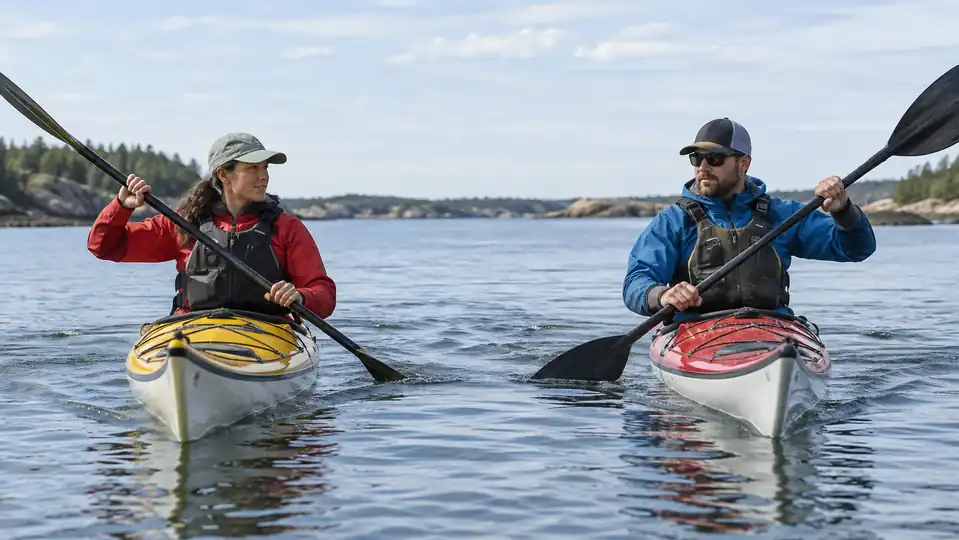
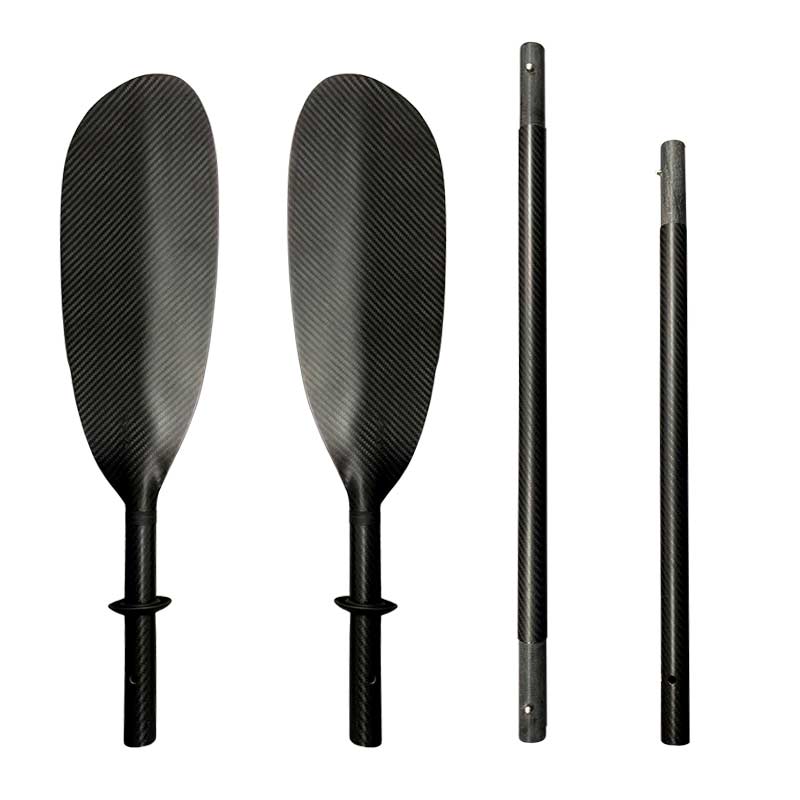
Kayak paddlers alternate two blades, so excess resistance repeats on both sides. A low-angle touring stroke generally pairs well with a longer, narrower blade that delivers progressive power. A high-angle stroke usually uses a shorter, broader profile for a stronger catch close to the hull.
| Kayak use | Typical blade direction | Why |
|---|---|---|
| Recreational / relaxed touring | Small-to-medium, narrower profile | Easy cadence and lower repeated load |
| Sea touring / distance | Efficient medium or narrow blade | Supports long-duration technique and smooth transitions |
| High-angle fitness | Medium, shorter/broader profile | More immediate catch near the hull |
| Whitewater / surf / maneuvering | Robust medium-to-large working area | Acceleration, correction and bracing, balanced against fatigue |
| Wing-style racing | Technique-specific wing geometry | Lift-producing stroke path; conventional area comparisons are incomplete |
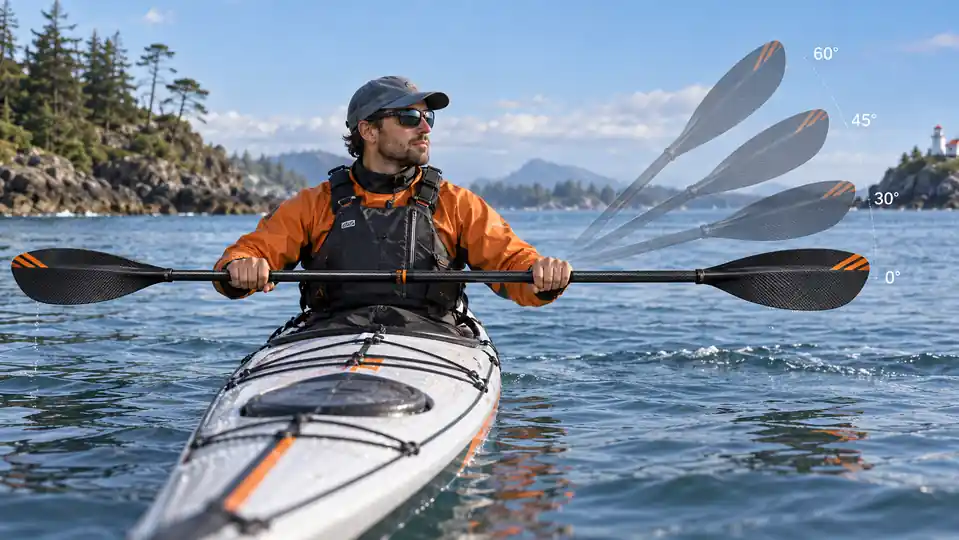
Do not use a larger blade to compensate for the wrong paddle length or feather angle. Length depends on boat width, seat height and stroke style. Feather affects wrist setup and recovery orientation. Review the kayak paddle feather-angle guide and Unity Sports’ kayak paddle range separately.
Canoe paddle blade size: water depth and control change the answer
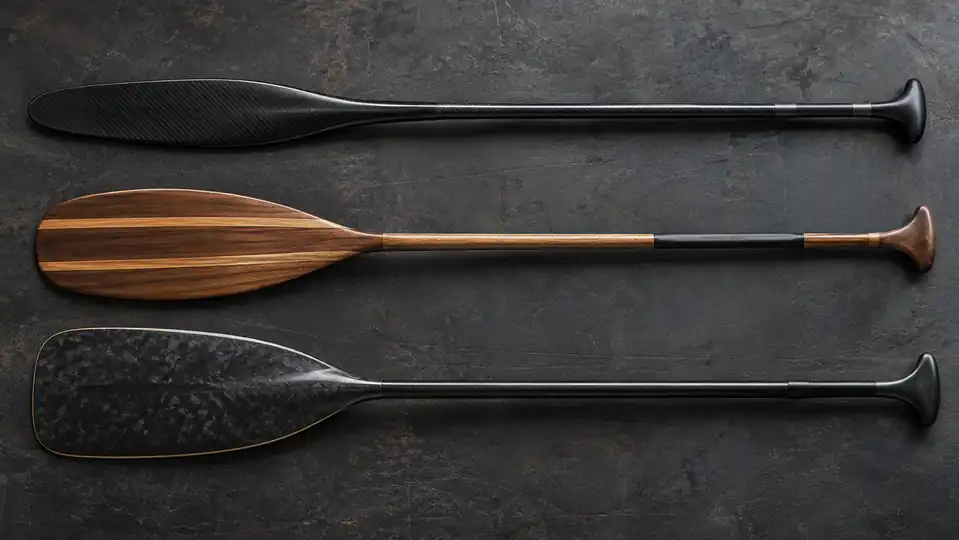
Canoe selection is not simply “bigger paddler, bigger blade.” The water depth, stroke style, boat load and need for correction strokes influence both area and outline.
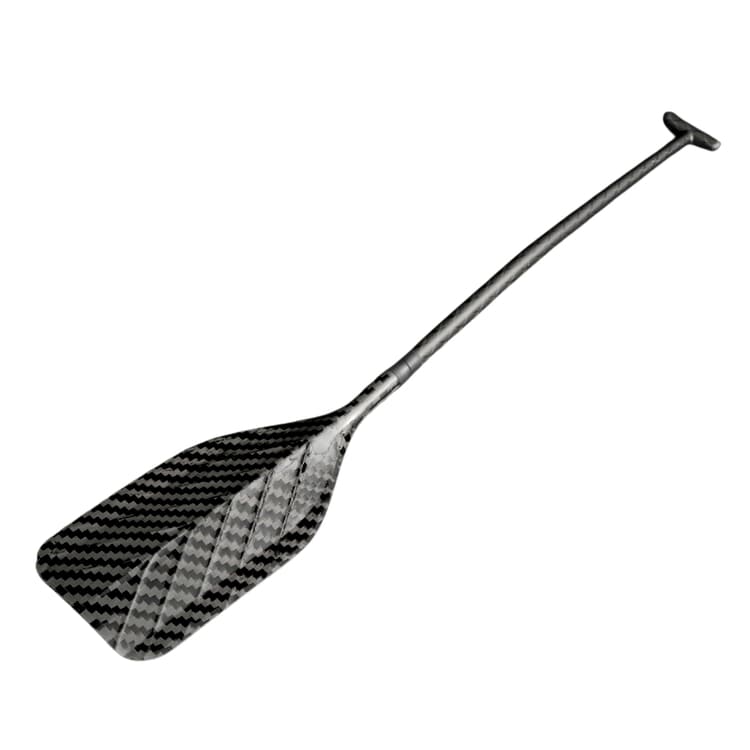
- Long, narrow ottertail-style blades immerse progressively and suit deep water, quiet strokes and controlled touring. Their length is less convenient in shallow, rocky water.
- General-purpose profiles balance acceleration, correction and clearance for mixed touring.
- Shorter, broader blades put more working area into limited depth and can suit moving water, quick maneuvers or loaded craft, provided the paddler can manage the load.
- Outrigger and racing designs require their own catch, exit and cadence criteria; do not select them only by visual similarity to recreational canoe blades.
For category-specific options, see Unity Sports’ canoe paddle manufacturing page and the existing canoe paddle selection guide.
Five factors in a practical Paddle Blade Size Guide
1. Intended cadence and duration
A blade that feels impressive for ten strokes may be wrong for a two-hour session. Choose for the longest representative workload, not a showroom pull.
2. Paddler size, strength and training
Body mass is a useful starting signal, not a complete prescription. Technique, mobility, training volume and injury history can justify a smaller blade even for a large paddler.
3. Craft resistance and load
A wide SUP, loaded canoe or maneuver-heavy kayak can require more immediate force than a narrow unloaded craft. First confirm that paddle length and technique suit the craft.
4. Water and wind conditions
Flat water rewards repeatability. Surf, current and technical water can increase the value of acceleration and bracing. Shallow water limits how a long blade can be immersed.
5. The rest of the paddle system
Shaft stiffness, length, grip, ferrule, feather, blade offset and total swing weight affect perceived load. Change one major variable at a time when testing.
Signs your paddle blade is too large or too small
| What you notice | Possible interpretation | What to test next |
|---|---|---|
| Shoulders or elbows fatigue early | Blade may be too large, shaft too stiff, cadence forced or technique arm-dominant | Try less area while keeping length and shaft similar; review technique |
| Stroke becomes shorter as effort rises | Peak load may exceed sustainable connection | Use a smaller blade or slightly softer shaft and compare video |
| Blade flutters or ventilates | Entry/shaft path or face geometry may be the issue—not necessarily area | Check full immersion, verticality and blade orientation |
| Acceleration feels weak despite clean technique | Blade may be too small for the craft and task | Test the next area up on the same timed acceleration |
| Cadence feels frantic on a loaded craft | Area or leverage may be insufficient | Compare one larger blade while monitoring joint load |
| Large blade feels good initially but pace fades | Short-term power is masking poor sustainability | Use a longer test interval and track stroke rate versus speed |
Pain is not a sizing metric. Persistent or sharp pain should be assessed by an appropriate health professional. Equipment changes can reduce load, but they do not diagnose an injury.
A practical 30–45 minute blade comparison test
- Choose adjacent sizes. Compare two blades from the same family where possible.
- Control the variables. Keep shaft length, flex, grip, craft, route and feather setting as similar as possible.
- Warm up first. Do not judge the blade during the first cold minutes.
- Run three blocks. Test easy sustainable pace, intended working pace and several controlled accelerations or maneuvers.
- Record more than speed. Note cadence, perceived effort, catch stability, ability to hold technique and discomfort during and after the session.
- Repeat in representative conditions. A flat-water winner may not be the best surf, current or loaded-craft choice.
Select the blade that meets the performance requirement with the lowest unnecessary load. If results are close, the more sustainable option is normally the safer starting point.
How manufacturers and buyers should specify blade size
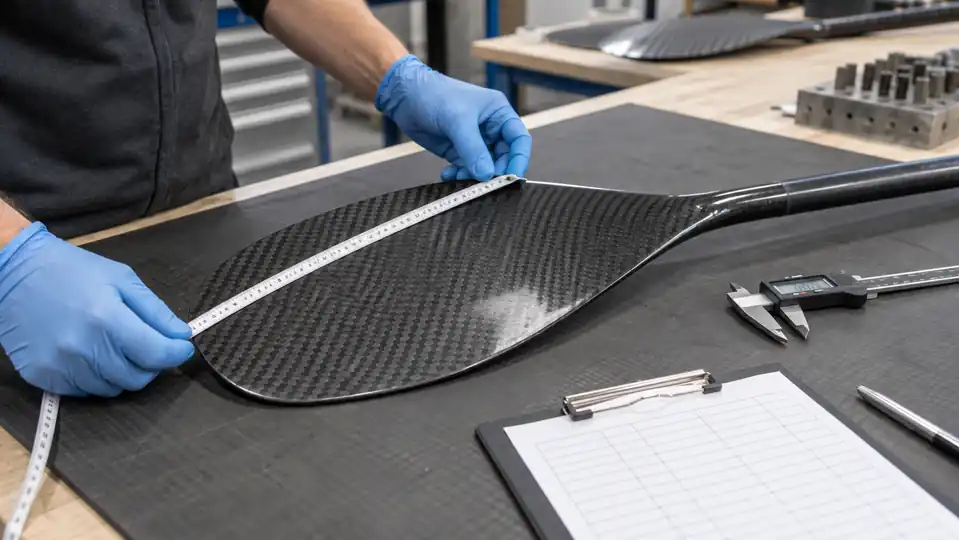
“Medium blade” is not a production specification. For buyers applying this Paddle Blade Size Guide to OEM/ODM sourcing, the approved drawing and sample should define:
- projected blade area and measurement method;
- overall blade length, maximum width and outline/profile coordinates;
- area distribution or reference sections where relevant;
- blade-to-shaft offset, face geometry, dihedral/spoon and edge profile;
- material system, fiber orientation, core or rib concept and reinforcement zones;
- target blade and complete-paddle weight, balance and allowed tolerance;
- finish, graphics, UV requirements and acceptable cosmetic standard;
- proof-load, fatigue, impact or field-validation plan appropriate to the product;
- golden sample, inspection method and change-control process.
Blade area affects structural load, so a larger outline should not be created by simply scaling a smaller laminate. The blade, neck and shaft connection must be reviewed as one load path. Unity Sports has produced composite water-sports products since 2012; buyers can review its broader custom paddle manufacturing capabilities or submit a target specification for discussion. Final tolerances and performance claims should always be confirmed in the approved specification and validation plan.
What leading paddle brands agree on—and where this guide adds detail
Leading fit guides consistently treat blade choice as a match between the paddler and intended use, not a single universal number. Black Project discusses SUP blade size through paddler weight, discipline, board and physical considerations; Starboard combines blade selection with paddle length and shaft stiffness; Aqua Bound and Werner organize kayak choice around fit and stroke category; Fishell shows how canoe profiles suit different paddling traditions and conditions.
For direct comparison, see the original manufacturer resources from Black Project, Starboard, Aqua Bound, Werner and Fishell. Their product-specific recommendations should be interpreted within each brand’s own range.
Paddle Blade Size Guide FAQ
Is a bigger paddle blade always faster?
No. A bigger blade creates more resistance per stroke, but speed depends on whether the paddler can sustain technique, cadence and power. Too much area can reduce cadence and cause early fatigue.
Are paddle blade areas comparable across SUP, kayak and canoe?
Not directly. The leverage, stroke path, immersion and blade geometry differ. Compare area within the same sport and preferably within the same blade family.
Should a beginner use a smaller blade?
Often, a moderate or smaller blade helps a beginner learn a clean catch without excessive peak load. However, the blade must still provide enough control for the craft and conditions.
Can a small paddler use a large blade?
Yes, for short power-focused tasks if technique and conditioning support it. Body size alone should not decide the blade, and sustainability should be tested.
Does a flexible shaft compensate for a blade that is too large?
A more flexible shaft may smooth the load, but it does not automatically make an oversized blade suitable. Test blade area and shaft flex as related but separate variables.
What information should I send an OEM paddle manufacturer?
Provide the sport, target users, discipline, desired area and outline, shaft length/flex, material, weight target, finish, validation needs, annual volume and reference sample or drawing.
Final selection rule
Use this paddle blade size guide as a starting framework, then validate on the water. Choose the smallest blade that reliably delivers the acceleration, control and support your real use requires while allowing you to preserve technique and repeat the stroke comfortably.