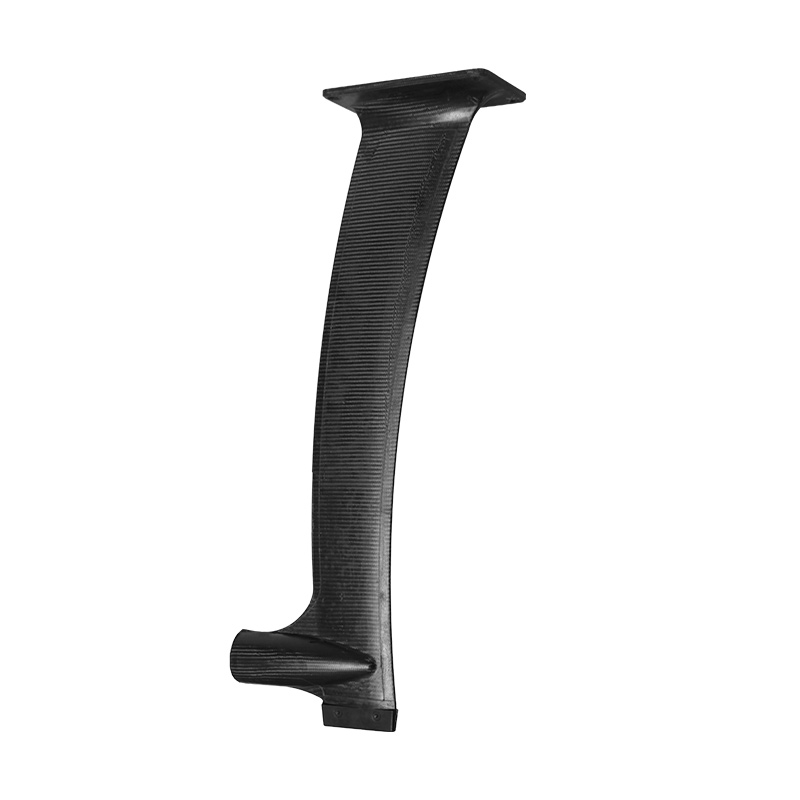
Choose a longer hydrofoil fuselage when predictable pitch control, straight tracking and an easier learning curve matter most. Choose a shorter one when you already control ride height and want quicker pitch response, tighter turns and a faster pumping rhythm. For most riders who are unsure, the system maker’s medium or standard fuselage is the most useful baseline.
That answer is only the starting point. Hydrofoil Fuselage Length is not one universally comparable catalog number: brands measure different shapes, position the mast differently, and pair the fuselage with different front wings, stabilizers and shims. This guide explains what actually changes, how to compare options without guessing, and what an OEM buyer should specify beyond “short” or “long.”
The quick decision map
The practical effect of Hydrofoil Fuselage Length is easiest to understand as a stability-versus-response decision inside one compatible component family.
| Your main need | Start testing | Expected direction | Watch for |
|---|---|---|---|
| First controlled flights | Standard to longer option in the same system | Calmer pitch response and more time to correct | Extra turning radius and slower pump rhythm |
| Freeride and mixed conditions | Medium / standard | Balanced stability and maneuverability | Do not assume “standard” matches another brand |
| Tight surf carving | Shorter than your stable baseline | Quicker direction and pitch changes | More precise front-foot control required |
| Dockstart progression | Longer while learning, then shorter by one step | Stability first; quicker cadence later | Stabilizer and front-wing changes can mask the result |
| Fast, straight-line riding | Medium to longer | More settled pitch and tracking | Discipline-specific geometry matters |
| One component range for several riders | Medium plus one adjacent length | A controlled progression path | Maintain a verified compatibility matrix |
This is a test order, not a universal sizing chart. Armstrong’s buyer guide, for example, describes its longer TC70 as the most pitch-stable choice and shorter options as progressively more reactive. Those conclusions are useful inside that system; the TC numbers are not an industry measurement standard.
“Fuselage length” may describe three different distances
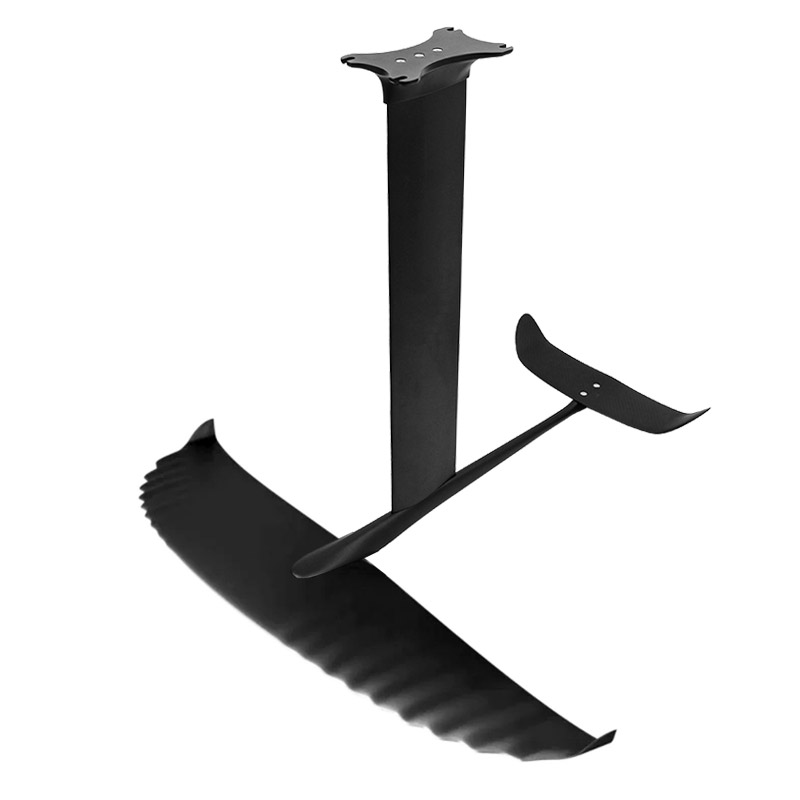
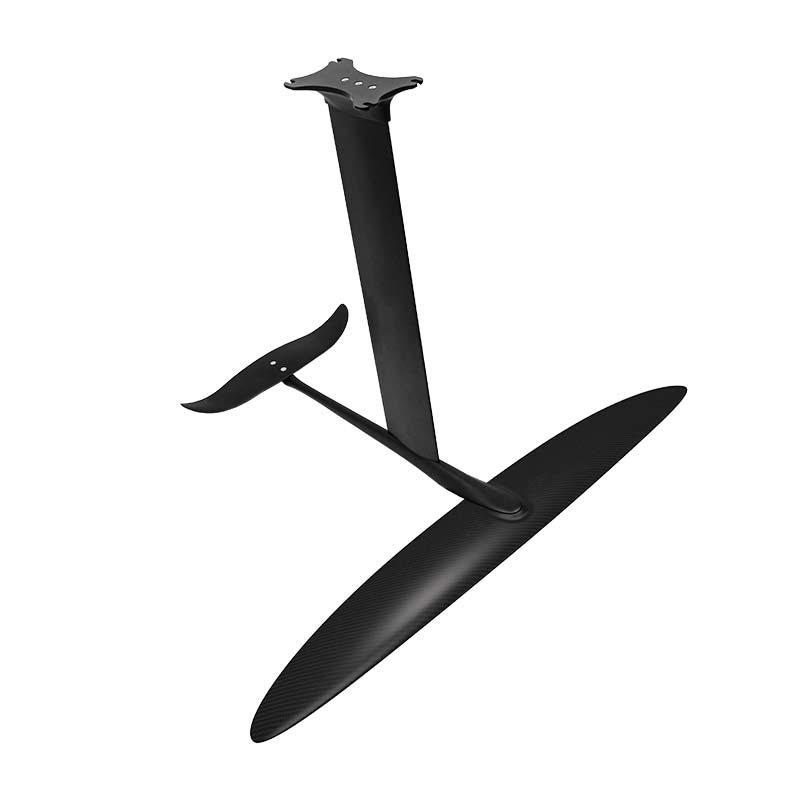
A catalog may list the component’s overall end-to-end length. A designer may care more about the distance from the front-wing reference point to the stabilizer reference point. A rider may feel the relationship among the front wing, mast and tail. Those are connected, but they are not identical.
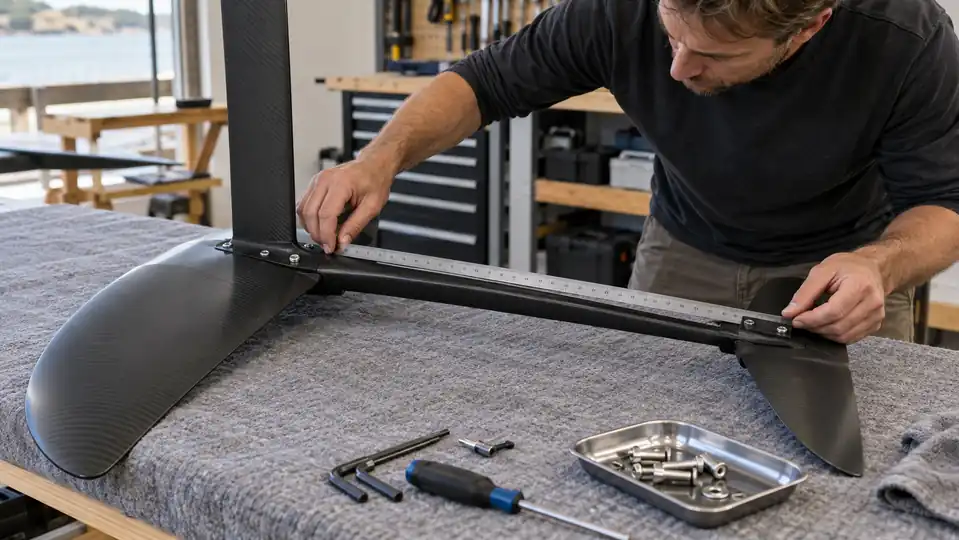
Overall component length
This is easy to publish and inspect, but noses, tails and connection features can add length without changing the aerodynamic spacing by the same amount. Never assume two “700 mm” parts create the same foil geometry.
Front-wing-to-stabilizer spacing
This distance changes the stabilizer’s lever arm relative to the front wing. A longer arm can generate the required balancing moment with less tail force, and it generally slows the rate at which the system responds in pitch. The exact result still depends on stabilizer area, section and angle.
Mast position relative to the front wing
Two fuselages with similar wing spacing may place the mast differently. AXIS explicitly offers “Advance” configurations that move the mast closer to the front wing, demonstrating why overall length alone cannot describe balance and turning feel. Changing this relationship may also change the useful mast-track position on the board.
For an honest comparison, obtain a dimensioned side view showing the front-wing, mast and stabilizer reference datums. If a supplier cannot define what its published length measures, treat cross-model conclusions as provisional.
Stability is not one sensation
Riders often say a foil is “stable” without identifying the axis. Fuselage length primarily changes the fore-aft relationship that influences pitch, but the complete system can also alter yaw tracking and the way a foil enters a roll.
Pitch stability: how quickly height changes
Pitch is the nose-up or nose-down rotation that controls ride height and angle of attack. More front-to-tail spacing usually makes the foil feel less nervous because the stabilizer acts through a longer lever arm. Small foot-pressure errors then produce a slower response, giving a learner more time to correct.
Duotone’s foiling basics likewise state that a longer fuselage provides more pitch stability and is easier for beginners, while a short fuselage is more agile and demanding. This is the clearest and most consistently supported effect.
Yaw stability: how strongly the foil tracks
Yaw is rotation left or right around a vertical axis. A longer, more spread-out assembly often feels more locked into a line, but vertical surfaces, wing sweep, tips and connection stiffness also influence tracking. Do not diagnose every wandering sensation as a length problem; loose hardware, asymmetric damage or mast alignment may be the real cause.
Roll response: how readily the foil banks
Roll is the bank used to carve. Shorter systems are commonly described as looser and quicker turning, but fuselage length does not set roll response alone. Front-wing span and planform, stabilizer geometry, mast stiffness and rider leverage all matter. Review our high- versus low-aspect hydrofoil guide before attributing every turning difference to the fuselage.
What a longer fuselage changes on the water
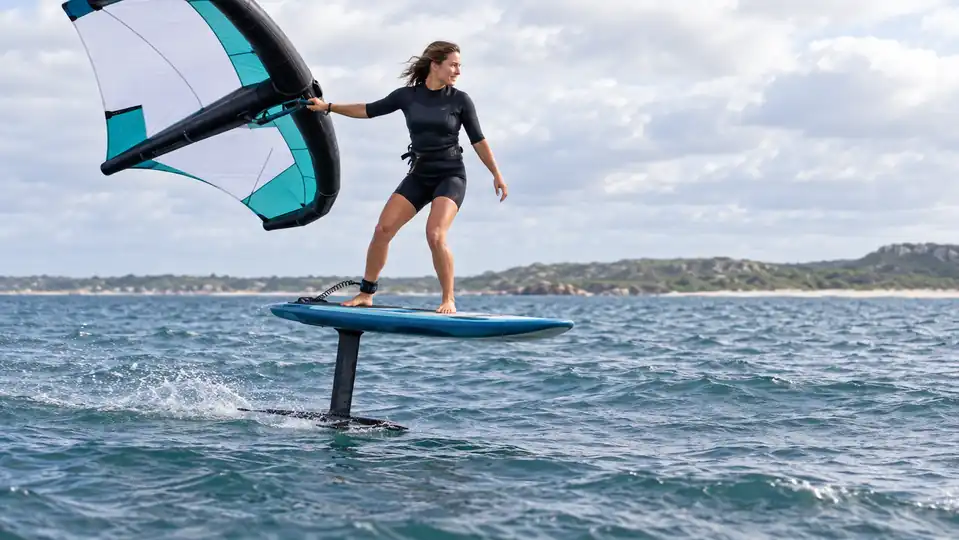
A longer option generally makes takeoff progression smoother rather than more explosive. Once flying, the rider can make larger or slower body movements before the board changes angle as rapidly. That is valuable for learning, cruising, controlling speed and holding a predictable line through disturbed water.
The trade-off is a more drawn-out turning arc and a slower pitch cycle. During pumping, the foil may prefer a longer, more measured cadence. It can feel reluctant if the rider tries to force the same quick rhythm used on a short setup.
- Useful for: early progression, distance-oriented riding, larger conditions where a settled platform matters, and riders prioritizing predictable control.
- Possible penalty: less immediate redirection, more effort to force a tight pitch cycle, and a ride that advanced surf foilers may call “locked in.”
- Do not infer: that a longer component automatically glides farther. Wing efficiency, stabilizer drag, alignment and rider technique remain decisive.
What becomes possible when the fuselage gets shorter

A shorter fuselage reduces the distance between the main lifting surfaces in many modular systems. The setup can change angle more quickly, pivot through a tighter arc and support a faster pump cadence. Skilled riders often value this in pocket surfing, freestyle and reactive carving.
The same responsiveness narrows the timing window. An abrupt front-foot input can drive the foil down; an equally abrupt release can send it back up. A rider who is still porpoising on the stable baseline usually needs technique and setup checks before an even shorter part.
Unifoil’s current setup guide describes the same progression: shorter spacing produces a tighter pivot and faster pumping cadence but demands more precise pitch, roll and yaw control; longer spacing slows the cadence and feels calmer. That is a useful mechanism-based explanation, not a reason to copy its centimeter categories into another system.
Fuselage length and pumping cadence belong together
Pumping is a repeating exchange among rider movement, foil pitch, wing lift and forward speed. A short setup can cycle through nose-up and nose-down phases quickly. That may suit an efficient rider with a fast cadence, especially when linking bumps or pumping a compact board.
A longer setup tends to smooth the cycle. Beginners may find it easier to avoid over-correcting, but experienced pumpers can feel that the system resists rapid changes. Duotone’s pump-foil guidance reflects this trade-off by recommending longer options for learning and medium or shorter options after the start is mastered.
Do not evaluate cadence from fuselage length alone. A larger stabilizer can add control and resistance; a smaller tail can loosen the system. Front-wing area, span and section determine the speed range and lift available. Board swing weight and mast drag affect how much energy each cycle consumes.
Five variables that can impersonate a length change
- Stabilizer size and outline. A larger tail often adds control; a smaller tail can feel quicker and less supported.
- Stabilizer shim. A small angle change alters tail force and foot pressure. The same shim may feel stronger through a longer lever arm.
- Front-wing geometry. Span, section, area and aspect ratio change lift, roll and glide.
- Mast-track position. Moving the complete foil changes its balance under the rider. Review the system relationship in our foil track box installation guide.
- Connection stiffness and play. A loose or flexible interface can feel delayed, unstable or imprecise even when the nominal geometry is correct.
When switching fuselage length, start with the manufacturer’s approved wing, tail, shim and hardware combination. Recheck board balance rather than assuming the old mast position will remain ideal.
A fair A/B test takes one session, not one guess
Before entering the water
- Confirm both fuselages are approved for the same mast, front wing, stabilizer and fasteners.
- Inspect threads, inserts, mating faces and corrosion; remove sand and salt.
- Use the same front wing, tail, shim, board, mast and hardware for both runs.
- Record mast position and stabilizer orientation. Photograph the setup.
- Follow the brand’s tightening sequence and torque instructions where supplied.
On-water test card
| Task | What to record | Why it matters |
|---|---|---|
| Three controlled takeoffs | Speed, overshoot and foot correction | Separates smooth lift from abrupt pitch response |
| Straight flight through similar chop | Height corrections and yaw wandering | Shows settled control rather than one successful turn |
| Equal-radius turns both directions | Input, arc and exit stability | Reveals reactivity and possible asymmetry |
| Ten pump cycles | Natural cadence and speed retained | Tests rhythm without claiming laboratory efficiency |
| One low-speed recovery | Stall approach and pitch correction | Shows whether the setup remains manageable near the limit |
Repeat in comparable conditions and change only the fuselage. If you change the stabilizer or shim at the same time, you have tested a new system—not isolated length.
Choosing Hydrofoil Fuselage Length without false precision
There is no reliable universal chart based only on rider weight or height. A heavier rider may load the system more, but front-wing selection, speed, stance and stiffness are usually more direct design inputs. Use skill, discipline and the current system response as the first filters.
- New rider: choose the brand-approved stable or longer option supplied for your front wing, then learn repeatable height control.
- Improving freerider: use the standard option until turns and pumping are predictable; test one step shorter rather than jumping to the minimum.
- Surf-focused rider: test shorter only after confirming the wing and tail already suit the desired speed and turn shape.
- Pump foiler: select around cadence, start consistency and the chosen wing—not a fashionable number.
- Brand buyer: offer a rational progression within one connection ecosystem, not several unexplained lengths.
Unity Sports currently lists 620, 700 and 765 mm aluminum hydrofoil fuselage options. Those dimensions should be evaluated with the intended front wing, rear wing, mast position and connection drawings; they are not universal equivalents to another brand’s same-number part.
The OEM specification has to describe more than millimeters
A production drawing should define overall length and the functional datums that control ride geometry. At minimum, specify the front-wing, mast and stabilizer interface locations; their angles; centerline relationship; fastener pattern; thread or insert requirements; and the mating-surface tolerances.
Design and compatibility data
- dimensioned reference points for all three interfaces;
- approved mast, front-wing, stabilizer, shim and fastener combinations;
- material and temper, coating or anodizing specification, and galvanic-isolation strategy;
- maximum intended wing span, rider/use class and design load assumptions;
- assembly orientation, torque requirements and service inspection criteria.
Manufacturing and acceptance controls
- straightness, twist and interface-position inspection from controlled datums;
- flatness and angle of wing and mast mating faces;
- thread, insert and go/no-go gauge checks;
- coating thickness and coverage at corrosion-sensitive regions;
- static proof and fatigue validation with documented fixtures, load directions, lever arms, cycles and failure criteria;
- batch traceability, approved golden sample and change control.
A test statement without fixture geometry, sample count and acceptance criteria cannot support a meaningful comparison. Our hydrofoil manufacturing process overview provides broader composite-production context; an aluminum fuselage program also needs appropriate machining, surface treatment and corrosion controls.
Common mistakes that produce the wrong conclusion
- Comparing numbers across brands: measurement datums and mast location may differ.
- Changing two components: a new stabilizer plus new fuselage cannot reveal which change caused the result.
- Keeping mast position fixed by habit: the system balance may have shifted.
- Using shim to hide poor control: tune only after verifying assembly, compatibility and baseline technique.
- Calling faster response “faster speed”: maneuverability and top speed are different outcomes.
- Ignoring interface play: loose joints can mimic unstable geometry and become a safety problem.
Questions riders and product teams ask
Is a longer foil fuselage always better for beginners?
Usually within the same approved system, because it tends to calm pitch response. It cannot compensate for an unsuitable front wing, incorrect assembly, excessive speed, poor stance or unsafe conditions.
Does a short fuselage pump farther?
Not automatically. It can support a quicker pitch cycle, while total distance depends on wing efficiency, tail drag, cadence, speed, board weight and rider technique. Test the complete system under comparable conditions.
Can I mix a fuselage, mast and wings from different brands?
Only with documented compatibility or a properly engineered adapter and validation. Similar-looking bolt patterns do not prove interface fit, alignment, strength or corrosion compatibility.
Should I change the stabilizer shim after changing length?
Return to the manufacturer’s approved baseline first. Because lever arm changes can alter how strongly a given tail angle is felt, re-evaluate trim in small controlled steps rather than assuming the old shim remains ideal.
What should a buyer request from a fuselage supplier?
Request controlled drawings, material and finish specifications, a compatibility matrix, inspection records, structural validation with disclosed test geometry, corrosion controls, traceability and an approved reference sample.
One useful rule to remember
Use Hydrofoil Fuselage Length to tune response only after the rest of the foil is compatible and predictable. A longer system generally gives you more time to correct pitch; a shorter system asks for better timing in exchange for quicker movement. Compare functional geometry inside one foil family, change one variable at a time, and record what happens.
For a new OEM range, begin with the target rider task and build the length progression around verified wing, mast and stabilizer combinations. To review a custom drawing, compatibility plan or sample-validation requirement, contact Unity Sports with the intended discipline, rider range and component interfaces.