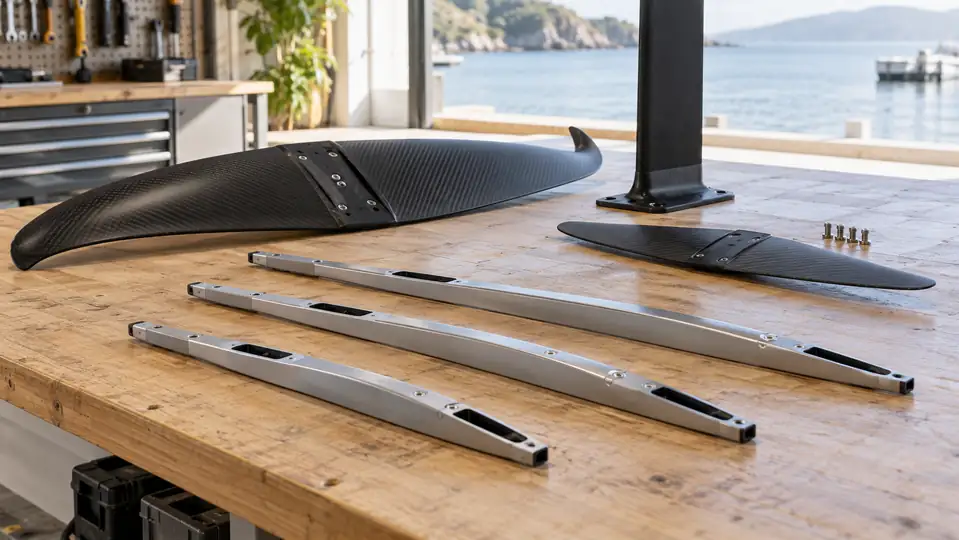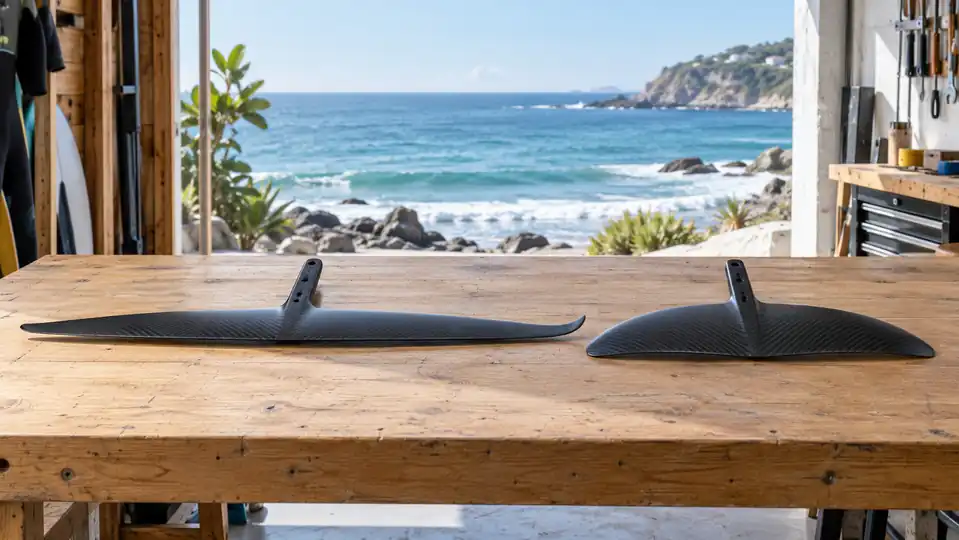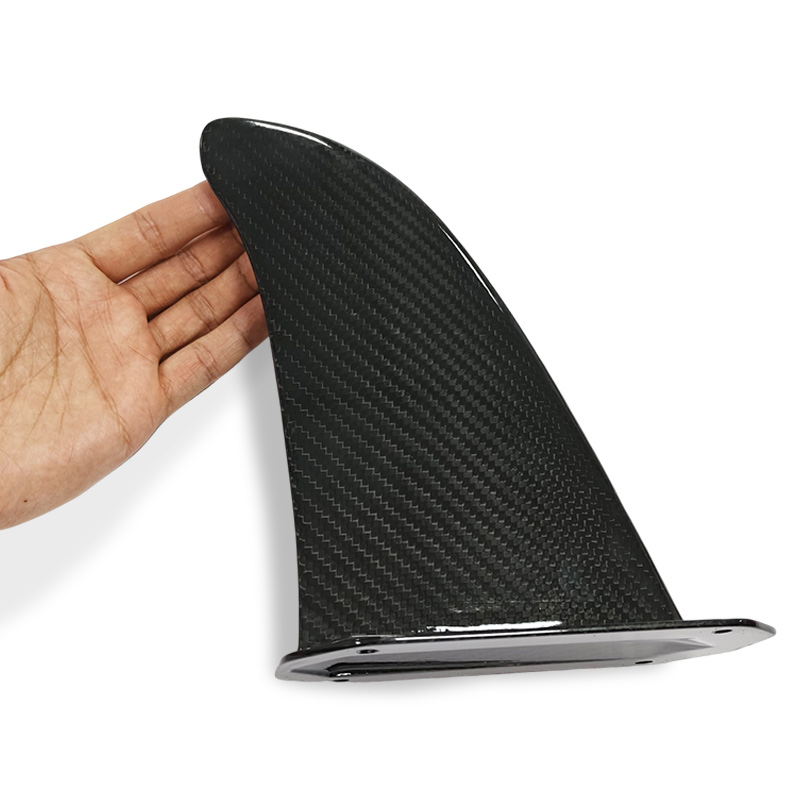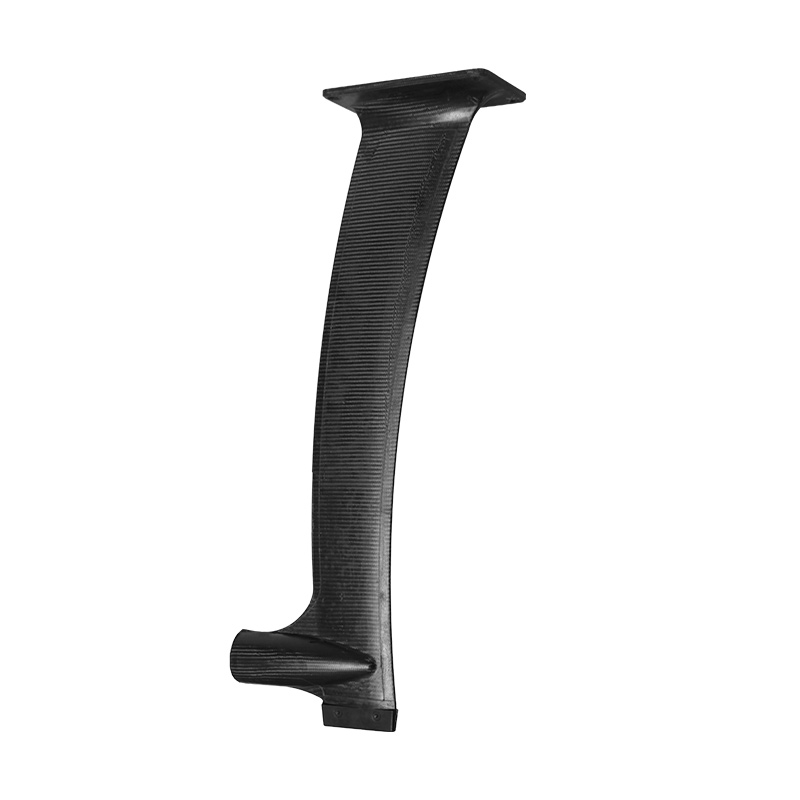
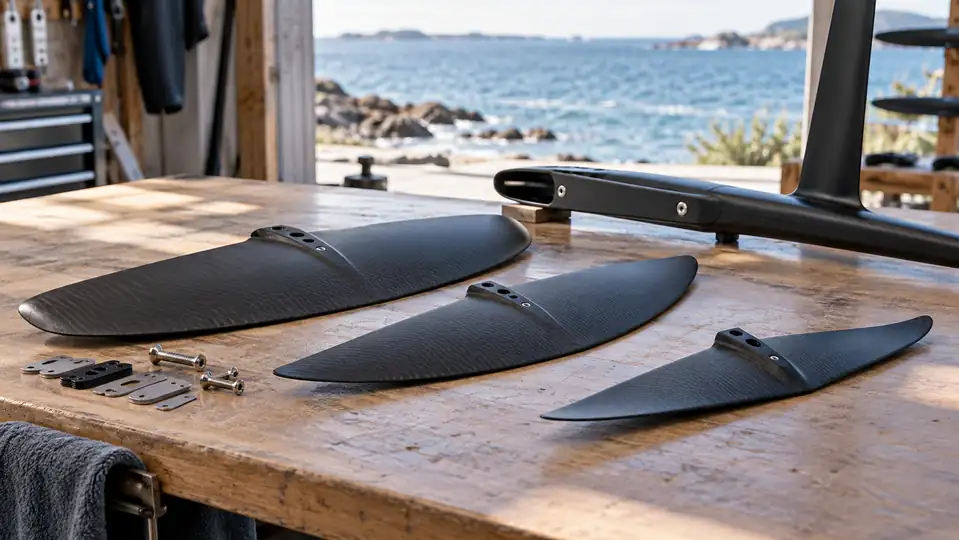
Start with a larger hydrofoil stabilizer when you need calmer pitch control, easier takeoff recovery and a more forgiving learning platform. Test a smaller stabilizer when your height control is already consistent and you want less drag, quicker pitch response and freer turning. Change the shim only after confirming that the tail size, mounting direction, hardware and baseline mast position are correct.
Hydrofoil Stabilizer Size is not just a square-centimeter choice. Two tails with the same area can feel different because their span, chord, aspect ratio, section, sweep, wingtip geometry and mounting angle differ. This guide gives riders a diagnosis-first tuning order and gives OEM buyers the specifications that a simple “small/medium/large” label leaves out.
The 30-second choice
| What you feel or need | Start by testing | Expected direction | Check first |
|---|---|---|---|
| Porpoising while learning | Larger approved tail at stock shim | Slower, more supported pitch response | Stance, mast position and loose joints |
| Too much front-foot pressure as speed rises | Manufacturer-approved lower-tail-force shim step | Less balancing downforce and drag | Shim sign and mounting orientation |
| Foil feels locked in during turns | One size smaller or a freer outline | Quicker roll/yaw response | Front-wing span and fuselage length |
| Dockstart falls apart at low speed | Larger, supportive tail | More pitch support and easier rhythm | Front-wing suitability and cadence |
| Advanced rider wants speed and release | Smaller/thinner approved tail | Lower drag potential, more sensitivity | Control near stall and at top speed |
| New product range | Stable baseline plus one performance option | Clear progression without option overload | Compatibility and validation matrix |
This is a test sequence, not a promise. Armstrong’s foil buyer’s guide describes its larger CF300 as a forgiving starting point and smaller stabilizers as faster or more reactive. The direction is useful; its model sizes remain specific to Armstrong geometry.
What the tail wing actually does
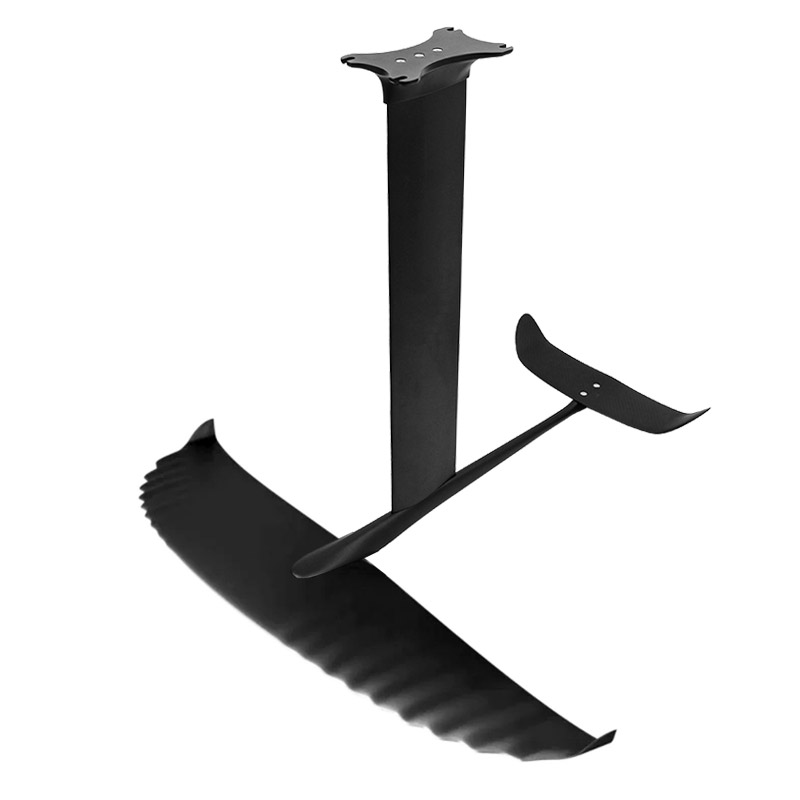
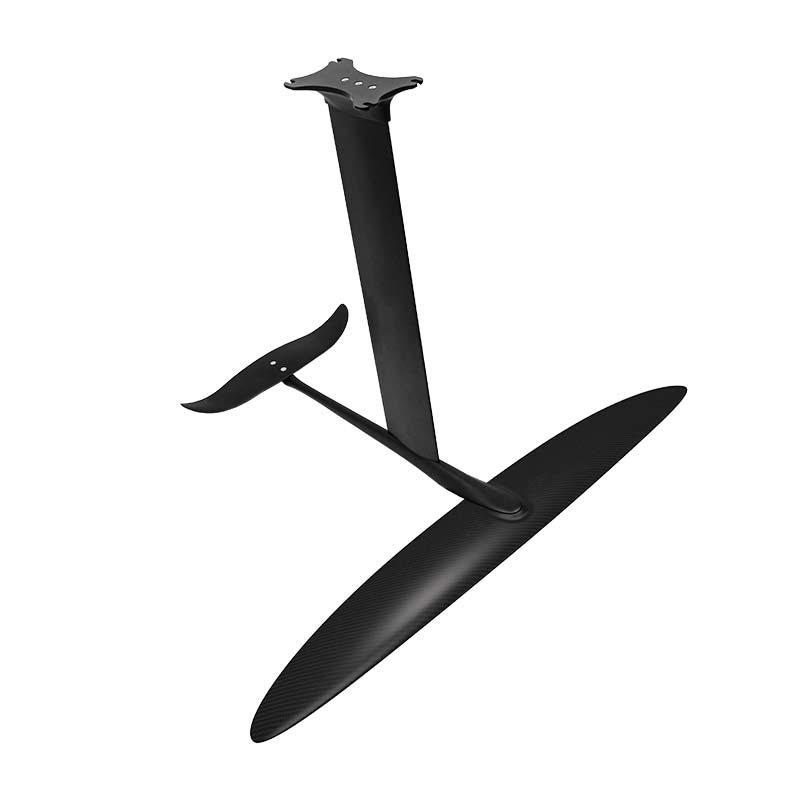
The front wing supplies most of the system’s lift, but it also creates a pitching moment. The rear stabilizer acts at a distance behind it to help balance that moment and make the foil controllable. In many conventional setups the tail produces a downward force relative to the front wing, although exact sections and operating conditions vary.
Because the stabilizer sits on a lever arm, a small change can be felt strongly. Tail area, angle and fuselage length interact: more tail force or a longer lever arm generally increases the balancing moment. That is why changing two of them at once makes diagnosis difficult.
SABFOIL’s stabilizer guide explains this longitudinal balance and correctly warns that there is no global size answer independent of setup and discipline.
Area is only the first number
Span and chord
A wider tail can distribute area across more span; a deeper-chord tail concentrates it closer to the center. Even at equal area, this changes induced drag, roll influence, structural loading and how close tips operate to disturbed flow.
Aspect ratio and section
A higher-aspect tail may offer efficient lift distribution but can feel different in roll and ventilation recovery. Section thickness and camber change the speed range and force produced at a given incidence. “200 cm²” alone cannot predict either.
Sweep, tips and dihedral
Sweep and tip geometry influence yaw and turning feel. Dihedral or anhedral changes how the tail couples roll and yaw. These design variables explain why replacing a tail by area alone can produce an unexpected result.
Use our hydrofoil aspect-ratio guide for the same geometry principles applied to the front wing, while remembering that a stabilizer has a different balancing role.
What a larger stabilizer gives you

A larger approved tail usually provides more authority at low speed and resists abrupt pitch changes. A learner gets a wider timing window; a pump-foil beginner may find it easier to establish rhythm; a rider in disturbed water may value the planted feel.
The cost is normally more wetted area and drag, plus a stronger stabilizing influence that can feel locked in. The foil may require more effort to pitch through a rapid pump cycle or tight transition. Duotone’s dockstart guide similarly describes a large stabilizer as supportive and stable while noting the additional drag and restricted pitch movement.
- Best starting use: progression, low-speed support and repeatable control.
- Possible symptom when oversized: heavy front-foot pressure, slow pitch cycle, reluctant turning or speed that plateaus.
- Do not assume: bigger is always safer; an unapproved tail or incorrect angle can create excessive force and poor trim.
What changes when the stabilizer gets smaller

A smaller tail generally reduces stabilizing authority and drag. Skilled riders may feel freer roll and yaw, quicker pitch changes, higher speed potential and a faster pump cadence. In surf, that can make a foil redirect more naturally with the wave.
The trade-off appears at the limits: the setup can become pitch-sensitive, less supported near stall and harder to recover after a mistimed pump. Moving straight to the smallest compatible tail may make a foil feel fast for seconds but reduce the length and consistency of the session.
Shim angle fine-tunes force; it does not replace the correct tail
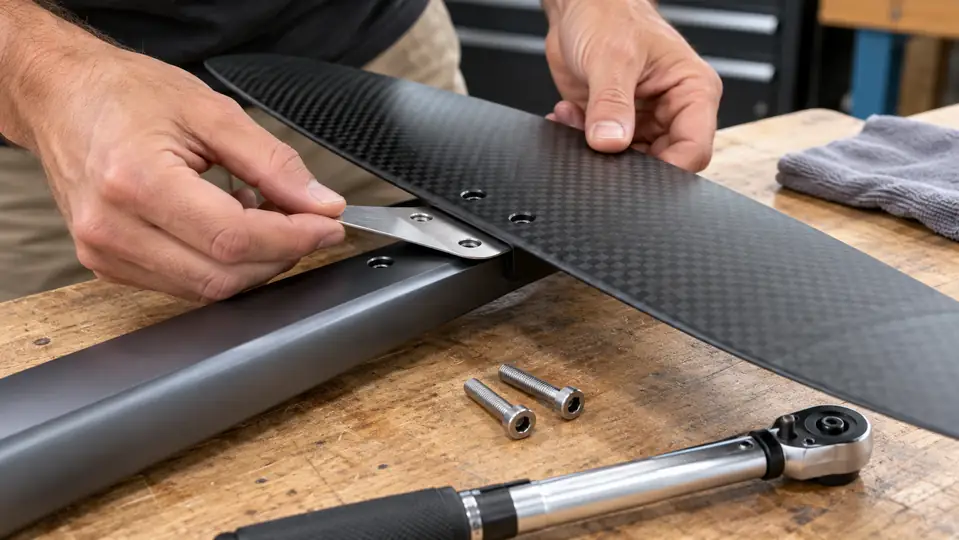
A shim changes stabilizer incidence relative to the front wing and fuselage. Increasing the tail’s effective balancing force generally adds front-foot pressure and low-speed support but can add drag. Reducing it generally frees the foil and can reduce front-foot pressure, but may also reduce pitch support.
Do not rely on “positive” or “negative” without reading the manufacturer’s convention. AXIS defines its shim signs by the change in front-to-rear wing angle and explains the details in its foil-angle and shim brochure. SABFOIL explicitly notes that its sign convention works differently in its incidence tuning guide. Describe the physical outcome—“increase stabilizer incidence” or “decrease it”—when comparing systems.
Change size when…
- you want a meaningful change in low-speed support, maneuverability or drag;
- the current tail sits at the wrong end of the approved rider/discipline range;
- the foil remains too locked-in or too sensitive after returning to the stock angle and sound technique.
Change shim when…
- the approved tail is fundamentally suitable but foot pressure is unbalanced;
- trim changes too much across the normal speed range;
- the manufacturer supplies a documented small-step tuning sequence.
Diagnose the symptom before buying another part
| Symptom | Possible tail cause | Other causes to eliminate |
|---|---|---|
| Constant front-foot pressure at speed | Too much tail force or incidence | Mast too far forward, front-wing choice, stance |
| Foil rises and falls abruptly | Tail too small or insufficient support | Short fuselage, loose joint, speed and technique |
| Hard to initiate a turn | Large span/area or locked-in geometry | Front-wing span, long fuselage, board leverage |
| Pumping feels slow and heavy | Tail too large or too much incidence | Cadence mismatch, front-wing drag, board weight |
| Tail ventilates or loses control | Tip/section unsuited to conditions | Breach height, damage, contaminated edges |
| One direction feels different | Asymmetry, twist or mounting defect | Mast alignment, wing damage, rider stance |
Fuselage length changes the same pitch system. Read our fuselage-length guide before solving a short-fuselage problem with an extreme tail or shim.
A safe single-variable tuning sequence
- Return to the approved baseline. Use the stock tail, stock shim, correct orientation and specified hardware.
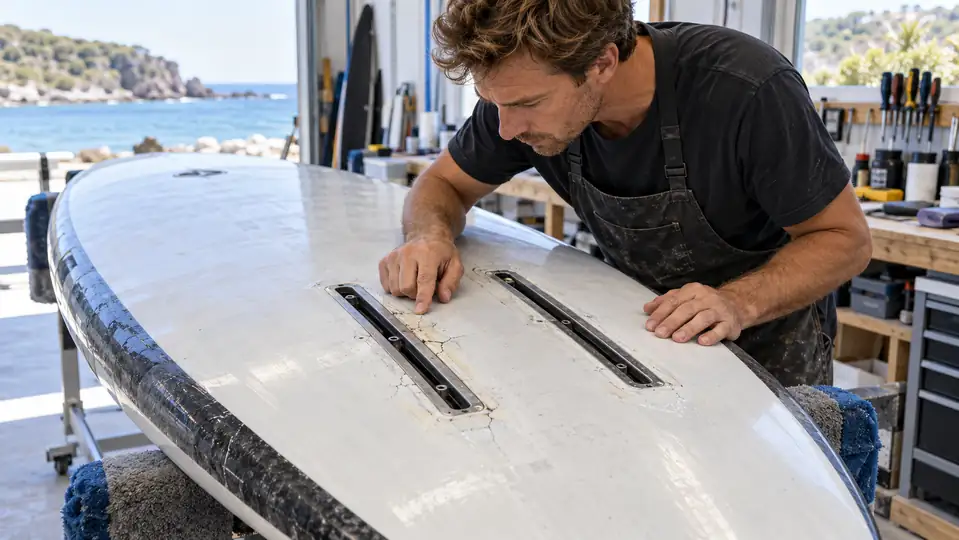
- Inspect. Stop if the tail is cracked, distorted, loose, water-damaged or has damaged mounting holes.
- Set mast position. Begin from the board/foil maker’s reference and record it.
- Run the baseline. Record takeoff, steady flight, both turns, ten pump cycles and high-speed foot pressure.
- Change one item. Use one approved shim step or one adjacent stabilizer size—not both.
- Repeat in comparable conditions. Keep front wing, fuselage, mast, board and stance unchanged.
- Confirm twice. A single clean run is not enough to distinguish equipment from water or technique.
After any shim change, confirm that bolts still have the manufacturer-required engagement and do not bottom out. A shim can require different fastener length. Tighten only to documented guidance and recheck after the first short session.
Hydrofoil Stabilizer Size by rider task
- First flights: use the maker’s larger, forgiving tail with stock incidence.
- All-round freeride: begin at the system’s medium baseline; tune pressure with an approved small shim step.
- Surf carving: test a smaller or more maneuverable outline after pitch control is reliable.
- Pump progression: choose support for consistent starts first, then reduce tail authority as cadence improves.
- Speed-focused riding: a thinner/smaller tail may reduce drag, but verify control through the full speed range.
Unity Sports lists several carbon tail options, including its 355 cm² hydrofoil rear wing and 339 cm² stabilizer. These figures should be evaluated with the matching front wing, fuselage, section, incidence and interface—not compared by area alone.
What an OEM drawing and control plan should include
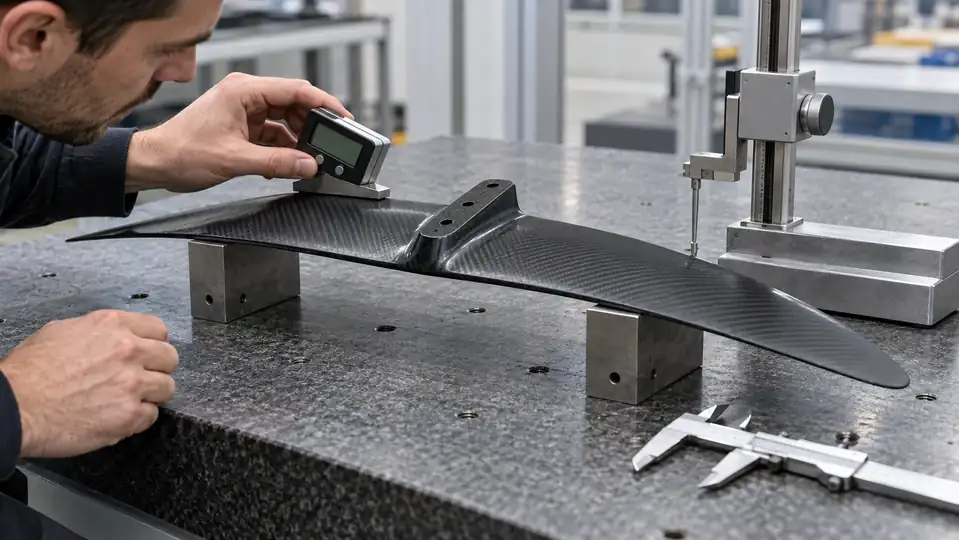
Geometry and compatibility
- projected area, span, center and tip chord, sweep and aspect ratio;
- section references, thickness distribution, twist, dihedral/anhedral and tip geometry;
- mounting-face angle and incidence from controlled datums;
- bolt pattern, counterbores, inserts, fastener length and approved shim stack;
- compatible fuselages, front wings, rider/use class and design speed/load assumptions.
Production acceptance
- mass, external dimensions, symmetry and twist inspection;
- mounting-face flatness and incidence-angle verification;
- insert position, thread and pull-out validation where applicable;
- surface finish, leading/trailing-edge profile and defect criteria;
- representative static and fatigue tests with disclosed fixtures and failure limits;
- batch traceability, golden sample and controlled engineering changes.
Do not accept “tested” without load direction, fixture, lever arm, cycles, sample count and pass/fail definition. Our hydrofoil manufacturing overview explains the wider composite process; tail-wing approval still needs model-specific evidence.
Short answers to common questions
Does a bigger stabilizer create more lift?
It can create more tail force and pitch authority at a given condition, but the direction and magnitude depend on its section and incidence. Describe the complete balance rather than treating tail area like extra front-wing area.
Can a shim make a large tail behave like a small tail?
No. A shim changes incidence; it does not change span, area, section, inertia or tip geometry. It can fine-tune pressure and drag within a suitable setup.
Is rider weight enough to choose a stabilizer?
No. Weight matters, but front wing, speed, fuselage length, stance, discipline and skill also change the required balance. Use the foil maker’s compatibility guidance as the baseline.
Which shim direction reduces front-foot pressure?
The physical goal is usually to reduce effective tail force, but shim signs and mounting orientation vary. Follow the exact brand diagram; never infer direction from “plus” or “minus” alone.
Can I mix stabilizers across brands?
Only with documented geometry, interface compatibility and structural validation. A matching bolt pattern does not prove the incidence, strength or hydrodynamic balance is safe.
The tuning rule that prevents expensive mistakes
Choose Hydrofoil Stabilizer Size for the behavior you need; use a shim only to refine a compatible baseline. Start large enough to control pitch, progress one size or one angle step at a time, and record the complete setup. If a brand is developing a new tail range, specify the geometry, incidence and compatibility system before discussing the marketing size label.
For custom stabilizer development or sample validation, contact Unity Sports with the intended front wing, fuselage length, rider/use class, target behavior and interface drawing.