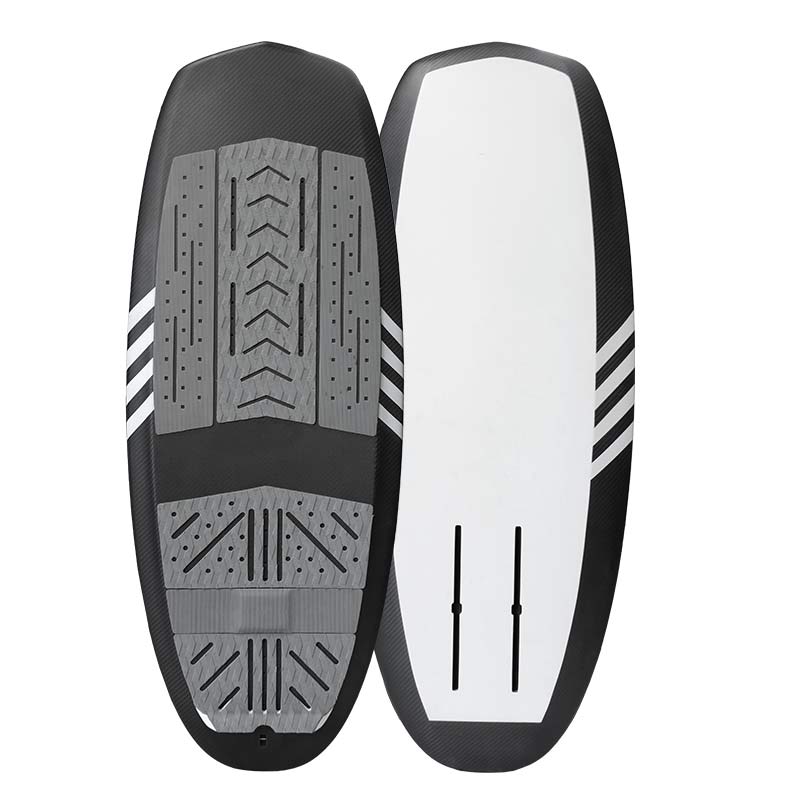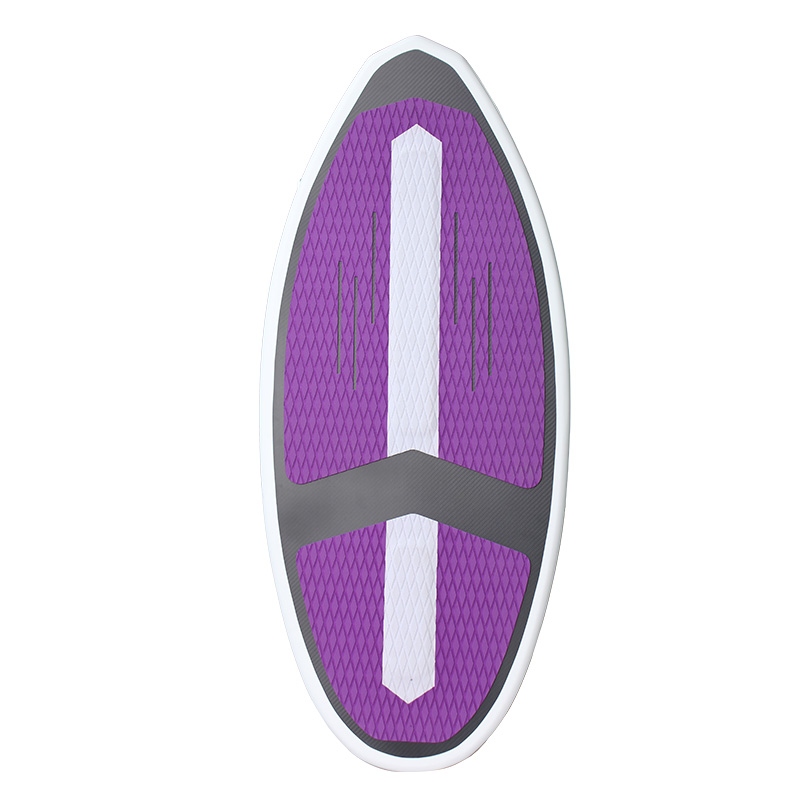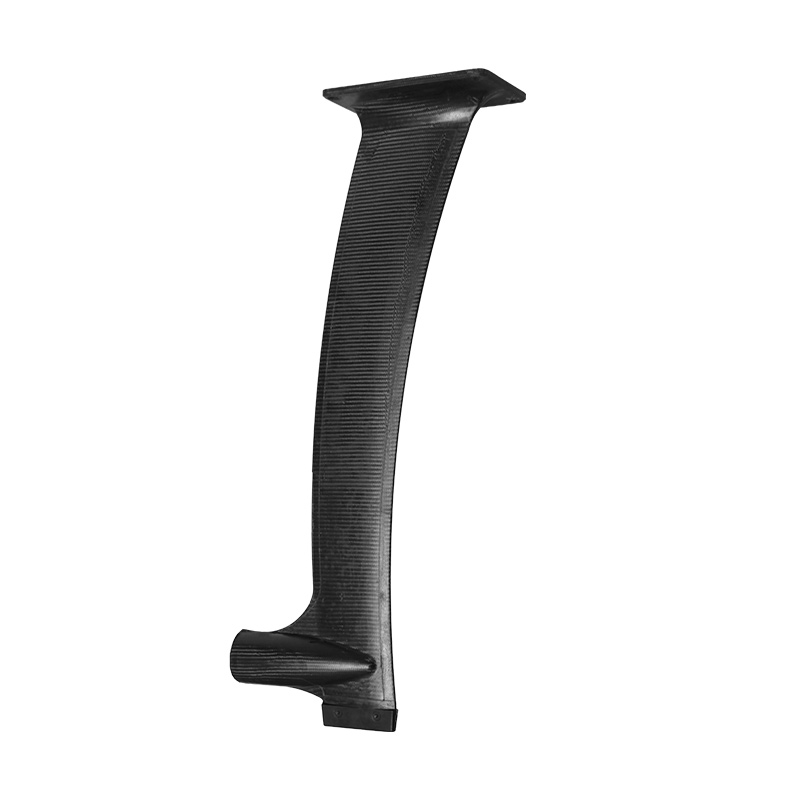
Land windsurfing is a wind-powered board sport that adapts windsurfing equipment for use on solid ground instead of water. A rider stands on a wheeled board and uses a sail, mast, and boom to capture the wind, combining wind power with balance, steering, and sail-control skills.
Also referred to as windskating, street windsurfing, or dirt windsurfing in some contexts, land windsurfing can be practiced on suitable paved surfaces, hard-packed sand, dirt, grass, and other open areas where the activity is permitted.
For windsurfers, it provides another way to practice sail handling and balance without needing access to water. For newcomers, it offers a different type of wind-powered board sport that combines elements of windsurfing, skateboarding, and landboarding.
This guide explains how land windsurfing works, what equipment is required, how wind and surface conditions affect performance, and how carbon fiber can be used in performance-oriented board and rig components.
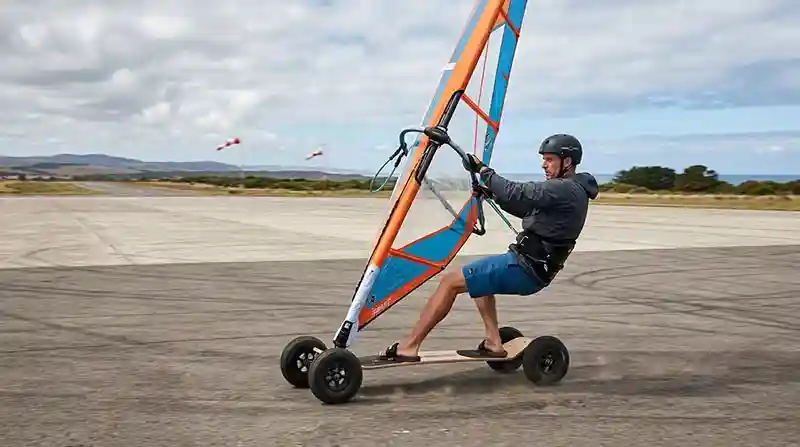
What Is Land Windsurfing?
Land windsurfing is the practice of using a windsurfing-style sail and wheeled board to travel across land. Instead of relying on a floating board and water resistance, the rider moves using wheels and trucks while controlling the sail to generate forward and lateral force from the wind.
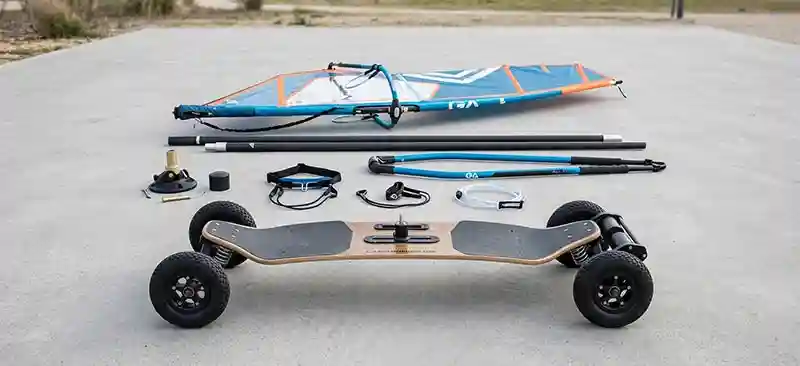
A basic setup typically includes:
- A wheeled land windsurfing board
- A sail
- A mast
- A boom
- A mast base or universal joint
- Wheels and trucks
- Footstraps or bindings on some board designs
- Appropriate protective equipment
The rider controls direction and speed by combining sail trim, body position, steering input, and weight distribution.
Unlike conventional windsurfing, the board does not need to float. This means the design of the board, trucks, wheels, and connection between the rig and deck becomes particularly important.
Is Land Windsurfing the Same as Land Sailing?
Not exactly.
Land windsurfing generally refers to a board-based activity where the rider stands on a wheeled board and handles a windsurfing-style rig. Land sailing is a broader category that can include three-wheeled or four-wheeled land yachts and other sail-powered vehicles.
The two sports share the basic principle of converting wind energy into movement, but their equipment, riding position, steering systems, and handling characteristics can be very different.
How Does Land Windsurfing Work?
Land windsurfing works by combining wind force, sail control, rolling wheels, and rider balance.
When wind flows across the sail, the sail generates aerodynamic force. The rider adjusts the sail angle and body position to control how that force moves the board. Meanwhile, the wheels and trucks allow the board to roll and change direction.
The basic control system can be understood as four connected elements:
Wind → Sail → Rider → Wheeled Board
The rider must continuously adjust these elements to maintain balance and control.
Sail Control
The sail is the primary source of propulsion. Moving the boom and adjusting the sail angle changes how much force the wind generates.
Balance
Because the board is supported by wheels rather than water, the rider must maintain balance while the board accelerates, turns, and responds to uneven surfaces.
Steering
Land windsurfing boards typically use trucks or other mechanical steering systems. Turning input is transferred through the rider’s body position and board movement.
Surface Interaction
Unlike water windsurfing, rolling resistance becomes an important part of performance. Asphalt, concrete, compact sand, dirt, and grass can produce significantly different handling characteristics.
For this reason, there is no single wind speed or equipment configuration that works equally well in every land windsurfing environment.
A Brief History of Land Windsurfing
Land-based wind-powered board sports developed as riders looked for ways to use windsurfing techniques away from the water.
French windsurfer Arnaud de Rosnay is frequently associated with early land-windsurfing experimentation. In the late 1970s, he demonstrated the potential of using windsurfing equipment on land, including long-distance journeys across desert terrain.
Later developments in wheeled boards, trucks, wheels, and lightweight sail equipment helped establish modern forms of land windsurfing and windskating.
Today, land windsurfing remains a niche sport, but the concept continues to attract interest from windsurfers, board-sport enthusiasts, and manufacturers developing lightweight composite equipment.
Land Windsurfing vs. Windsurfing
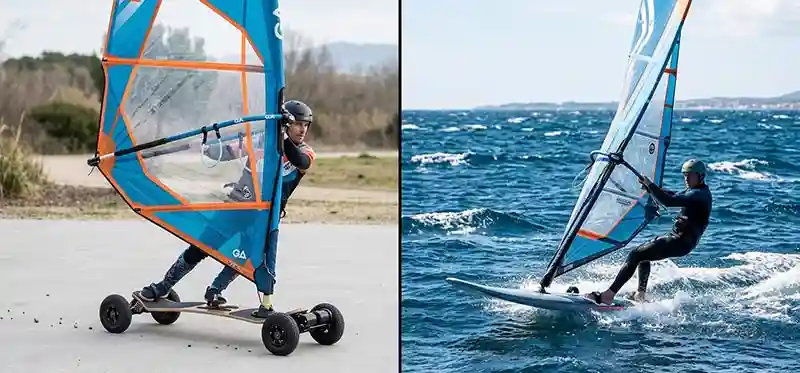
Although the two sports share a sail-control concept, the riding environment creates important differences.
| Feature | Land Windsurfing | Water Windsurfing |
|---|---|---|
| Riding surface | Asphalt, concrete, sand, dirt, grass | Ocean, lake, river |
| Board | Wheeled board | Floating board |
| Propulsion | Sail + wheels | Sail + water |
| Steering | Trucks and rider input | Board rail, fin, and rider input |
| Rolling resistance | Depends on wheels and surface | Depends on water and board design |
| Falling environment | Hard surface | Water |
| Main skills | Balance, steering, sail control | Balance, sail control, water starts, board handling |
| Location requirements | Open, suitable land area | Suitable body of water |
| Equipment protection | Important due to hard-surface falls | Important due to water exposure |
Land windsurfing can therefore complement water windsurfing, but it should not be considered an exact substitute. Skills such as sail handling and balance can overlap, while water-specific techniques still need to be learned in an appropriate aquatic environment.
Land Windsurfing vs. Land Sailing
The terms land windsurfing and land sailing are sometimes used interchangeably in general discussions, but they can describe different types of equipment.
| Feature | Land Windsurfing | Land Sailing |
|---|---|---|
| Rider position | Usually standing | Often seated or positioned inside/on a vehicle |
| Main platform | Wheeled board | Land yacht or sail-powered vehicle |
| Rig | Windsurfing-style rig | Dedicated land-sailing rig |
| Steering | Board trucks / rider input | Mechanical steering system |
| Typical design | Compact and board-oriented | Larger vehicle-style platform |
| Primary skills | Sail handling + balance + board control | Sail handling + vehicle steering |
Understanding this distinction is useful when researching land windsurfing equipment, because a product designed for a land yacht may not be suitable for a wheeled windsurfing board.
What Equipment Do You Need for Land Windsurfing?
A basic land windsurfing setup combines components from windsurfing and wheeled board sports.
The exact configuration depends on the riding surface, rider experience, wind conditions, and intended use.
Land Windsurfing Board
The board is the foundation of the setup.
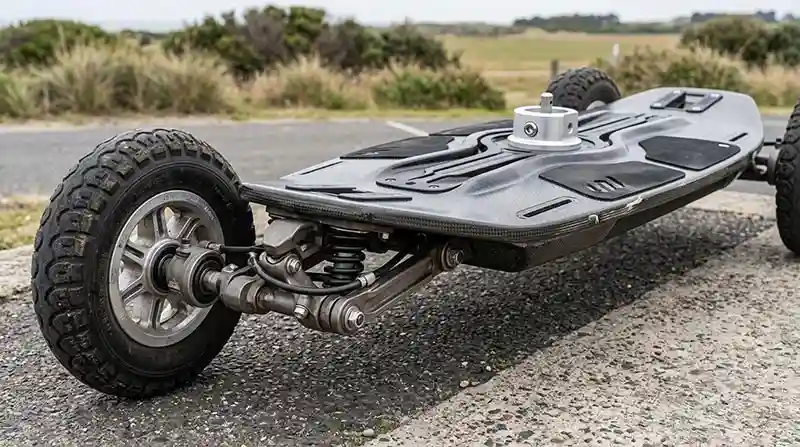
Unlike a conventional windsurfing board, a land windsurfing board needs a wheel and truck system capable of transferring wind-generated forces to the ground.
Common design considerations include:
- Deck length and width
- Wheelbase
- Wheel diameter
- Truck geometry
- Deck stiffness
- Overall weight
- Mast-base mounting position
- Footstrap configuration
A shorter and lighter board may provide responsive handling, while a larger platform can provide greater stability for certain applications.
For manufacturers, the relationship between deck stiffness, weight, wheel placement, and steering geometry is particularly important when developing a performance-oriented land board.
Windsurfing Sail
A conventional windsurfing sail can potentially be used with some land windsurfing configurations, provided that the mast base, rig dimensions, and board connection are compatible.
Smaller sails are generally easier to control for beginners and in stronger wind conditions, while larger sails can generate more power when wind conditions and rider experience allow.
A suitable sail should be selected according to:
- Wind speed
- Rider weight
- Riding surface
- Board design
- Mast compatibility
- Rider experience
There is no universal sail size that is optimal for every land windsurfing setup.
Mast and Boom
The mast and boom provide the structural framework for the sail.
A carbon fiber mast can reduce weight while providing a high level of stiffness, which can be useful in performance-oriented applications where equipment weight and responsiveness matter.
The boom must also be compatible with the sail and mast and provide sufficient structural strength for repeated loading.
Wheels and Trucks
Wheels and trucks are fundamental differences between land windsurfing and water windsurfing.
Wheel characteristics influence:
- Rolling resistance
- Acceleration
- Grip
- Vibration
- Stability
- Turning behavior
Larger wheels can be useful when riding over rougher surfaces, while smaller wheels may provide different handling characteristics on smooth pavement.
Truck geometry also affects the turning radius and responsiveness of the board.
Mast Base and Universal Joint
The connection between the sail rig and board transfers forces from the sail into the deck.
This component needs to provide reliable movement while handling repeated loading from acceleration, turning, and changes in rider position.
Compatibility between the mast base, universal joint, and board mounting system should always be verified before using a particular rig.
Footstraps and Bindings
Some land windsurfing boards use footstraps or similar rider-retention systems.
These can provide additional control during acceleration and higher-speed riding, but they also affect how a rider exits the board during a fall.
Beginners should become comfortable with basic board control before progressing to configurations that require more committed foot positioning.
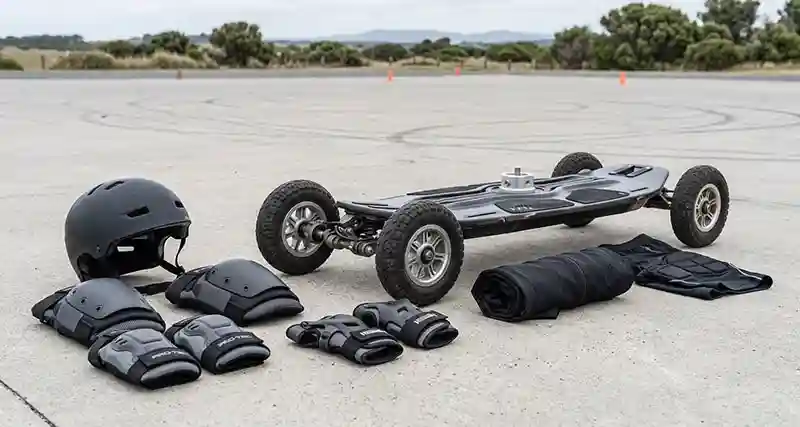
Safety Equipment
Land windsurfing takes place on a hard surface, so appropriate protective equipment is important.
Depending on the riding environment and conditions, riders may consider:
- Helmet
- Knee protection
- Elbow protection
- Wrist protection
- Gloves
- Appropriate footwear
The riding area should also be checked for traffic, pedestrians, obstacles, loose debris, and other hazards before practice begins.
What Wind Speed Is Best for Land Windsurfing?
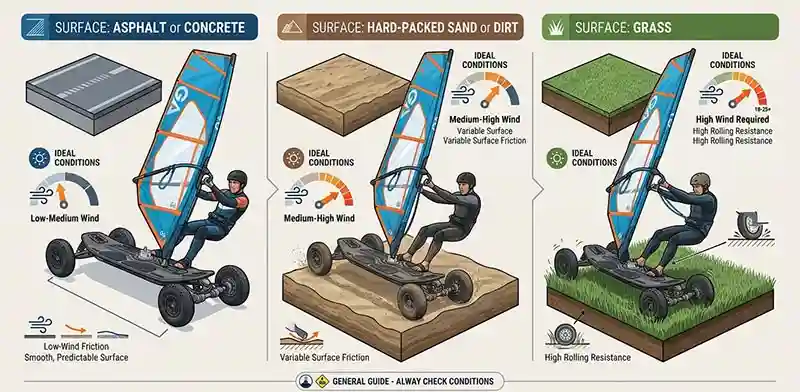
The required wind speed depends on several variables, including surface type, sail size, rider weight, wheel setup, and wind consistency.
As a general reference, smooth paved surfaces can require less wind than grass or surfaces with higher rolling resistance.
| Riding Surface | General Wind Guidance* |
|---|---|
| Asphalt / concrete | Around 4–8 knots |
| Hard-packed sand / dirt | Around 8–12 knots |
| Grass | Around 13–17 knots |
*These figures are general guidance rather than fixed requirements. Actual conditions can vary significantly depending on equipment, rider weight, surface quality, and wind characteristics.
Smooth pavement can provide relatively low rolling resistance, allowing a suitable board to begin moving in lighter winds. Grass and uneven terrain can require more wind because of increased rolling resistance.
For beginners, consistent and moderate wind conditions are generally easier to manage than highly gusty conditions.
Where Can You Practice Land Windsurfing?
Suitable land windsurfing locations need more than just sufficient wind. The surface should be reasonably smooth, open, and free from significant obstacles.
Potential locations may include:
- Large permitted paved areas
- Hard-packed beaches
- Dry lake beds
- Compact dirt surfaces
- Suitable grass fields
- Other open areas specifically permitted for the activity
Before riding, check local rules and property restrictions. Avoid areas with vehicle traffic, pedestrians, overhead obstacles, loose debris, or other hazards.
A large open space with consistent wind is generally more useful than a small location with stronger but highly turbulent wind.
How to Choose a Land Windsurfing Setup
The right setup depends on what you want to achieve.
For Beginners
Prioritize:
- Stable board design
- Manageable sail size
- Predictable steering
- Durable wheels
- Easy rig handling
- Appropriate protective equipment
For Training
If the main objective is practicing sail handling and balance, compatibility with an existing windsurfing rig may be more important than maximum speed.
For Performance Riding
More experienced riders may focus on:
- Lower overall equipment weight
- Board stiffness
- Wheel characteristics
- Truck geometry
- Rig responsiveness
- Aerodynamic efficiency
This is where composite materials such as carbon fiber can become particularly relevant.
Why Do People Try Land Windsurfing?
Land windsurfing offers an alternative way to enjoy wind-powered board sports while developing skills that can complement conventional windsurfing.
Year-Round Practice
Access to water can be limited by location, season, water temperature, or local conditions. Land windsurfing allows riders to practice on suitable land surfaces when access to a lake, river, or ocean is not convenient.
This can make it particularly useful for riders who live inland or want another way to practice between water sessions.
Sail-Control Practice
Land windsurfing places significant emphasis on sail handling.
Riders can practice controlling the sail, adjusting their body position, responding to changes in wind direction, and coordinating the rig with board movement.
These skills can complement water-based windsurfing training, although techniques that depend on water conditions must still be learned on water.
Balance and Board Control
A wheeled board responds differently from a floating windsurfing board. Riders need to coordinate their weight distribution with the steering system while maintaining control of the sail.
This creates a distinct combination of:
- Balance
- Sail handling
- Steering
- Weight transfer
- Wind awareness
- Board control
Access to Open Land
One of the main attractions of land windsurfing is that it does not require a body of water.
Where permitted, an open paved area, hard-packed beach, dry lake bed, or suitable field can provide enough space for practice.
The availability of suitable land is therefore an important factor when considering land windsurfing as an alternative board sport.
Is Land Windsurfing Safe for Beginners?
Land windsurfing can be learned by beginners, but it should not be considered inherently safer than water windsurfing.
The most important difference is the riding surface.
A fall on water and a fall on asphalt, concrete, or compact dirt have very different consequences. Beginners should therefore start with appropriate protective equipment, manageable wind conditions, and sufficient open space.
Basic Safety Guidelines
Before riding:
- Inspect the riding area. Remove or avoid rocks, debris, holes, vehicles, pedestrians, and other obstacles.
- Check the wind. Avoid conditions that are beyond your ability to control the sail and board.
- Wear protective equipment. A helmet and appropriate impact protection are especially important on hard surfaces.
- Check the equipment. Inspect the mast base, boom, sail, trucks, wheels, and board before each session.
- Keep sufficient space. A land windsurfing board can accelerate quickly on a smooth surface.
- Learn to stop. Riders should understand how to depower the sail and bring the board under control before attempting higher-speed maneuvers.
- Avoid traffic and restricted areas. Only use locations where the activity is permitted.
Beginners should build skills progressively rather than starting with strong winds or high-speed equipment.
What Techniques Can You Practice on Land?
Land windsurfing can be used to practice several fundamental aspects of windsurfing, although the exact techniques vary according to the board and rig configuration.
Stance and Balance
A stable stance helps the rider manage the forces generated by the sail.
The rider needs to coordinate foot position, body position, and sail angle while the board is moving.
Sail Position
Changing the sail angle affects the amount and direction of aerodynamic force acting on the rider and board.
Learning how to sheet in, sheet out, and depower the sail is an important part of controlling the rig.
Steering
On a wheeled board, steering is influenced by truck geometry, rider weight distribution, and board movement.
Small changes in body position can affect the board’s direction, so smooth movements are generally easier to control than abrupt inputs.
Tacking and Jibing
Depending on the equipment and riding environment, riders can use land windsurfing to practice the coordination involved in tacking and jibing.
However, these maneuvers should be learned progressively because the board and sail respond differently on land than they do on water.
Materials Used in Land Windsurfing Equipment
Land windsurfing equipment can incorporate several materials depending on the component, performance requirements, manufacturing method, and target price.
Common materials include:
- Aluminum
- Fiberglass composites
- Carbon fiber composites
- Engineering plastics
- Steel
- Hybrid composite structures
Different components have different requirements. Wheels need suitable wear and grip characteristics, trucks require structural strength and controlled flex, while boards and masts may benefit from high stiffness and low weight.
For performance-oriented equipment, composite materials can provide manufacturers with more flexibility when balancing weight, stiffness, geometry, and durability.
Why Is Carbon Fiber Used in Land Windsurfing Equipment?
Carbon fiber is attractive for performance-oriented land windsurfing equipment because it can provide high stiffness at relatively low weight.
This can be relevant to boards, masts, booms, structural components, and other parts where reducing mass without sacrificing structural performance is important.
Lightweight Construction
Equipment weight matters when riders need to carry, assemble, transport, and repeatedly reposition their equipment.
Carbon fiber composites allow manufacturers to engineer lightweight structures by combining carbon reinforcement with a polymer resin system.
The final weight and mechanical properties depend on:
- Fiber type
- Fiber orientation
- Fiber volume
- Laminate thickness
- Resin system
- Core material
- Manufacturing process
- Component geometry
Carbon fiber itself should therefore not be treated as a guarantee of performance. The complete composite design determines how a finished component behaves.
High Stiffness
Carbon fiber composites can provide high specific stiffness, making them useful where controlled deformation and structural responsiveness are important.
For a mast, for example, stiffness influences how the rig responds when the sail is loaded by the wind.
For a board, structural stiffness can influence how efficiently forces are transferred through the deck and into the wheel and truck system.
Corrosion Resistance
Unlike steel or aluminum, carbon fiber itself does not rust.
This can be advantageous for outdoor sporting equipment exposed to moisture and changing environmental conditions. However, a finished carbon fiber component is not simply “corrosion-proof” because it may contain metal fittings, inserts, fasteners, coatings, or other materials that require their own protection.
Design Flexibility
Composite manufacturing also allows engineers to control fiber orientation and laminate construction according to the loads experienced by a component.
This can make carbon fiber suitable for applications where a manufacturer needs to balance:
Weight + Stiffness + Strength + Geometry + Manufacturing Requirements
For B2B equipment developers, this design flexibility can be more important than simply reducing the material weight.
Carbon Fiber vs. Aluminum for Land Windsurfing Components
Carbon fiber and aluminum each have different characteristics, and the appropriate choice depends on the component and intended use.
| Characteristic | Carbon Fiber Composite | Aluminum |
|---|---|---|
| Weight | Low potential weight | Generally higher for equivalent stiffness |
| Specific stiffness | High | Lower than carbon fiber composites |
| Corrosion | Carbon itself does not rust | Requires appropriate alloy/protection |
| Fiber orientation | Can be engineered | Isotropic metal behavior |
| Shape flexibility | High with composite tooling | Depends on extrusion, machining, forming, etc. |
| Repair | Requires composite-specific methods | Often easier to repair or replace |
| Manufacturing cost | Can be higher | Often more economical |
| Custom layup | Possible | Not applicable |
This comparison does not mean carbon fiber is automatically the better choice for every application. Aluminum may remain appropriate where cost, manufacturing simplicity, impact resistance, or ease of replacement is a priority.
For manufacturers, the choice should be based on the component’s actual load requirements and production objectives.
Carbon Fiber Manufacturing for Board-Sport Equipment
Producing a carbon fiber component involves more than selecting a carbon fabric.
Depending on the product design, manufacturers may use processes such as:
- Prepreg layup
- Autoclave curing
- Compression molding
- Resin transfer molding (RTM)
- Wet layup
- CNC machining
- Post-machining and drilling
- Surface finishing
- Painting and clear coating
For performance board-sport equipment, process selection can influence dimensional consistency, laminate quality, surface finish, production volume, and overall cost.
Prepreg Carbon Fiber
Prepreg uses reinforcement material that has been pre-impregnated with a controlled resin system.
The controlled resin content can help manufacturers achieve consistent laminate construction when appropriate processing and curing conditions are maintained.
Autoclave Manufacturing
Autoclave curing combines controlled temperature, pressure, and vacuum conditions to consolidate composite laminates.
This process is commonly used for high-performance composite components where laminate quality and structural consistency are important.
Compression Molding
Compression molding applies pressure to a composite charge inside a mold.
For suitable product designs, it can provide repeatable geometry and support higher-volume manufacturing compared with some manual composite processes.
The appropriate process depends on the component geometry, material system, required volume, tooling investment, and performance requirements.
Developing Custom Land Windsurfing Components
For equipment brands, distributors, and product developers, custom manufacturing can be useful when an existing off-the-shelf component does not meet the required dimensions, performance targets, or brand specifications.
A typical development process can include:
1. Product Requirements
The customer provides the target application, dimensions, expected loads, material requirements, surface finish, and production quantity.
2. CAD and Engineering Review
The manufacturer reviews the design and identifies potential manufacturing constraints.
Important considerations can include:
- Wall thickness
- Draft angles
- Mounting points
- Load paths
- Fiber orientation
- Inserts
- Tooling requirements
- Assembly interfaces
3. Prototype Development
Prototype tooling or initial samples can be used to verify fit, dimensions, appearance, and basic functional requirements.
4. Composite Layup and Molding
The selected carbon fiber material and manufacturing process are used to produce the component.
5. CNC Trimming and Drilling
After molding and curing, CNC machining can be used to achieve final dimensions and mounting features where required.
6. Surface Finishing
Depending on the product, finishing options may include:
- Gloss carbon fiber
- Matte carbon fiber
- Clear coating
- Painted surfaces
- Custom cosmetic finishes
7. Quality Inspection
The finished component can be inspected for dimensions, appearance, surface defects, and other customer-defined requirements.
Carbon Fiber Manufacturing for Land and Board-Sport Applications
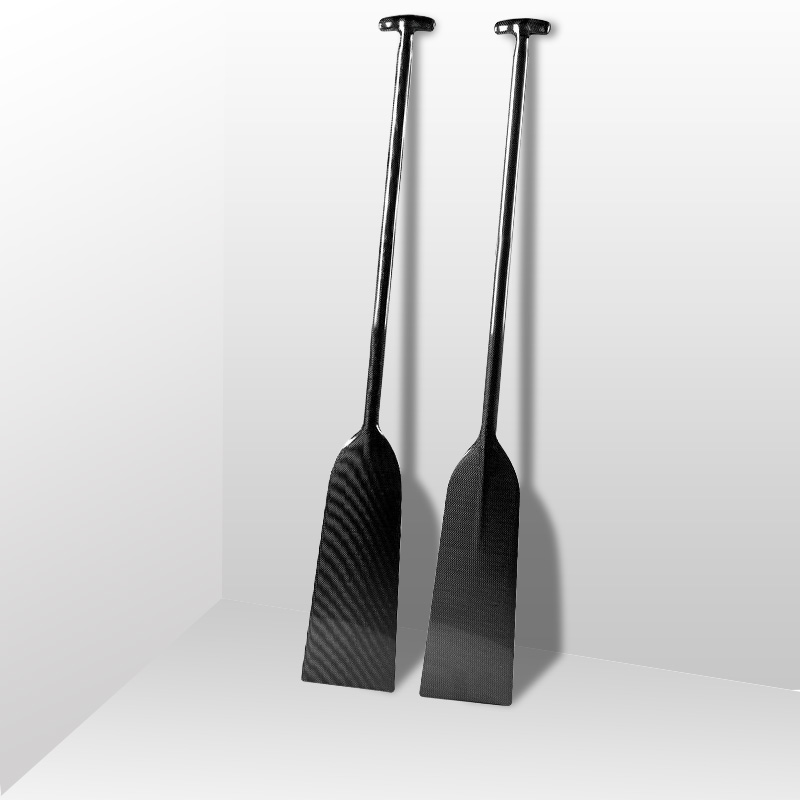
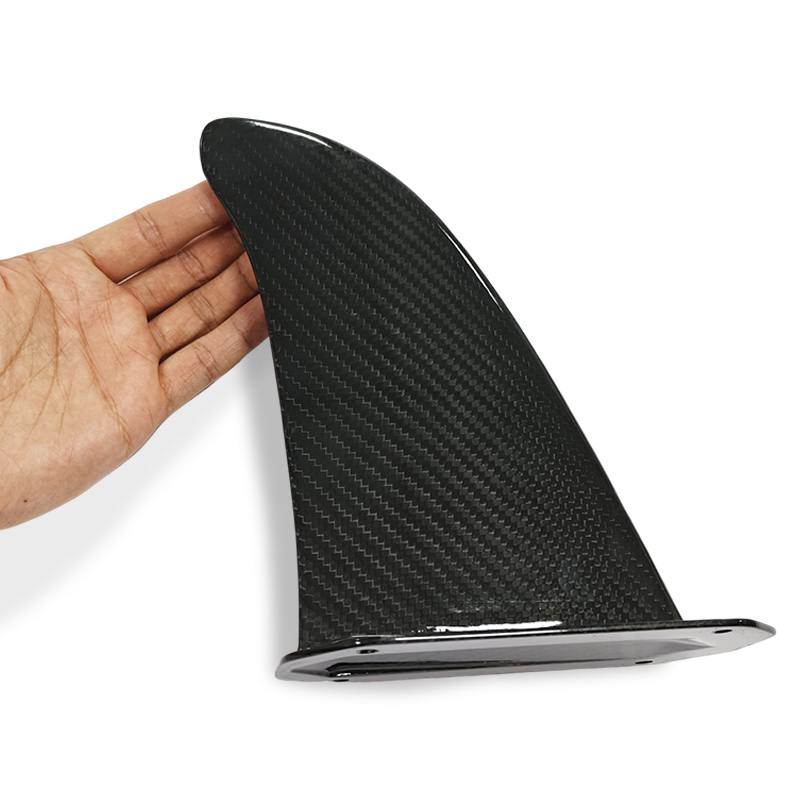
Unity Sports develops and manufactures carbon fiber composite components for board-sport and hydrofoil applications.
Our experience includes composite material preparation, layup, molding, machining, finishing, and quality control. This manufacturing background can be applied when developing lightweight composite components for specialized board-sport applications.
For brands and equipment developers exploring custom carbon fiber components, the development process can begin with a product drawing, 3D CAD file, existing sample, or detailed application requirements.
Depending on the project, we can discuss material selection, construction, manufacturing process, tooling, surface finish, and production requirements.
The Future of Land Windsurfing Equipment
The development of land windsurfing equipment is closely connected to improvements in board design, wheels, steering systems, sails, and composite manufacturing.
Potential areas of development include:
- Lighter board structures
- More efficient wheel and truck systems
- Custom composite decks
- Lightweight carbon fiber masts and structural components
- Hybrid carbon-fiber constructions
- Improved ergonomic designs
- More efficient manufacturing processes
Rather than assuming that one material or technology will dominate every application, future equipment development is likely to focus on matching materials and manufacturing processes to specific performance requirements.
For manufacturers, advances in composite design can create opportunities to develop equipment that is lighter, more precisely engineered, and better optimized for its intended riding environment.
How to Start Land Windsurfing
If you are new to land windsurfing, start with the fundamentals rather than immediately focusing on speed.
Step 1: Choose a Suitable Location
Find a large, open area with a suitable surface and consistent wind. Confirm that land windsurfing is permitted at the location.
Step 2: Select Basic Equipment
A beginner setup should prioritize controllability and stability.
A suitable land board, manageable sail, compatible mast and boom, and appropriate safety equipment are more important than maximum performance.
Step 3: Learn Sail Control
Before increasing speed, practice:
- Rig handling
- Sail positioning
- Depowering
- Basic steering
- Body positioning
Step 4: Practice in Moderate Conditions
Start in manageable wind and gradually increase the difficulty as your control improves.
Avoid strong gusts, crowded areas, and surfaces that make steering unpredictable.
Step 5: Upgrade According to Your Needs
Once you understand your riding style, equipment upgrades can be selected based on specific goals.
For example, a performance-oriented rider may prioritize lighter composite components, while a beginner may place greater value on durability and ease of use.
Land Windsurfing FAQ
What is land windsurfing?
Land windsurfing is a wind-powered board sport that uses a wheeled board and windsurfing-style sail rig to travel across land instead of water. It combines sail handling, balance, steering, and wind awareness.
Is land windsurfing the same as windskating?
The terminology varies by region and community. Windskating is commonly used for wind-powered wheeled board activities, while land windsurfing specifically emphasizes the use of windsurfing-style equipment and techniques on land.
Can you use a normal windsurfing sail for land windsurfing?
Some land windsurfing setups are compatible with conventional windsurfing sails and rigs. Compatibility should be verified between the sail, mast, boom, mast base, and land board before use.
What wind speed do you need for land windsurfing?
There is no single minimum wind speed. Smooth paved surfaces may allow a suitable board to move in relatively light winds, while grass or rougher surfaces generally require more wind. Sail size, rider weight, wheel configuration, and wind consistency also affect the required wind speed.
What type of board is used for land windsurfing?
Land windsurfing uses a wheeled board equipped with trucks and wheels rather than a floating water board. Board dimensions, wheelbase, truck geometry, and deck stiffness vary according to the intended riding conditions.
Is land windsurfing good for learning windsurfing?
Land windsurfing can help riders practice sail handling, balance, steering, and wind awareness. However, it does not replace water-based training because techniques such as water starts, water-specific board control, and riding in waves must be learned on water.
Is carbon fiber necessary for land windsurfing?
No. Carbon fiber is not necessary for basic land windsurfing. Aluminum, fiberglass, and other materials can also be used depending on the equipment design. Carbon fiber becomes particularly relevant when low weight and high stiffness are important design objectives.
Where can you practice land windsurfing?
Suitable locations may include permitted open paved areas, hard-packed sand, dry lake beds, dirt surfaces, and suitable grass fields. The location should have enough space, suitable wind, and minimal obstacles or traffic.
Can land windsurfing equipment be custom manufactured?
Yes. Custom carbon fiber and composite components can be developed around specific dimensions, mounting interfaces, material requirements, surface finishes, and production volumes. Manufacturers may work from CAD files, drawings, physical samples, or application requirements.
Conclusion
Land windsurfing combines the principles of windsurfing with a wheeled board to create a wind-powered sport that can be practiced on suitable land surfaces.
Its appeal comes from the combination of sail handling, board control, balance, and accessibility to locations away from open water.
For beginners, the most important considerations are a suitable riding area, manageable wind conditions, compatible equipment, and appropriate protective equipment. For experienced riders and equipment developers, board geometry, wheel systems, rig configuration, materials, and manufacturing methods provide opportunities to optimize performance.
Carbon fiber can play a role in performance-oriented land windsurfing equipment because of its combination of low weight and high specific stiffness. However, material selection should always be based on the requirements of the complete component rather than the material name alone.
For equipment brands, distributors, and product developers, composite manufacturing also creates opportunities to develop customized boards, masts, structural components, and other board-sport products around specific design and production requirements.
Unity Sports brings experience in carbon fiber composite manufacturing for hydrofoil and board-sport applications, supporting projects from material and process selection through prototyping, production, finishing, and quality control.