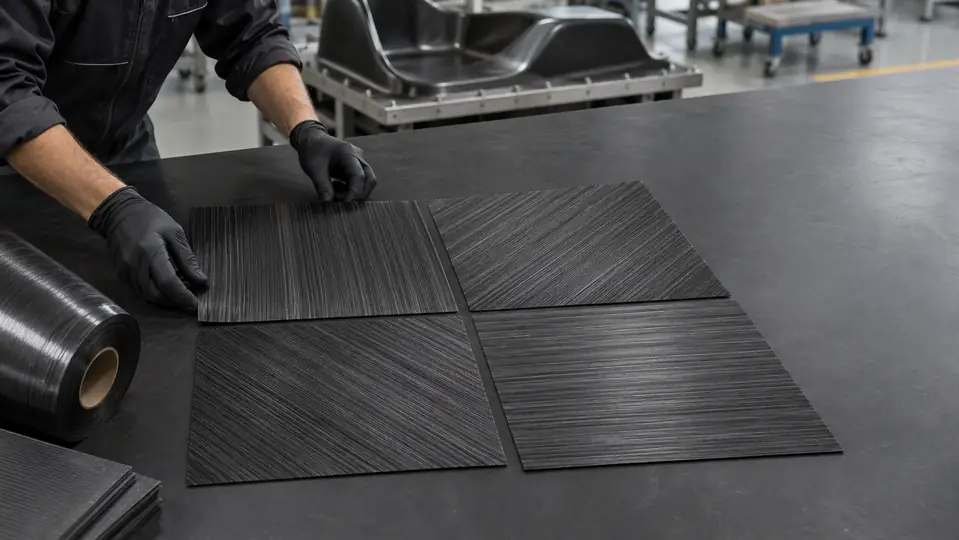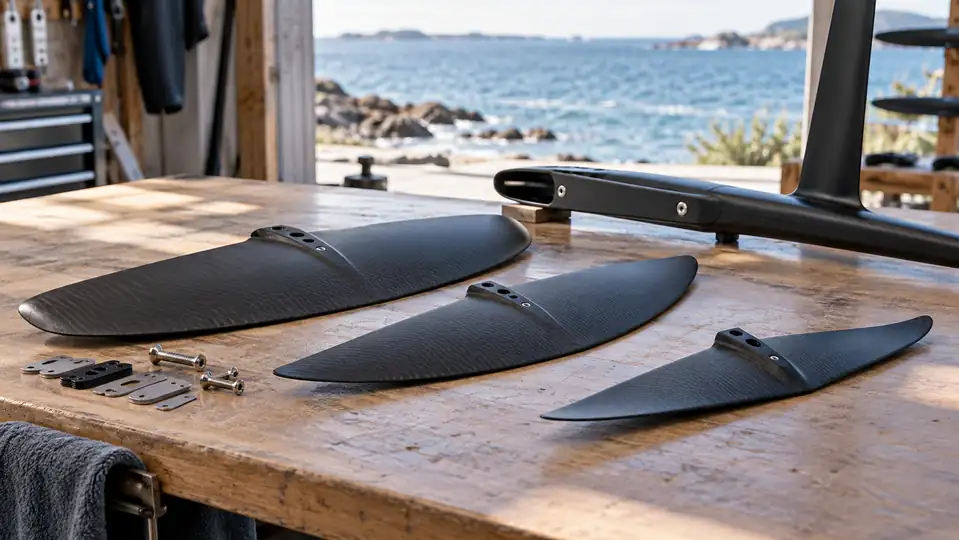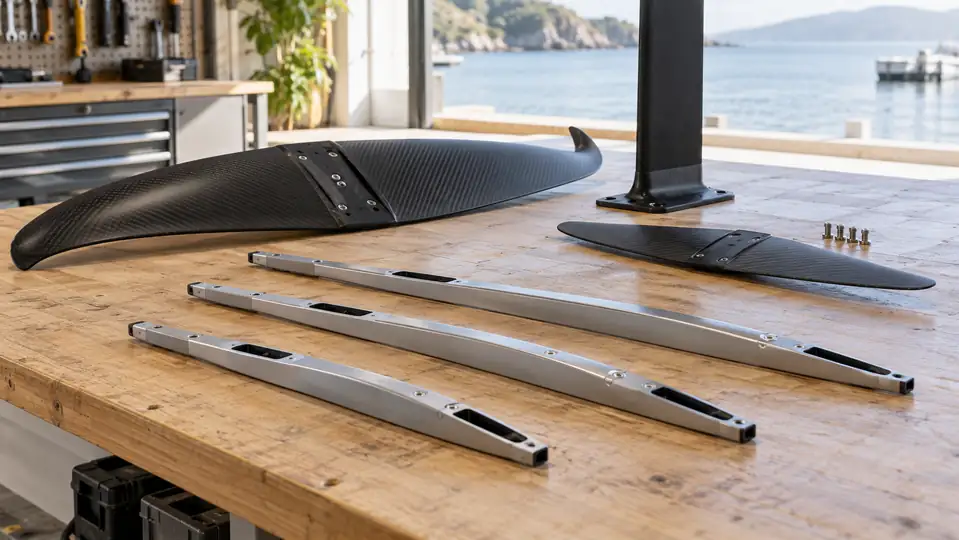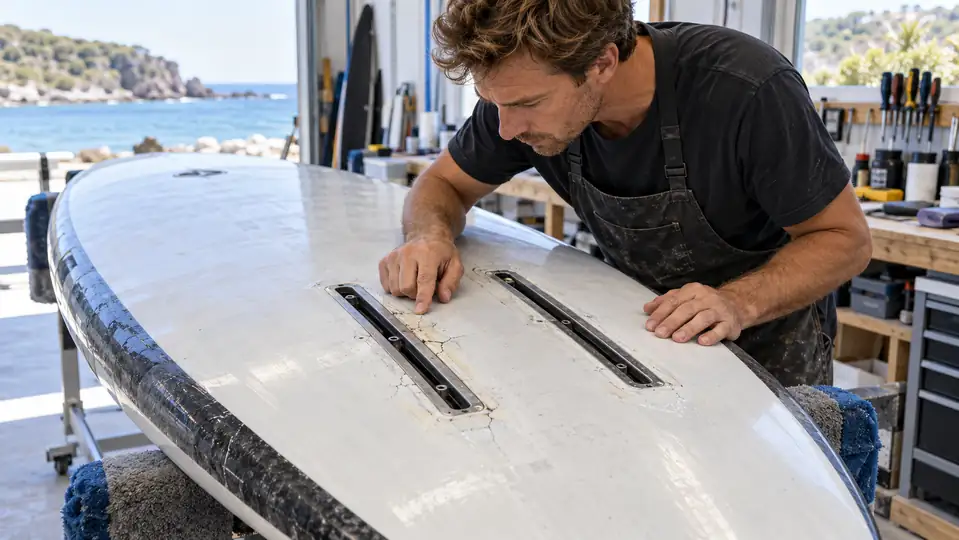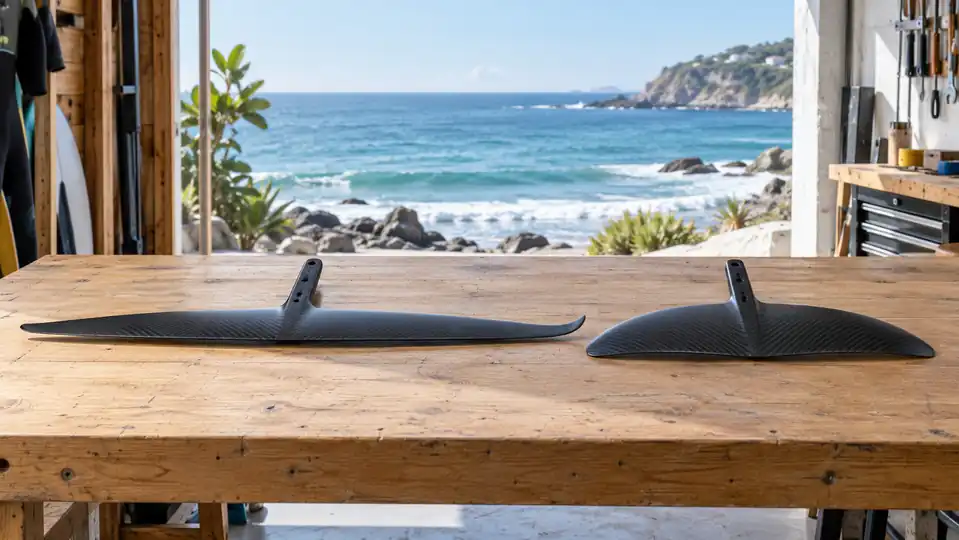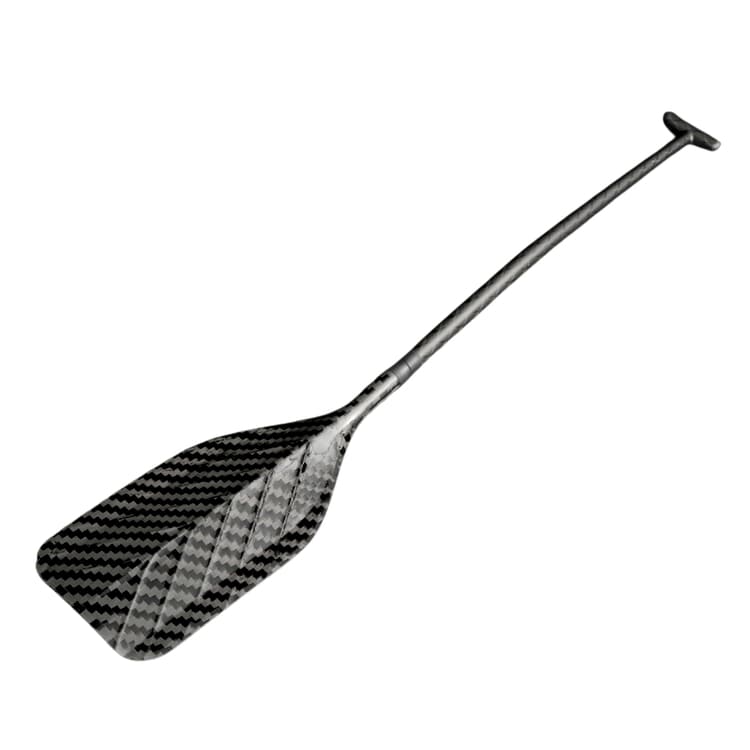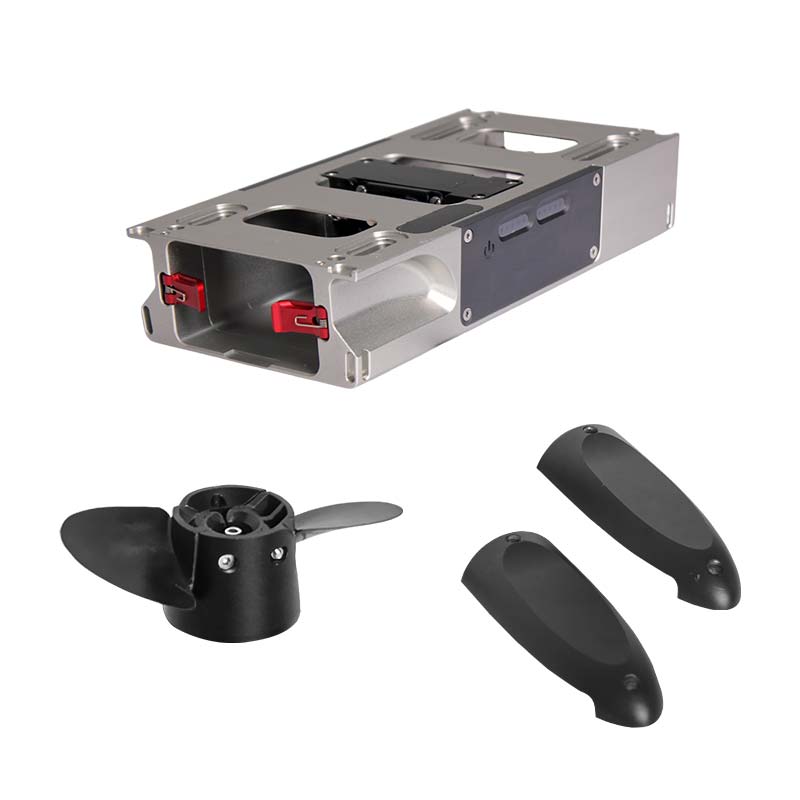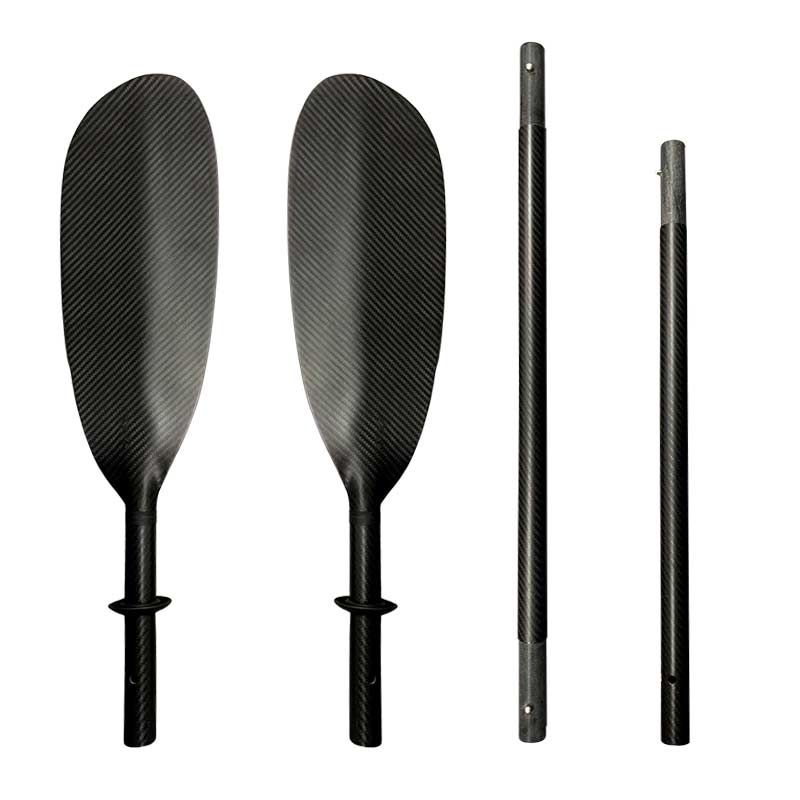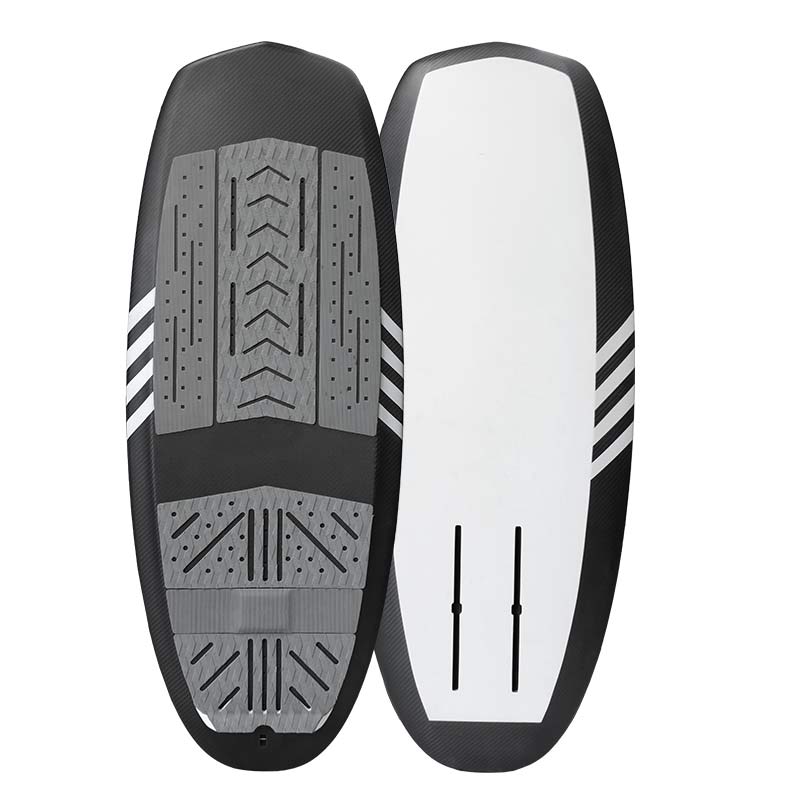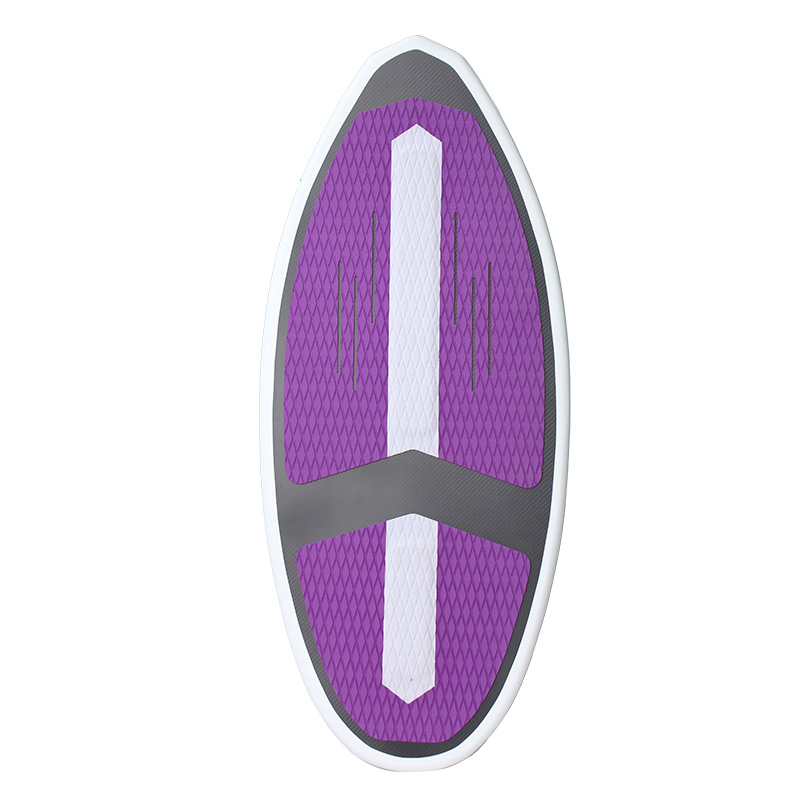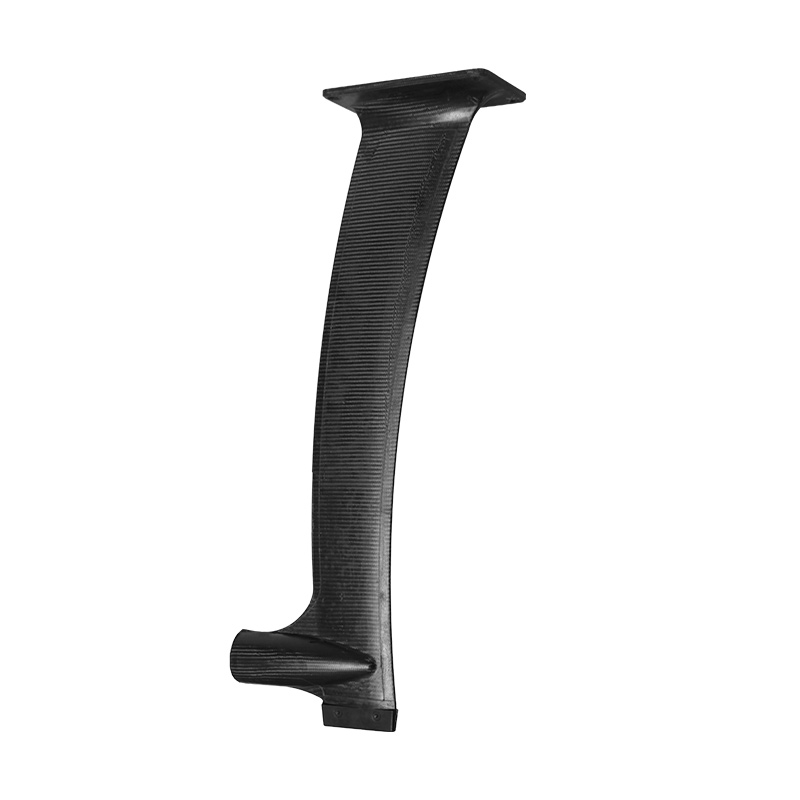
Carbon fiber galvanic corrosion occurs when electrically conductive carbon fiber and a less noble metal—often aluminum—become electrically connected while water or another electrolyte bridges the interface. In that cell, the aluminum acts as the anode and can corrode faster than it would alone. Salt water raises the risk because dissolved ions make the water more conductive and chloride can attack protective aluminum oxide films.
Three conditions must overlap
- A conductive carbon-fiber surface and a galvanically different metal;
- an electrical path between them, including through a fastener or damaged coating; and
- an electrolyte path such as seawater, salt spray, trapped rinse water or a persistent moist salt film.
Break either the electrical path or the electrolyte path and the galvanic cell cannot operate in the same way.
This matters in water sports because a compact product can combine carbon laminates, anodized aluminum, stainless or titanium fasteners, bonded inserts and narrow wet crevices. The goal is not to fear mixed materials. It is to design and maintain each interface so that drainage, electrical isolation, coatings, sealing and inspection work together.
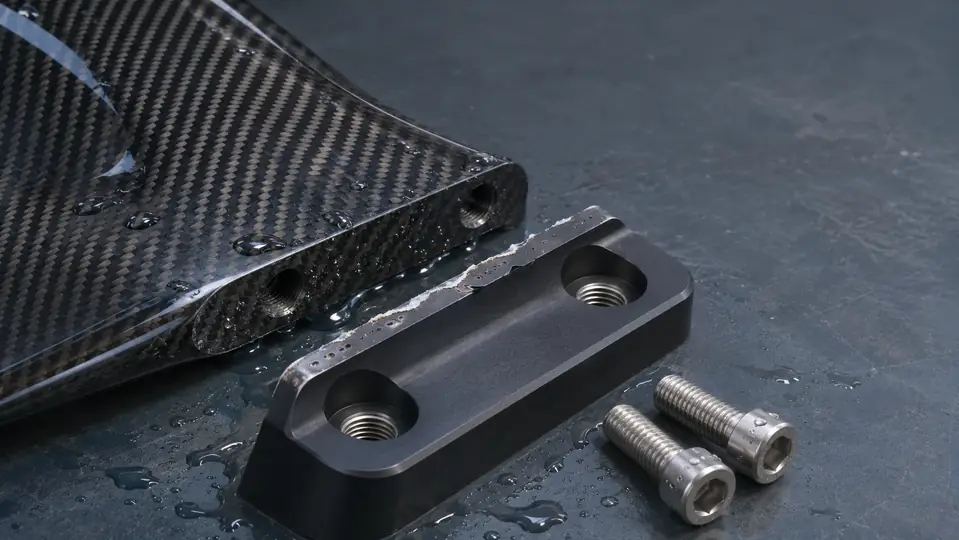
Why carbon fiber and aluminum can behave like a small battery
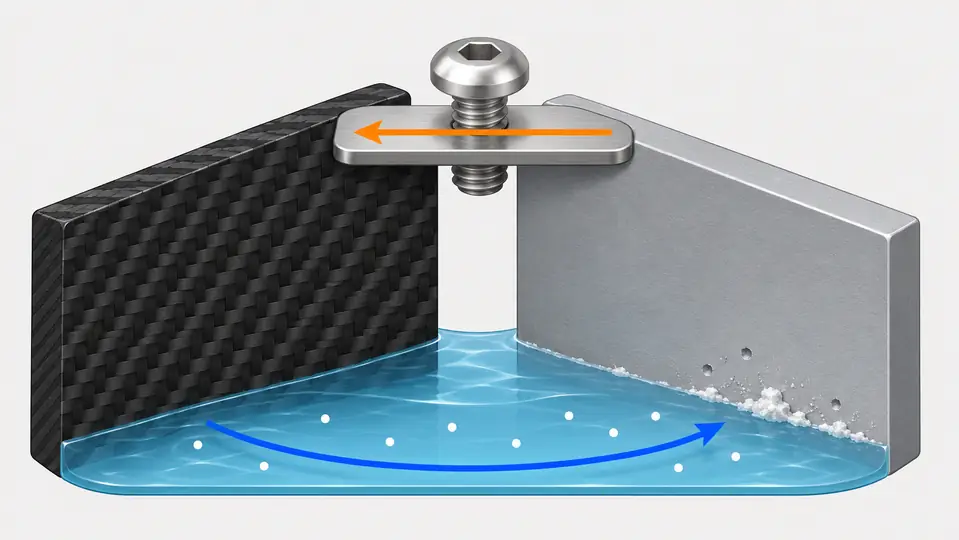
Carbon fibers conduct electricity. When exposed fibers or a conductive carbon laminate are electrically connected to aluminum, the two surfaces have different electrochemical potentials. Add a conductive liquid and charge can move through the coupled system: oxidation occurs at the aluminum anode, while reduction reactions occur on the more noble carbon-fiber cathode.
The Fraunhofer Institute for Manufacturing Technology and Advanced Materials explains that carbon fibers act as the cathode when CFRP is part of a galvanic couple. Research on aluminum/carbon systems also reports that direct electrical contact and a liquid electrolyte are required, while chloride-containing environments can strongly accelerate aluminum attack.
The resin around carbon fibers is normally an electrical and environmental barrier, but a finished composite is not automatically insulated everywhere. Trimmed edges, drilled holes, worn coatings, cracked resin, exposed tows, inserts and conductive fasteners can create a path. The risk therefore depends on the real joint—not simply on whether a product is described as “carbon” or “anodized aluminum.”
Salt water raises the risk but immersion is not required
Seawater is an efficient electrolyte because it contains dissolved salts. Yet a part does not need to remain underwater. Salt spray can dry on a surface, then absorb moisture again in humid air. Water retained beneath a washer, inside a threaded hole or behind a damaged edge seal can keep a small interface active after the equipment appears dry.
This explains why storage matters. A foil rinsed briefly and then assembled wet inside a closed bag may retain water in exactly the crevice that needs to dry. Conversely, fresh-water equipment is not immune: mineral content, contamination, cleaning products and dissimilar conductive materials can still complete a cell, although the severity may differ.
Where the risk hides on water-sports equipment
| Interface | Possible conductive path | Where water can remain | Design or maintenance question |
|---|---|---|---|
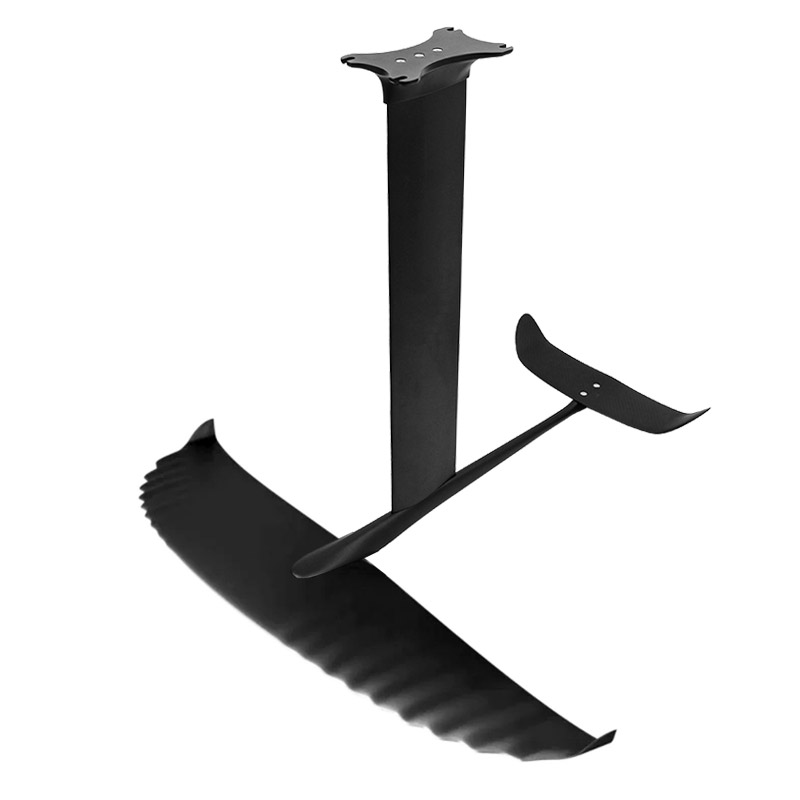
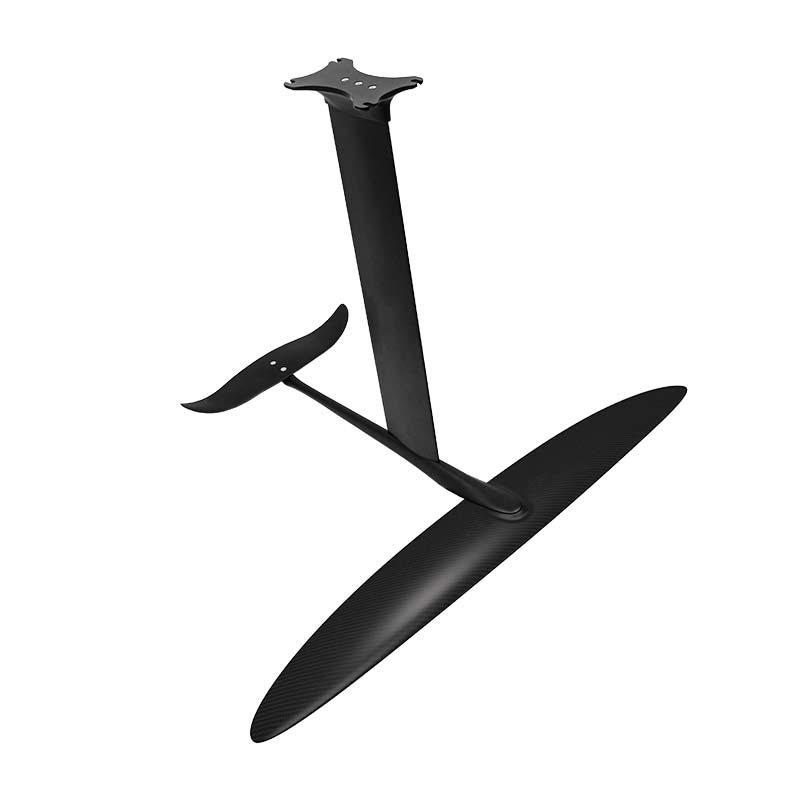
| Carbon wing or board insert with aluminum fitting | Exposed carbon edge, metal insert or conductive fastener | Bond line edge, recess or fastener hole | Is there a continuous isolation layer and sealed perimeter? |
| Carbon front wing on an aluminum fuselage | Bolt, worn contact face or damaged coating | Mating face and threaded bore | Can the parts be separated, inspected, cleaned and dried? |
| Carbon mast with aluminum top plate or base | Bonded sleeve, exposed laminate or hardware | Internal cavity, adhesive edge or countersink | Is the joint permanently sealed or intentionally serviceable? |
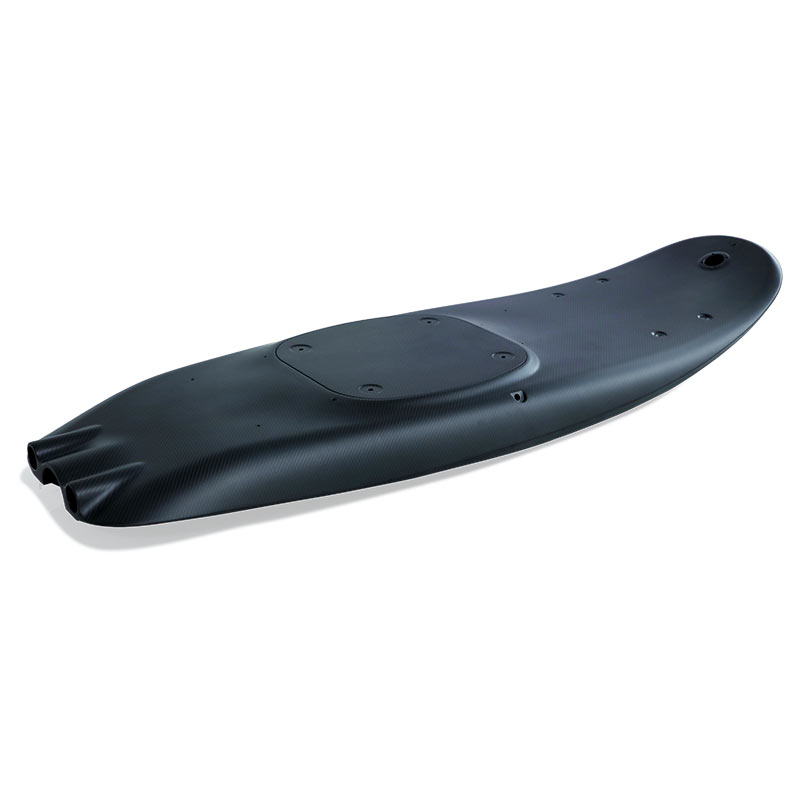
| Board track and mounting hardware | Metal hardware contacting carbon reinforcement or insert system | Track slot, washer interface and wet deck recess | Are the track structure and fastener materials electrically compatible? |
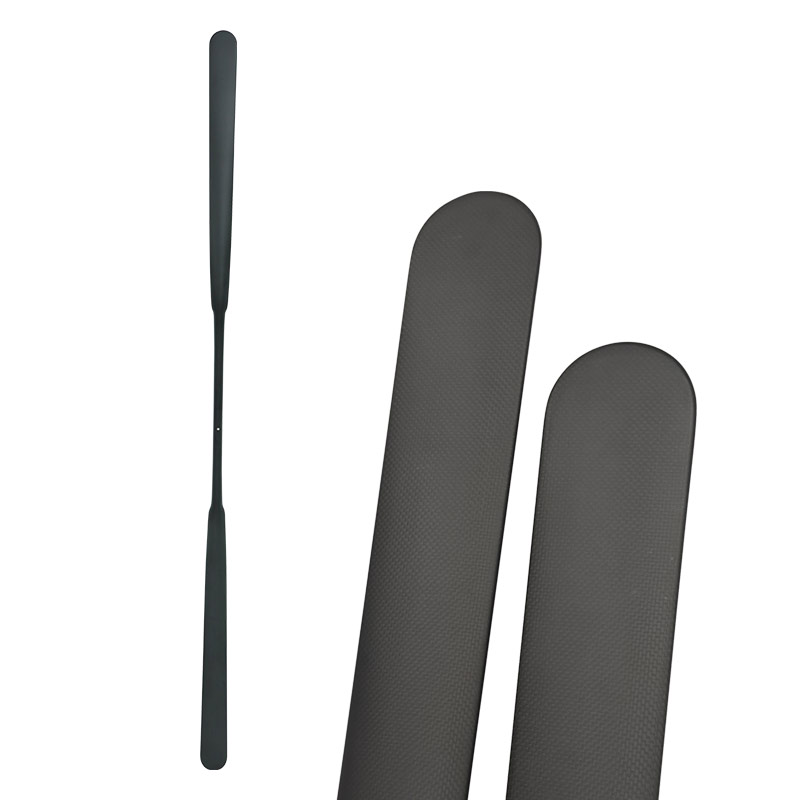
| Carbon shaft with metal ferrule or clamp | Conductive fibers at a cut end or worn bonding surface | Ferrule overlap and adjustment mechanism | Does the joint use a durable nonconductive bond/isolation layer? |
These are interface questions, not claims that every mixed-material product will fail. Geometry, alloy, coating system, carbon exposure, cathode-to-anode area ratio, temperature, salinity, time and maintenance all influence the outcome.
For the broader material trade-offs of an aluminum foil system, see Unitysurf’s aluminum hydrofoil overview. Component-specific pages for the hydrofoil mast, fuselage and mounting screws show why the interface must be assessed as an assembly rather than as isolated materials.
What carbon fiber galvanic corrosion looks like
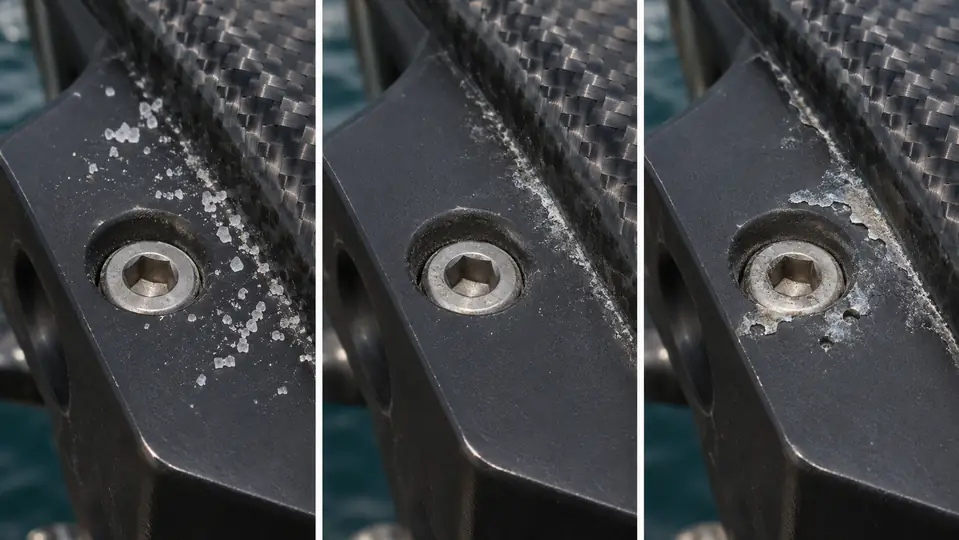
Galvanic corrosion of aluminum is often localized near the conductive interface. Possible signs include white or gray corrosion products, pits, lifting or bubbling paint, staining at an edge, loss of material around a fastener, rough threads, or hardware that becomes difficult to remove. In advanced cases, a joint may loosen even while the carbon component still looks intact.
No single visual sign proves the cause. White deposits can include dried salt or cleaning residue. A faded anodized finish is not automatically deep pitting. A seized bolt can involve thread galling, deposits, deformation, incompatible compounds or corrosion. Clean and inspect the part according to its manufacturer’s instructions before deciding what happened.
| Observation | What it may indicate | Appropriate next step |
|---|---|---|
| Loose white powder that washes away | Dried salt, aluminum corrosion product or both | Rinse, dry, inspect the cleaned metal under good light |
| Paint or coating bubbles beside a carbon joint | Moisture and corrosion progressing under the coating | Stop treating it as a cosmetic issue; obtain product-specific inspection guidance |
| Deep pits or material loss | Localized aluminum attack and reduced section | Remove from service until the responsible manufacturer or qualified technician evaluates it |
| Fastener repeatedly binds after salt-water use | Deposits, corrosion, thread damage or galling | Do not force it; follow the approved disassembly and thread-inspection procedure |
| Cracked sealant or exposed carbon at an edge | Barrier system may no longer interrupt electrical/moisture paths | Repair only with the specified compatible system and preparation method |
Isolation, sealing and coating do different jobs
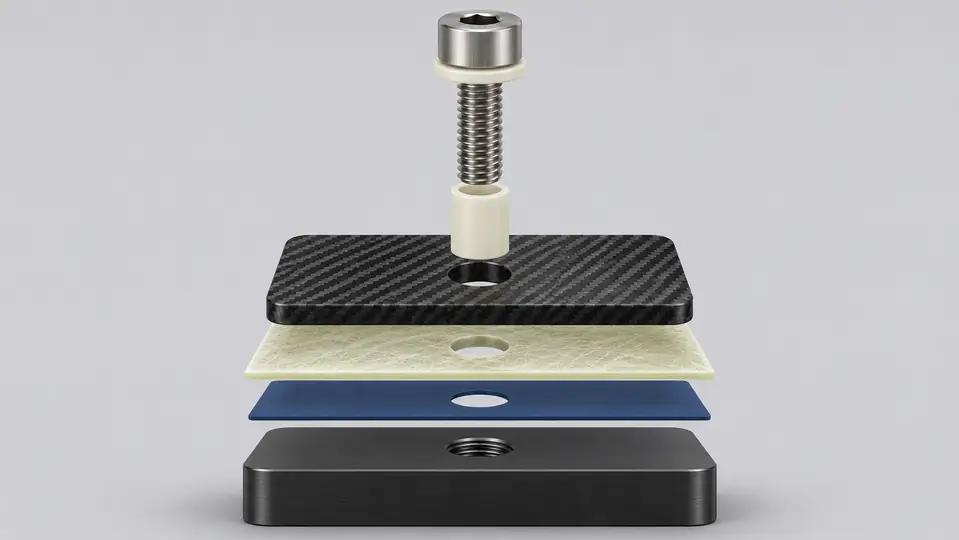
A robust joint rarely relies on one thin defense. The US Department of Transportation report Formation of Galvanic Corrosion Between Metallic and Composite Aerospace Structure discusses glass-fiber barriers, sealants and protective treatments as complementary measures. The exact materials and thicknesses must come from the approved product design, but the functions translate well to water-sports hardware.
| Control | Primary job | Important limitation |
|---|---|---|
| Glass-fiber barrier ply | Places a nonconductive reinforcement layer between carbon and metal | A fastener or exposed edge can bypass the barrier if the detail is incomplete |
| Nonconductive washer, sleeve or shim | Interrupts metal-to-composite contact at a removable joint | It must survive clamp load, wear, water exposure and assembly tolerances |
| Anodizing or conversion/coating system | Protects the aluminum surface and can add electrical resistance | Scratches, machining, fretting and damaged edges can expose the base metal |
| Adhesive or sealant | Blocks moisture entry and may electrically isolate the faying surfaces | Voids, poor surface preparation, edge cracks and incompatible chemistry undermine it |
| Assembly compound or marine grease | Helps exclude water and may reduce thread seizure in a serviceable joint | It is not a permanent structural barrier and may need renewal; use only product-approved chemistry |
| Drainage and ventilation | Reduces the time an electrolyte remains at the interface | A drain cannot compensate for an exposed conductive contact that stays wet |
The most reliable concept is layered defense: reduce direct electrical contact, protect the aluminum, seal the perimeter, avoid water traps, make inspection possible and define what must be renewed during service.
Why a coating alone can fail at the worst place
An anodized or painted aluminum part can perform well while the coating remains continuous. Joint assembly, however, concentrates wear: bolt torque, fretting, sharp carbon edges, sand, repeated disassembly and machining can damage the protective layer at a small spot.
A small exposed aluminum area electrically connected to a much larger carbon surface can be especially unfavorable because the anodic current is concentrated on the small metal area. This is why “the rest of the coating looks perfect” does not dismiss a pit beside a fastener. Coating continuity, edge detail and contact area matter more than color.
Likewise, simply replacing an aluminum bolt with a more noble fastener does not isolate a carbon–aluminum interface. The fastener may become another conductive bridge. Material selection has to consider the whole current path, not one component name.
A practical after-session routine for owners
- Follow the product manual first. Some assemblies are meant to remain bonded; others have defined disassembly and lubrication instructions.
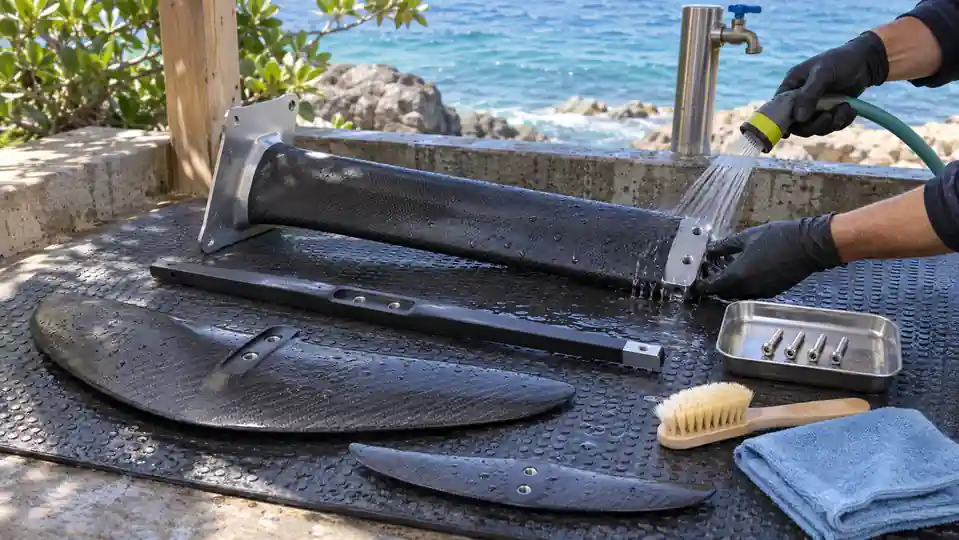
- Rinse before salt dries. Use fresh water to remove salt from joints, tracks, fasteners and recesses without driving contaminants deeper with inappropriate pressure.
- Open serviceable joints at the specified interval. Do not invent an interval for a safety-critical part; water, frequency and product design change the requirement.
- Dry the interfaces and storage bag. Avoid sealing damp equipment in a hot closed environment.
- Inspect clean surfaces. Look for pits, coating lift, cracked sealant, exposed carbon, thread damage and unusual looseness.
- Renew only approved compounds. Mixing greases, anti-seize products, thread lockers and sealants can affect plastics, adhesives, torque and future disassembly.
- Stop when material is missing. Do not sand away a pit or force a seized safety-critical joint and assume the original strength remains.
Fresh-water rinsing is valuable because it removes conductive salt, but it cannot replace missing aluminum, restore a damaged coating or rebuild a cracked isolation barrier.
An OEM checklist for mixed carbon and metal assemblies
For a new water-sports product, preventing carbon fiber galvanic corrosion belongs in the drawing, bill of materials, work instruction and validation plan—not in a generic care paragraph added after production.
- Map every carbon-to-metal contact, including fasteners, inserts, bearings and conductive coatings.
- Define which surface or layer provides electrical isolation.
- Prevent exposed carbon edges from contacting aluminum after trimming or drilling.
- Specify coating preparation, coverage, masked areas, thickness or acceptance evidence where relevant.
- Define the compatible adhesive, sealant, washer, sleeve and assembly compound systems.
- Control fastener material, torque, lubrication state and installation sequence together.
- Avoid blind wet crevices, or provide an intentional drainage and drying path.
- Make critical interfaces inspectable without damaging the barrier.
- Validate representative production joints after environmental conditioning, not only isolated material coupons.
- State acceptable cosmetic change separately from rejectable pitting, coating failure or section loss.
- Freeze the approved materials and require review before substitutions.
Salt-spray testing needs a defined question
Unitysurf has salt-spray test equipment available for project-specific verification. The equipment alone does not define a pass: the customer and manufacturer still need to agree the specimen or assembly, surface preparation, exposure method, duration, inspection intervals and acceptance criteria. A representative assembled joint can reveal failure paths that separate carbon or aluminum coupons may miss.
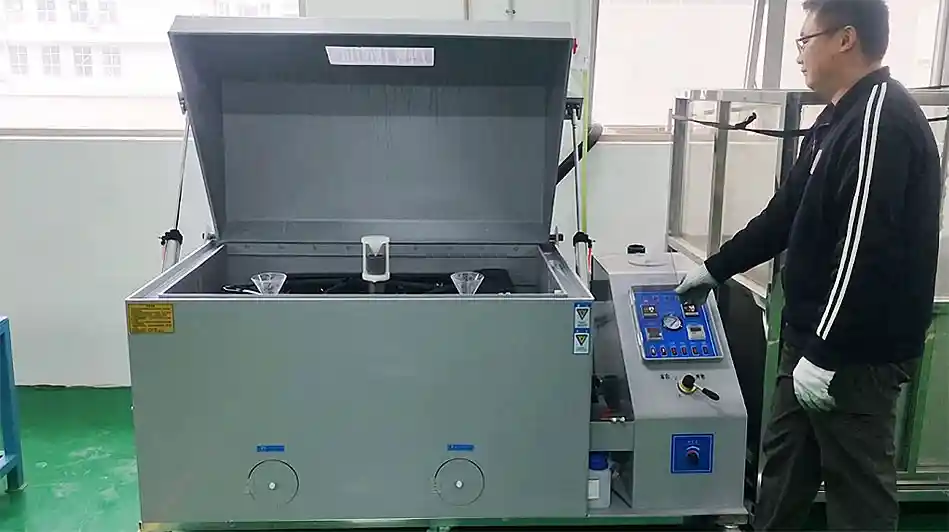
Unitysurf’s hydrofoil manufacturing overview places material selection, molding, machining, assembly and testing in one development process. For projects that extend beyond hydrofoils, the custom carbon fiber manufacturing page outlines OEM/ODM review, tooling, finishing and verification capabilities.
Common questions about mixed carbon and aluminum parts
Does carbon fiber itself rust?
No. Rust is an iron-oxide term. Carbon fibers do not rust like steel, but the surrounding polymer can age or become damaged, and carbon can participate as the conductive cathode in a galvanic couple that accelerates corrosion of aluminum or another anodic metal.
Does anodized aluminum solve the problem permanently?
Anodizing can substantially improve aluminum’s surface protection, but it is not an unlimited guarantee. Machined areas, scratches, wear, thin coverage, threaded interfaces and installation damage can expose metal. A joint should still manage electrical contact and moisture.
Is stainless steel safe beside carbon fiber?
No material pairing should be approved from a generic web answer. Stainless steel is relatively noble and may perform differently from aluminum, but it can also create galvanic concerns for adjacent aluminum and can provide a conductive path through a joint. Use the product’s specified fastener and isolation system.
Will marine grease stop carbon fiber galvanic corrosion?
A compatible grease or assembly compound can help exclude water and protect threads, but it can be displaced, washed out or applied incompletely. It does not replace a durable isolation design, intact coating, correct seal and inspection plan.
Can I repair pitted aluminum by sanding it smooth?
Sanding removes additional material and does not establish the remaining strength of a loaded part. Deep pitting, looseness or coating failure near a structural joint should be evaluated under the manufacturer’s repair or replacement criteria.
The safest joint is the one designed to be inspected
Carbon and aluminum can coexist successfully in high-performance water-sports equipment, but carbon fiber galvanic corrosion must be addressed as both an electrochemical and mechanical interface problem. Keep carbon electrically separated where required, protect the aluminum, seal and drain the joint, control the fasteners and make early damage visible.
For a project review, send Unitysurf the assembly drawing, material stack, contact interfaces, intended water environment, service concept and validation requirements through the contact page. Those inputs are more useful than a one-line request for “salt-water-proof” hardware.
Technical note: This educational article explains general corrosion mechanisms and design questions. It is not a remote condition assessment or repair authorization for a specific product. Follow the original manufacturer’s instructions and obtain qualified evaluation for structural damage.