To audit a hydrofoil manufacturer, answer one question: can this supplier repeatedly turn the approved design into conforming production parts? A polished sample, a press and a certificate do not answer that alone. OEM buyers need evidence that engineering files, materials, tooling, layup, cure, inspection, changes and shipment records are controlled as one system.
This hydrofoil supplier audit checklist contains 25 questions for carbon front wings, stabilizers, masts, fuselages and related composite assemblies. Use it before paying for production tooling, when approving a new factory, or when a current supplier introduces a new process or production site.

How to use this hydrofoil supplier audit checklist
Audit the proposed product line, not an impressive but unrelated part of the building. Ask the supplier to follow one representative hydrofoil component from drawing release through material issue, layup, cure, trimming, inspection, packing and shipment. Sample records from a completed batch where confidentiality permits, or use redacted records when customer names and proprietary geometry cannot be disclosed.
Use three passes rather than trying to reach a decision during one factory walk. First, complete a desk review to identify missing documents, unclear specifications and processes that need deeper verification. Second, perform the on-site or live-video audit by following real material, parts and records through the proposed production route. Third, review the findings with engineering, quality and purchasing before defining approval conditions. This separation helps prevent an impressive facility tour from overriding unresolved technical risk.
The hydrofoil supplier audit checklist should also be scaled to the project stage. A prototype-only supplier may not yet have production capacity evidence, but it should still control files, materials and deviations. Before a mass-production release, require evidence that the approved process can be repeated at the intended rate, with inspection and packaging included in the capacity plan.
| Finding | Meaning | Typical action |
|---|---|---|
| Critical | A condition that can create a serious safety, legal, traceability or unauthorized-change risk | Do not approve production until contained and verified |
| Major | A missing or ineffective control that could affect repeated conformity | Require corrective action and objective closure evidence |
| Minor | An isolated lapse that does not show a system failure | Correct and monitor |
| Observation | An improvement opportunity without a demonstrated nonconformity | Discuss and track if useful |
Do not turn the audit into a simple percentage contest. A factory can score 92% and still fail because the missing 8% includes uncontrolled design changes or no material traceability. The ISO guidance on ISO 9001 in the supply chain explains that a supplier declaration, customer assessment and third-party certification provide different kinds of confidence. A certificate should be checked for issuer, validity, address and scope; it does not replace a product- and process-specific audit.
Before the visit, request an evidence pack
Before you audit a hydrofoil manufacturer, define the component family, development stage, intended volume, critical interfaces and acceptance criteria. Otherwise, the same factory may appear acceptable under a generic checklist while remaining unqualified for the specific product being sourced.
- legal company name, factory address and manufacturing scope;
- organization chart and named engineering, production and quality contacts;
- quality certificates, including their scope and issuing body;
- a process flow for the proposed component family;
- sample drawing, traveler, inspection report and material traceability record with confidential data removed;
- equipment list showing process, working envelope and calibration or maintenance status;
- sample nonconformance, corrective-action and engineering-change records;
- proposed prototype, testing, golden-sample and production-approval plan.
The checklist should be tailored to your construction. A prepreg compression-molded wing, a wet-laminated board, a pultruded mast and a machined aluminum fuselage do not need identical controls.
Factory identity, responsibility and project control
1. Which operations are performed at this address?
Why it matters: A supplier may design, mold and inspect in-house while subcontracting core machining, painting, metal inserts or testing. Subcontracting is not automatically a problem; an undisclosed or uncontrolled process is.
Ask to see: the actual production areas, process flow, approved subcontractor list and purchase specifications for outsourced work. Red flag: “Everything is made here” cannot be reconciled with the equipment, people or records on site.
2. Who owns engineering, quality and production decisions?
Why it matters: Buyers need named responsibility for design questions, deviations, inspection release and shipment approval. A salesperson should not be the only route to technical decisions.
Ask to see: organization chart, job responsibilities and escalation path. Red flag: no independent authority can stop production or quarantine suspect parts.
3. What relevant hydrofoil or load-bearing composite experience can be verified?
Why it matters: Glossy carbon appearance does not establish control of thin trailing edges, metal interfaces, spanwise stiffness or three-dimensional foil geometry.
Ask to see: permitted samples, redacted travelers, process qualifications and examples of similar geometry or structural requirements. Respect legitimate NDAs. Red flag: the only evidence is customer logos, copied photographs or verbal claims.
4. How are confidentiality and buyer-owned designs protected?
Why it matters: CAD, laminate schedules, molds and samples may contain the brand’s proprietary work.
Ask to see: NDA workflow, access controls, file permissions, visitor controls, sample disposal rules and separation of customer projects. Red flag: unrestricted shared folders, uncontrolled visitor photography or buyer files sent through personal accounts.
5. How does the factory review requirements before quoting and tooling?
Why it matters: A quote based only on an exterior CAD file can miss laminate targets, inserts, tolerances, finish classes, validation loads and packaging.
Ask to see: contract-review checklist, open-question log and DFM output. Compare this with the existing Unity Sports guide to the hydrofoil manufacturing process. Red flag: the supplier promises tooling immediately without recording technical assumptions.
Engineering files, tooling and change control
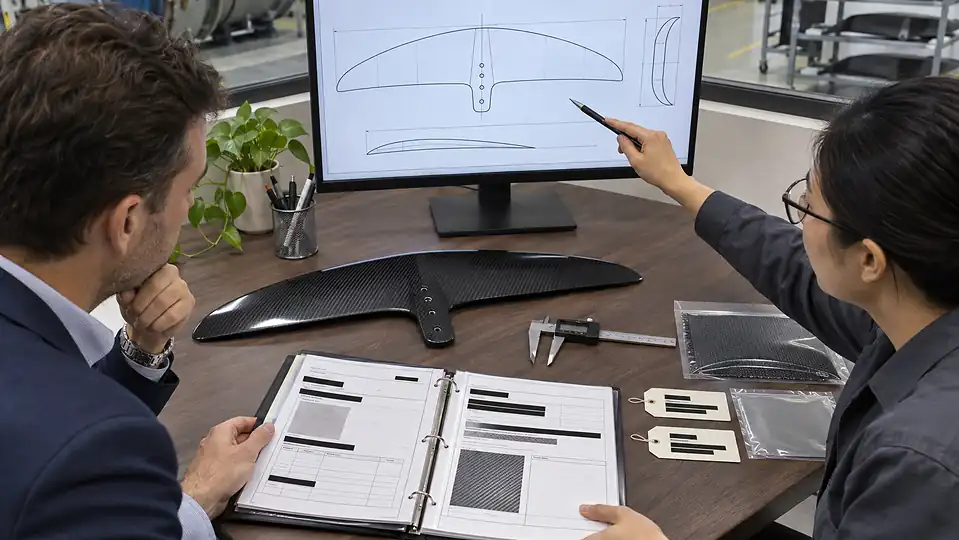
6. Which file is the controlling design authority?
Why it matters: CAD, 2D drawings, BOMs and emails can conflict. The contract must state which document controls geometry, tolerances, materials and finish.
Ask to see: released file list with revision, date and approval. Red flag: operators use screenshots or locally renamed files with no revision status.
7. How are drawings, BOMs, layup tables and work instructions revised?
Why it matters: A correct prototype can become an incorrect production batch when one document changes and the others do not.
Ask to see: document approval, obsolete-copy removal and revision acknowledgement. The carbon-fiber layup orientation guide explains why ply direction and stacking order cannot be reduced to “full carbon.” Red flag: handwritten production changes never reach the master file.
8. Who owns the molds, gauges and production data?
Why it matters: Tool ownership, storage, maintenance, permitted use and end-of-project disposition affect exclusivity and continuity.
Ask to see: written ownership terms, asset identification, storage location, maintenance record and restrictions on third-party use. Red flag: ownership is assumed but absent from the quotation or contract.
9. How is tooling condition verified before production?
Why it matters: Surface damage, wear, contamination, poor alignment or blocked vacuum paths can repeat defects across a batch.
Ask to see: pre-use checklist, maintenance history and acceptance criteria for parting surfaces, alignment and heating. Red flag: tools are repaired informally with no record or requalification.
10. What requires written buyer approval before a change?
Why it matters: Switching fiber, resin, core, insert supplier, cure cycle, mold, factory, subcontractor or inspection method can change the product even when its appearance stays similar.
Ask to see: change-notification procedure and a completed example. The NCAMP carbon-fiber base specification is an aerospace reference, not a water-sports requirement, but it illustrates the value of controlled process documents, traceability and approval before key process changes. Red flag: “equivalent material” substitutions need no buyer review.
Materials and composite process control
11. Can every critical material be traced to a supplier and lot?
Why it matters: Carbon reinforcement, resin or prepreg, core, adhesive and metal inserts must be linked to the production batch if a problem appears later.
Ask to see: receiving record, supplier certificate where specified, internal lot label and material issue record. Red flag: cut plies or mixed resin containers lose their identity before layup.
12. Are storage life and storage conditions controlled?
Why it matters: Prepreg out-time, resin shelf life, humidity-sensitive materials and adhesive storage affect processing and final properties.
Ask to see: temperature records, expiry status, thaw/out-time log and quarantine process for expired material. Red flag: the team relies on memory or relabels material without authorization.
13. How are ply kits and core components prepared and identified?
Why it matters: Wrong orientation, missing plies, damaged fibers, contaminated bond surfaces or incorrect core density may be hidden after the mold closes.
Ask to see: cutting files, kit labels, orientation marks, core inspection and clean-handling rules. Red flag: different revisions or materials share an unsegregated worktable.
14. Does each part travel with a controlled layup and assembly record?
Why it matters: The record should show who performed critical steps, which revision was used and whether required checks were completed before cure.
Ask to see: traveler, sign-offs, timestamps and hold points for inserts, adhesive, ply count and mold closure. Red flag: a generic checklist is completed after the batch rather than during production.
15. Are cure parameters recorded against the part or batch?
Why it matters: Time, temperature, pressure or vacuum are process variables, not just machine settings. A displayed target does not prove the actual cycle was achieved.
Ask to see: cure chart or logged data, sensor identification, acceptance limits and response to an excursion. FAA Advisory Circular AC 21-26A is written for aviation composites, but its discussion of incoming-material control, specifications and process evidence demonstrates why a supplier report alone is not the entire acceptance system. Red flag: no retained cycle record can be tied to the inspected part.

Inspection, testing and sample approval
16. Which characteristics are inspected at incoming, in-process and final stages?
Why it matters: Final inspection cannot recover evidence that was hidden during layup, bonding or mold closure.
Ask to see: control plan linking each characteristic to method, frequency, acceptance limit and record. The public Borisch supplier audit checklist provides a useful general example of asking for formal incoming and final inspection records. Red flag: “100% inspection” is claimed without a defined characteristic or report.
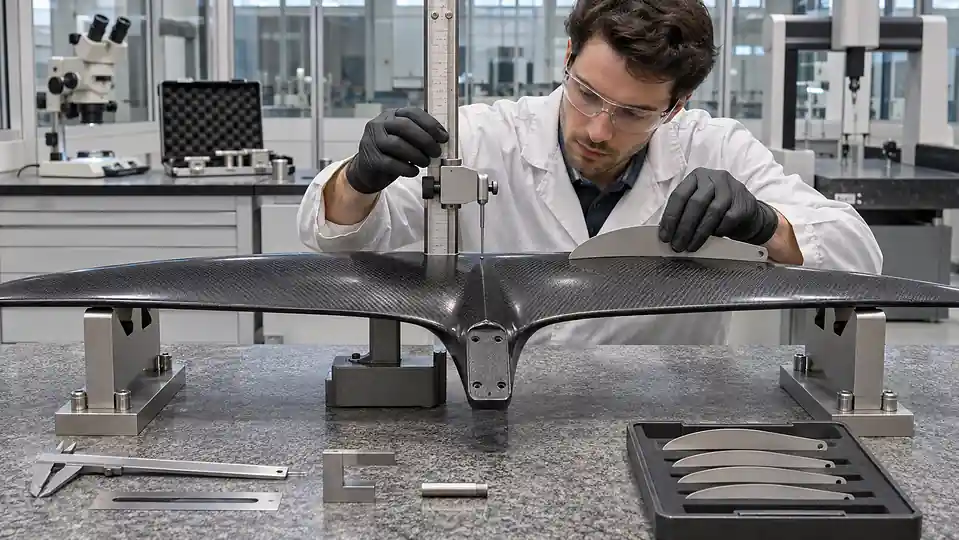
17. Can the supplier measure the geometry that makes the foil work?
Why it matters: Span and maximum thickness alone do not verify section shape, twist, sweep, anhedral, mounting planes or hole position.
Ask to see: drawing datums, section templates or scan strategy, fixture method and measurement report. Use the Unity Sports guide to three-dimensional hydrofoil shape when defining the required views, and review the separate foil interface and track-box guide when the project includes a board or mounting system. Red flag: inspection checks only overall length and surface appearance.
18. Are gauges calibrated and suitable for the tolerance?
Why it matters: Calibration status alone does not make a tool capable of measuring a curved wing or a tight interface tolerance.
Ask to see: gauge list, calibration status, measurement method, resolution and reference standard. Red flag: expired instruments remain in use or the fixture has no repeatability check.
19. How are internal defects and bond integrity evaluated?
Why it matters: Voids, dry areas, disbonds and insert problems may not be visible. The appropriate method depends on construction, risk, geometry and agreed acceptance criteria.
Ask to see: visual criteria, tap-test or NDT procedure where applicable, witness panels, destructive coupons or product tests agreed for the project. Red flag: a supplier promises that one inspection technology detects every defect without demonstrated suitability.
20. How are prototypes, first articles and golden samples approved?
Why it matters: A beautiful prototype is not a production specification. The approved baseline should include documents, measurements, finish, interfaces, weight range and test results.
Ask to see: signed approval record, retained sample conditions, first-article report and plan for production comparison. For masts, review how profile and stiffness are specified together. Red flag: approval occurs through an informal message with no identified revision.
Nonconformance, capacity and production readiness
21. What happens when a part or process falls outside the requirement?
Why it matters: Suspect parts must be identified, segregated and dispositioned by authorized people. Rework can change dimensions, fibers, finish or interfaces.
Ask to see: quarantine area, nonconformance report, concession workflow and reinspection record. Red flag: operators repair defects until they “look good” without documented limits.
22. How are recurring defects investigated and corrective actions verified?
Why it matters: Sorting one batch does not prevent recurrence. A corrective action should address the mechanism and verify effectiveness over appropriate subsequent production.
Ask to see: root-cause analysis, containment, corrective action, owner, due date and effectiveness evidence. Red flag: every problem is attributed to operator carelessness with no process investigation.
23. Is the proposed capacity supported by the real bottleneck?
Why it matters: Press count does not equal output. Tool count, cure duration, skilled layup labor, trimming, finishing and inspection may constrain delivery.
Ask to see: capacity calculation for the proposed SKU mix, normal utilization, shift pattern, maintenance allowance and ramp plan. Red flag: monthly capacity is a round number unrelated to cycle time and tooling.
24. How are subcontractors and upstream suppliers controlled?
Why it matters: A controlled molding operation can still fail through an uncontrolled insert, adhesive, coating, machining or heat-treatment source.
Ask to see: qualification criteria, approved supplier list, purchasing requirements, incoming verification and change notification. Toray Composite Materials America publishes a useful example of how a manufacturer frames supplier quality requirements across material receipt, production, handling and delivery. Red flag: the factory cannot identify who performs a critical outsourced operation.
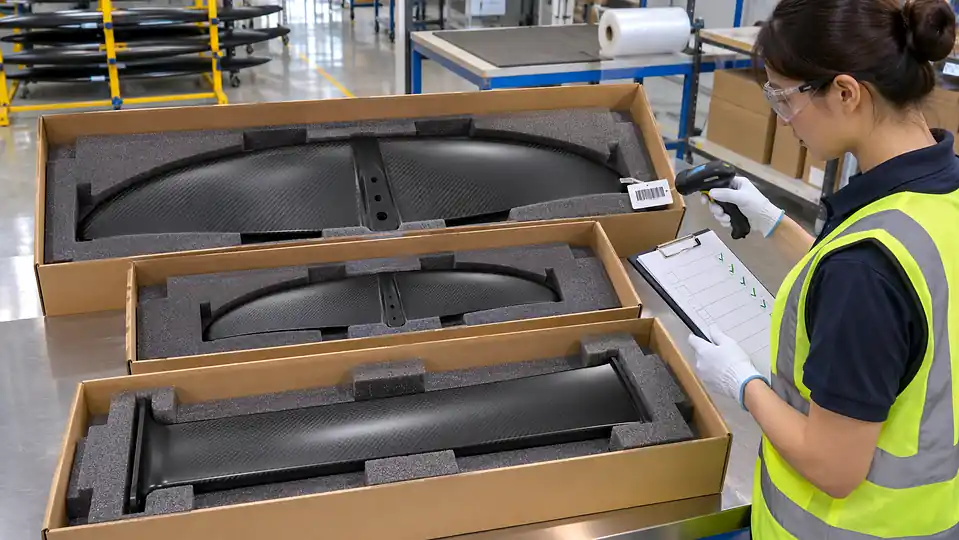
25. Can packaging and release records protect the approved product through delivery?
Why it matters: Thin trailing edges, wing tips, painted surfaces and precision interfaces can be damaged after final inspection.
Ask to see: packaging specification, trial pack, edge protection, hardware segregation, labeling, final release record and traceability to the shipped quantity. Red flag: packaging is decided only after production or different parts can contact each other in transit.
How to audit a hydrofoil manufacturer without being misled
- Choose one representative part. Follow its records end to end rather than touring every department superficially.
- Sample, do not accept a prepared example automatically. Ask for another completed batch, gauge or material lot and compare the system.
- Compare words, records and reality. A procedure, a completed record and the observed practice should agree.
- Separate capability from approval. Owning a scanner, press or test machine shows potential capability; a controlled method and acceptable results demonstrate project readiness.
- Close findings with evidence. A promise or revised procedure is not always enough; verify implementation where the risk warrants it.
For high-risk structural decisions, use qualified engineering and quality personnel and define project-specific acceptance criteria. This article is an OEM purchasing framework, not a certification standard and not a substitute for design validation.
Questions OEM buyers often ask
Is ISO 9001 certification enough to approve a hydrofoil manufacturer?
No. Certification can support confidence in a quality management system, but buyers should verify the certificate’s scope and assess the specific product, process, records and risks involved in their project.
Can a remote audit replace a factory visit?
When you audit a hydrofoil manufacturer remotely, a document review or live video audit can screen suppliers and close some findings. It may not reveal material handling, actual workflow, segregation, equipment condition or informal practices as effectively as an on-site visit. Match the audit depth to project risk and purchasing stage.
What is the biggest warning sign during a factory audit?
A serious warning sign is a break in the evidence chain: the supplier cannot connect the released requirement to the material lot, process record, inspection result and shipped part. This matters more than an untidy desk or an impressive showroom.
Should an audit demand confidential customer records?
No. The factory can demonstrate its controls with permissioned examples, redacted records, internal templates and the buyer’s own trial project. Respecting other customers’ confidentiality is itself useful evidence.
The decision is not simply pass or fail
A capable factory may be approved for one component family and not another, approved conditionally while major findings are closed, or limited to prototypes until production controls are demonstrated. Record the scope, products, processes, site and conditions of approval so that “approved supplier” does not become an unlimited label.
Keep the completed hydrofoil supplier audit checklist with the evidence reviewed, finding owners, due dates and closure records. Reassess the supplier when a critical material, process, subcontractor, production site or approved design baseline changes—not merely when a calendar reminder expires.
The best way to audit a hydrofoil manufacturer is to trace evidence across the complete product route and then verify that major findings are closed before tooling or production approval.
Most Unity Sports hydrofoil work involves OEM programs subject to customer confidentiality, so many production projects cannot be displayed publicly. Buyers are welcome to arrange a factory visit or contact Unity Sports to discuss the intended product, audit scope and specific project requirements.
Unity Sports manufactures composite hydrofoil components for brand projects and also supports broader custom carbon-fiber manufacturing. Bring the checklist, your drawings and your critical-to-quality requirements—the purpose of the audit is to replace assumptions with evidence before tooling and production commitments are made.