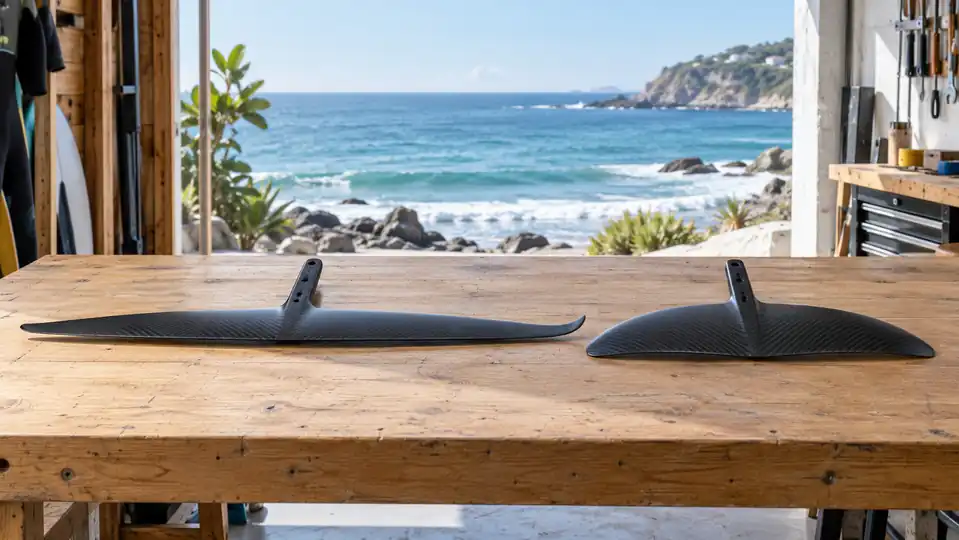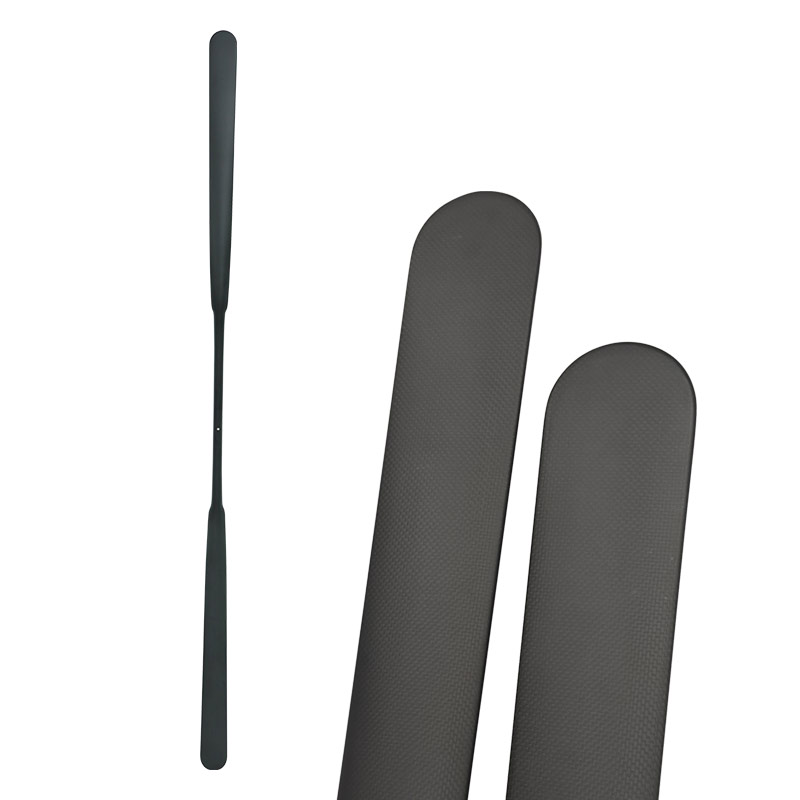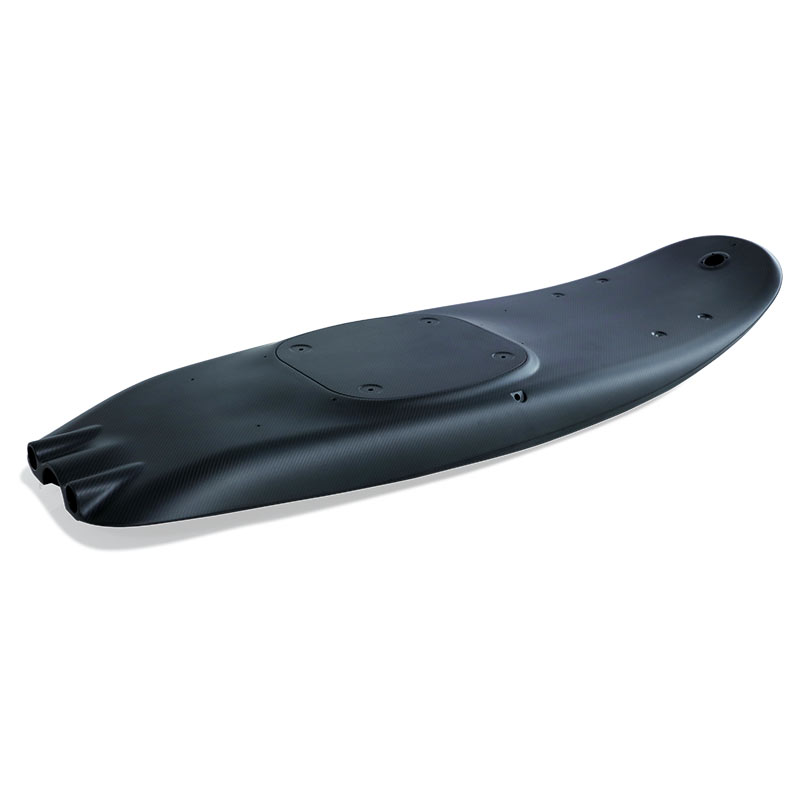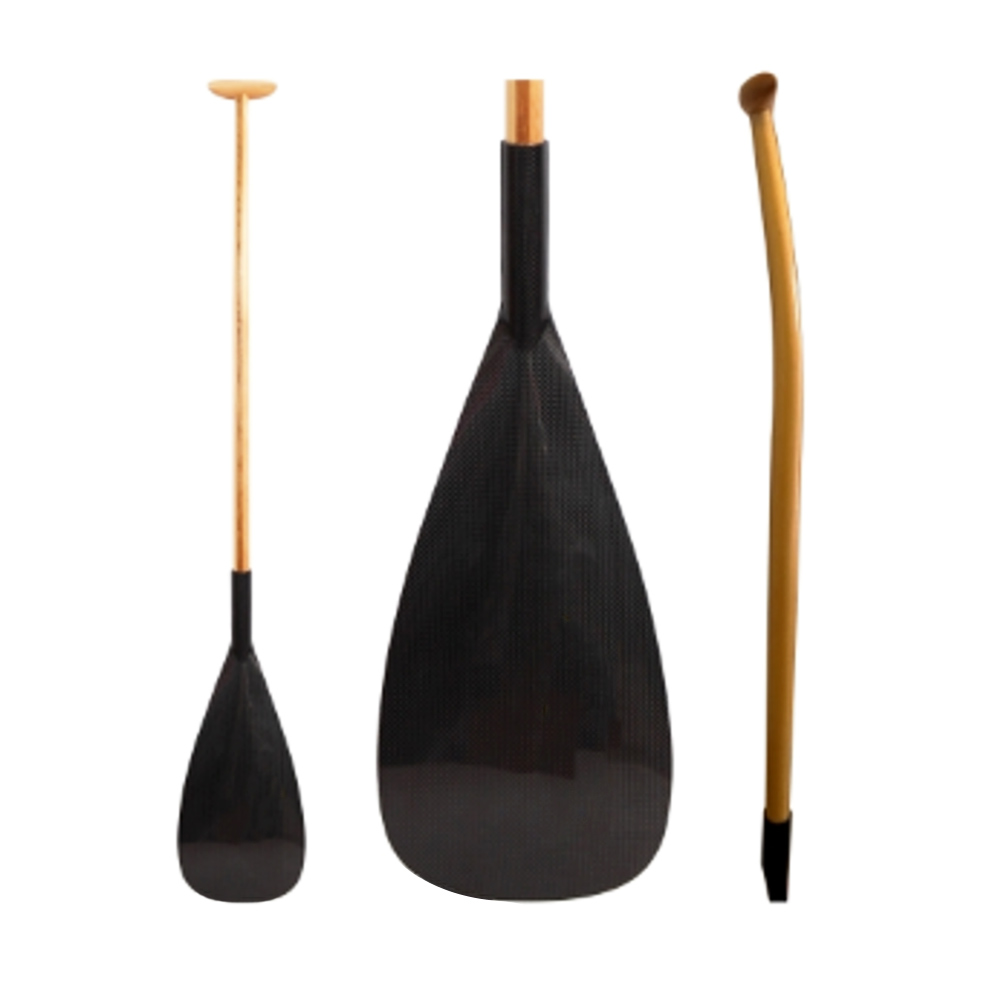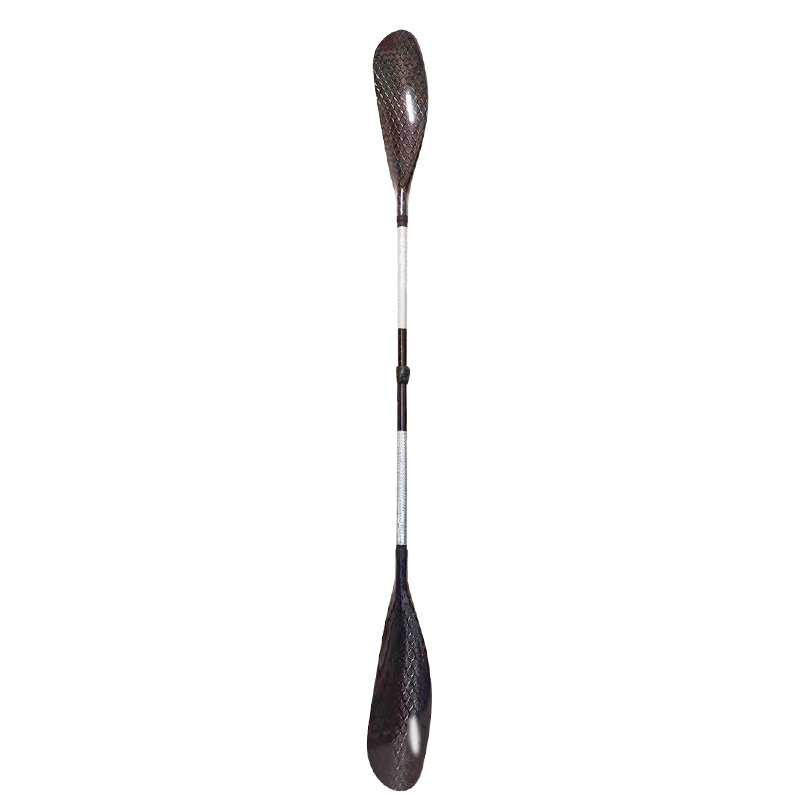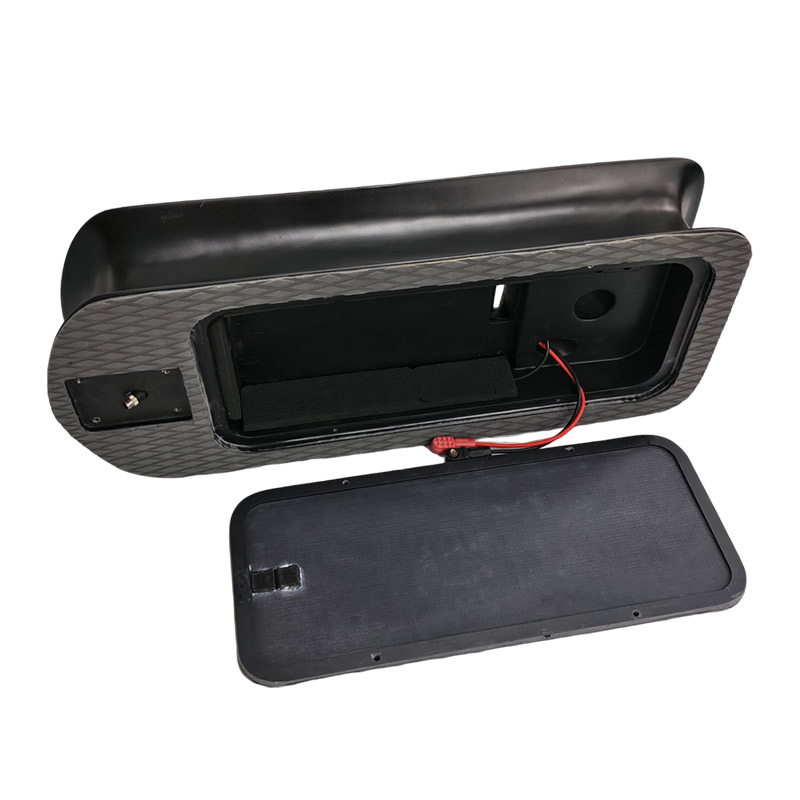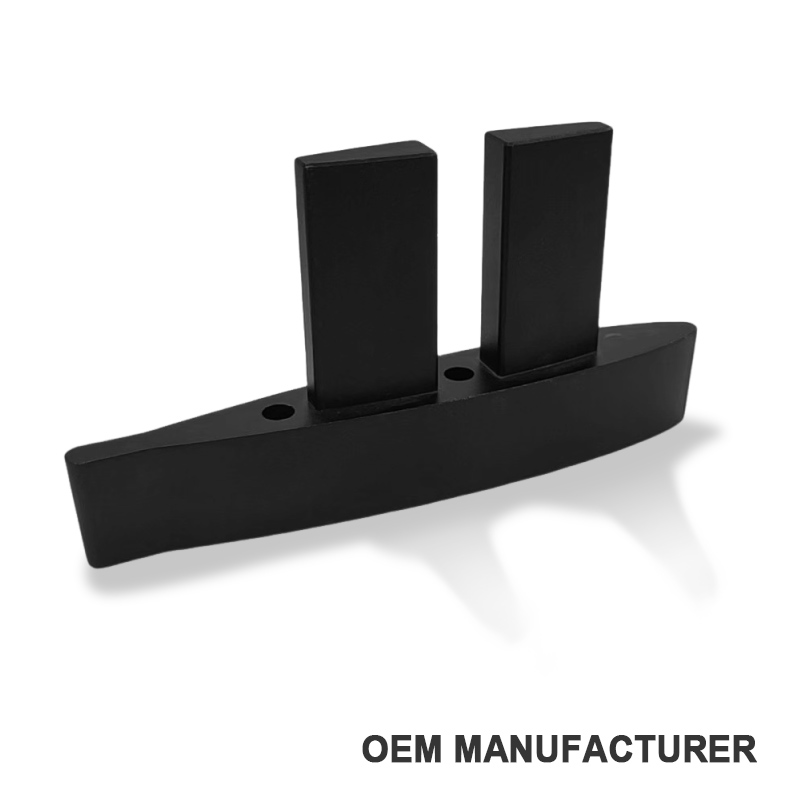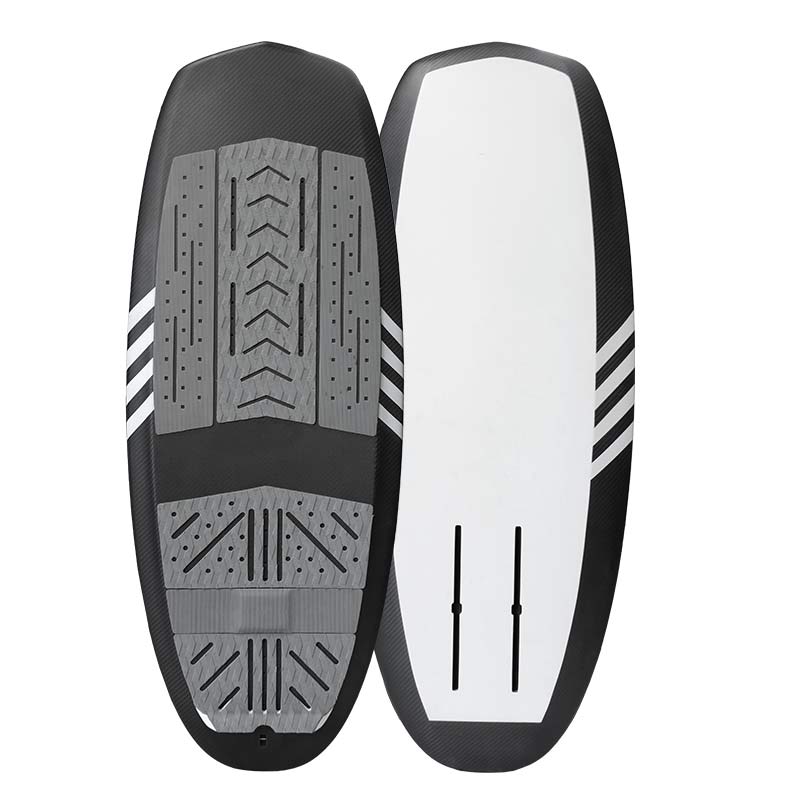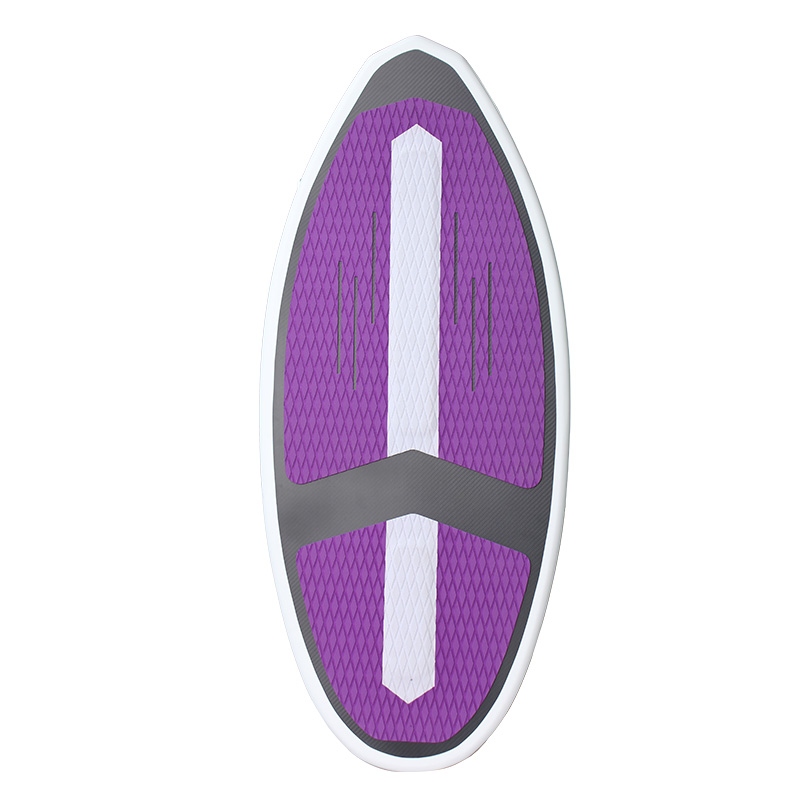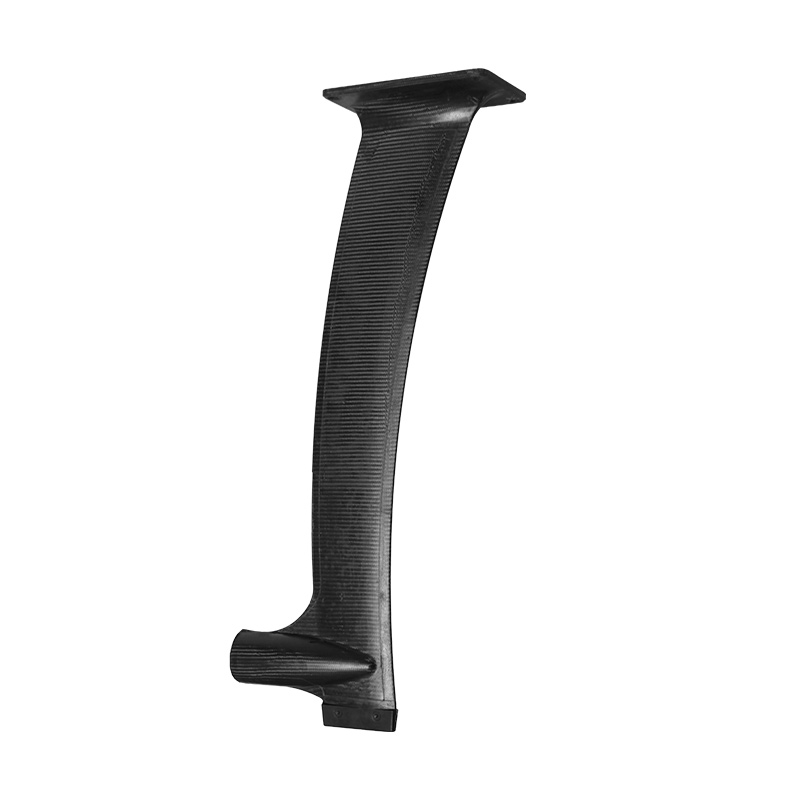
Water foil, more commonly known as hydrofoil or hydrofoiling in the water sports industry, is a technology that allows a board to rise above the surface of the water while the rider continues moving on an underwater wing system. Instead of relying on the board itself to generate most of the lift, a hydrofoil uses underwater wings to create hydrodynamic lift. Once enough speed is generated, the board lifts clear of the water, leaving the foil assembly below the surface.
Hydrofoil technology is now used across a wide range of water sports, including surf foil, prone foil, wing foil, kite foil, windsurf foil, wake foil, SUP foil, pump foil, and eFoil. While these disciplines differ in how they generate propulsion, they share the same basic principle: controlled water flow around a foil wing produces lift, while the rest of the foil system maintains stability and transfers loads between the rider and the underwater wings.
From a manufacturing perspective, a modern water foil is a highly engineered composite and metal structure rather than simply a board accessory. Front wings and rear wings can be manufactured from carbon fiber combined with lightweight wood or foam cores. The mast and fuselage can be produced from aluminum, titanium alloys, carbon fiber composites, or glass-fiber composites. Depending on the material and component design, manufacturing may involve CNC machining, anodizing, composite pultrusion, or hot compression molding.
This guide explains the history and working principles of water foils, the major types of foil sports, the structure of a hydrofoil system, the materials used in its construction, and the manufacturing technologies used to produce high-performance hydrofoil components.
What Is a Water Foil?
A water foil is an underwater lifting system designed to generate hydrodynamic lift as it moves through water. The basic concept is similar to an aircraft wing, but the working fluid is water rather than air.
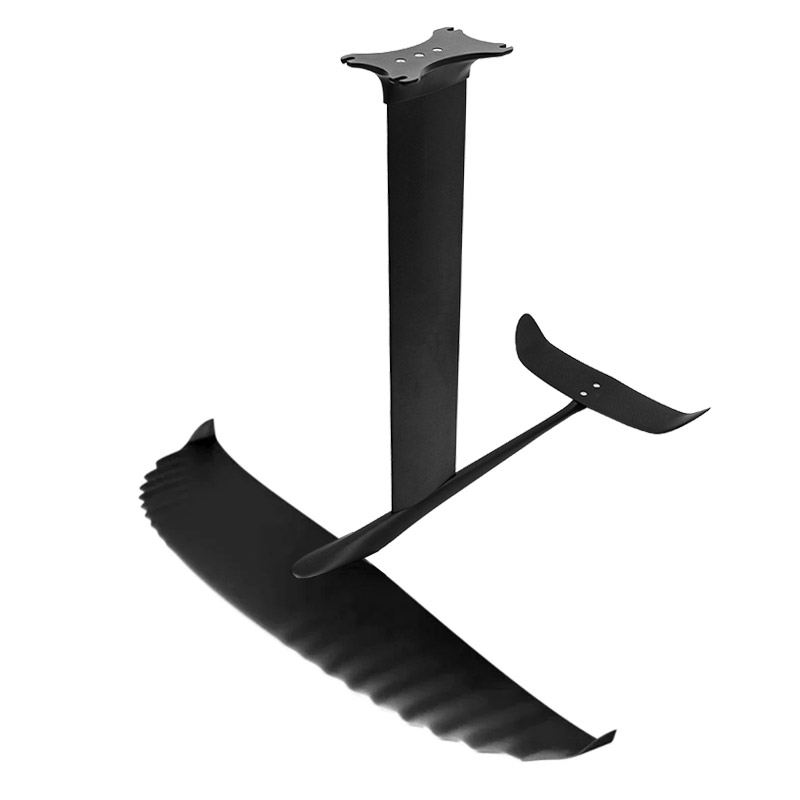
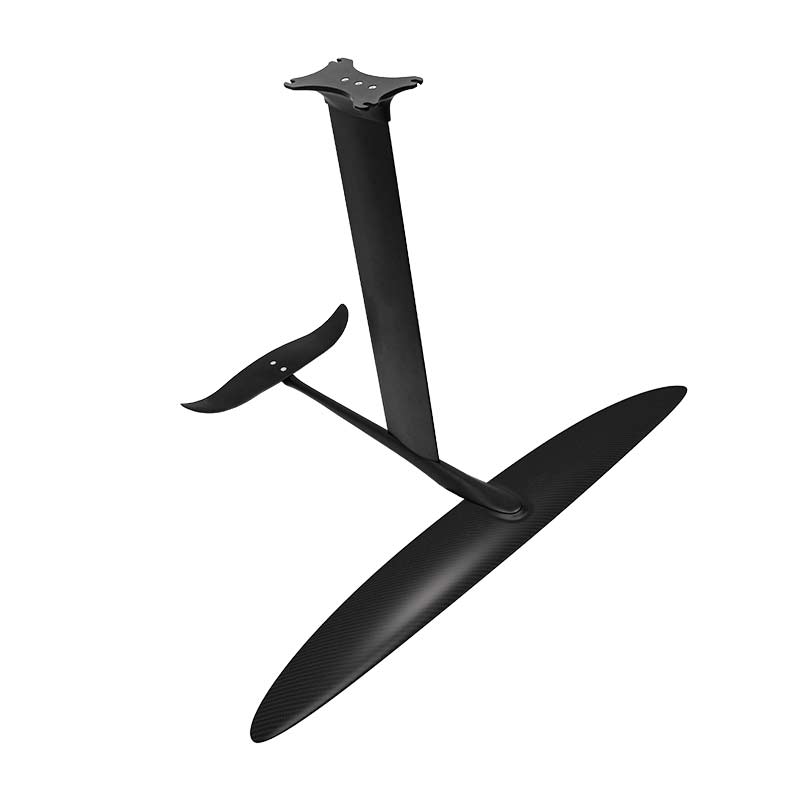
A typical water sports hydrofoil consists of four primary components: a front wing, a rear wing or stabilizer, a mast, and a fuselage. The mast connects the board to the underwater foil assembly, while the fuselage connects the front and rear wings. The front wing generates most of the lift, and the rear wing helps control pitch and stability.
As the foil moves through the water, the shape of the front wing changes the pressure and velocity of the surrounding water. This creates an upward force. When the generated lift becomes sufficient to support the rider and board, the board rises above the water.
This reduction in contact between the board and the water is one of the defining characteristics of hydrofoiling. A conventional board must continuously move its bottom surface through the water, creating substantial resistance. A hydrofoil board, once fully flying, has only the relatively narrow mast and underwater foil assembly interacting with the water. The result can be a smoother ride and significantly different acceleration, glide, and maneuverability characteristics.
Water Foil vs. Hydrofoil
The terms water foil and hydrofoil are often used to describe the same general technology in water sports. However, hydrofoil is the more widely established technical term within the industry.
A hydrofoil refers specifically to the underwater lifting structure. A hydrofoil board or foil board generally describes the board and foil equipment used together.
The word hydrofoil can also be combined with the specific discipline, such as surf foil, wing foil, kite foil, or eFoil. Although the equipment configurations differ, each uses a foil system to create lift and reduce the board’s direct interaction with the water.
A Brief History of Hydrofoil Technology
The idea of using underwater lifting surfaces to raise a vessel above the water is more than a century old. Early hydrofoil experiments appeared in the late 19th and early 20th centuries, long before hydrofoiling became a recreational water sport.
Italian inventor Enrico Forlanini developed an early ladder-type hydrofoil system in the late 1890s. Alexander Graham Bell and engineer Casey Baldwin later conducted important hydrofoil boat experiments in the early 20th century. Their work demonstrated that underwater lifting surfaces could be used to reduce the resistance of a vessel and achieve higher speeds.
During the following decades, hydrofoil technology was primarily associated with boats, military vessels, transportation, and experimental marine craft. The underlying principles were well established, but the technology had not yet become a mainstream personal water sport.
The development of personal hydrofoil equipment took place gradually. Hydrofoil systems began appearing in different forms of recreational water sports, including water skiing and specialized riding equipment. Later, hydrofoil concepts were adapted to surfing, kiteboarding, windsurfing, and other board sports.
The 2000s marked an important period for surf foiling. Riders and equipment designers demonstrated that a hydrofoil could use wave energy to generate sustained flight, opening up new possibilities for riding smaller swells and maintaining speed through sections of water where conventional surfboards would slow down.
During the 2010s, improvements in carbon fiber composites, computer-aided design, CNC machining, and foil manufacturing helped accelerate the development of modern hydrofoil equipment. Wing foiling, SUP foiling, downwind foiling, and other disciplines subsequently expanded the range of applications.
The emergence of electric propulsion created another major step in the evolution of the technology. eFoils use an electric motor, battery system, and electronic controls to provide propulsion without requiring wind, waves, or a tow vehicle.
Today, hydrofoiling is no longer limited to a single discipline. It has developed into a broad category of water sports with specialized foil geometries, boards, materials, and manufacturing methods for different riding conditions.

How Does a Water Foil Work?
The fundamental principle behind a water foil is the generation of hydrodynamic lift.
When a foil wing moves through water at an appropriate angle and speed, its shape causes the water flow around the wing to produce a pressure distribution that generates an upward force. This force is commonly described using the lift equation:
L = 1/2 ρV²SCL
Here, L represents lift, ρ represents water density, V represents the speed of the foil through the water, S represents wing area, and CL represents the lift coefficient.
The equation highlights several important relationships. Increasing speed can substantially increase lift because velocity is squared. Increasing wing area can also increase lift at a given speed. However, larger wings generally introduce additional drag, so hydrofoil design is always a balance between lift, efficiency, speed, stability, and maneuverability.
Front Wing Lift
The front wing is the primary lifting surface of the hydrofoil. Its area, thickness, profile, aspect ratio, and planform all influence the amount of lift generated and the speed at which that lift becomes useful.
A larger front wing generally provides more lift at lower speeds. This can be useful for riders who need earlier takeoff or for disciplines where available propulsion is relatively limited.
A smaller front wing typically requires more speed to generate sufficient lift but can provide different handling and speed characteristics once the foil is flying.
The correct wing size therefore depends on much more than rider preference. Rider weight, board design, propulsion source, water conditions, target speed, and riding discipline all influence the appropriate foil configuration.
Drag and Hydrofoil Efficiency
Lift is only one part of hydrofoil performance. Drag is equally important.
A foil moving through water experiences several forms of resistance, including profile drag and induced drag. Induced drag is associated with the generation of lift and the finite span of a wing.
This is one reason aspect ratio is important in foil design.
Aspect ratio is calculated as:
AR = b² / S
where b is wing span and S is wing area.
A higher-aspect-ratio wing has a relatively long span and narrow chord. Under comparable operating conditions, higher aspect ratio can reduce induced drag and improve aerodynamic or hydrodynamic efficiency. However, it does not automatically make a foil better for every application.
High-aspect-ratio foils can have different requirements for structural stiffness, turning behavior, low-speed performance, and rider control. A foil designed for racing or long-distance glide may therefore have very different geometry from a foil intended for beginner wing foiling or aggressive surf maneuvers.
Angle of Attack
The angle of attack is the angle between the foil section and the incoming water flow.
Within an appropriate operating range, increasing angle of attack generally increases lift. However, if the angle becomes excessive, the water flow can separate from the foil surface, causing a loss of efficiency and potentially a sudden reduction in lift.
For riders, this relationship is experienced through changes in board pitch and foil height. Small movements of the rider’s body can change the attitude of the board and therefore alter the foil’s operating angle.
This is why hydrofoil riding requires precise control. The rider, board, mast, fuselage, front wing, and rear wing function as a single system rather than as independent components.
Main Components of a Water Sports Hydrofoil
Although foil designs vary between disciplines, most modern water sports hydrofoils share several fundamental components.
The main structural components are the front wing, rear wing, mast, and fuselage.
Each component has a different role, and each may require a different material and manufacturing process.
Front Wing
The front wing is the primary lifting component of the hydrofoil.
Its geometry determines a large part of the foil’s performance characteristics. Important design parameters include wing area, span, aspect ratio, thickness, foil section, sweep, and overall planform.
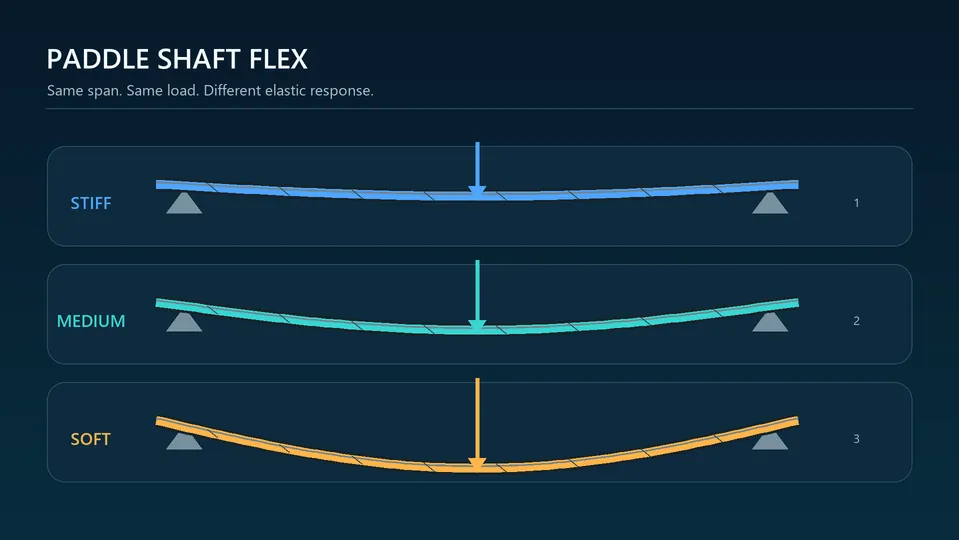
The front wing must be sufficiently stiff to maintain its designed geometry under load. Excessive bending or twisting can change the effective foil shape during riding and affect handling and efficiency.
For this reason, carbon fiber composites are widely used in high-performance front wings.
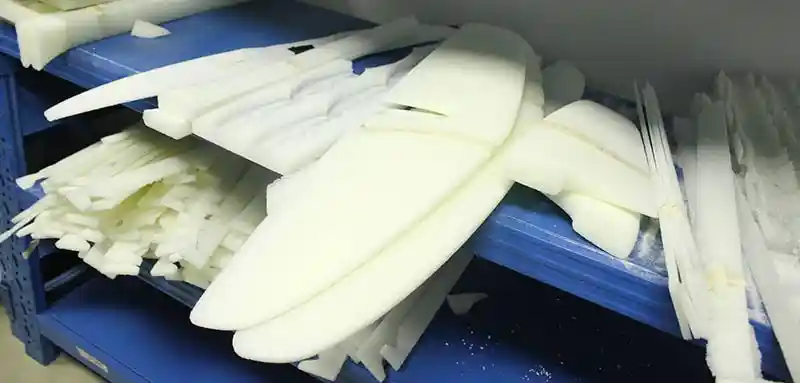
A composite front wing can be constructed using carbon fiber skins combined with a lightweight core. Common core options include Paulownia wood and foam core materials.
The sandwich construction provides structural thickness while keeping the overall component relatively light. The carbon fiber carries a large portion of the structural load, while the core helps maintain the distance between the skins and contributes to the stiffness of the overall structure.
Rear Wing
The rear wing, also called the stabilizer, is smaller than the front wing and works together with it to control the pitch behavior and stability of the foil system.
Although the rear wing generates less lift than the front wing, its geometry has a significant influence on how the foil feels during acceleration, turning, pumping, and high-speed riding.
Like the front wing, the rear wing can be manufactured using carbon fiber combined with a lightweight core. Paulownia wood and various foam cores can be selected according to the structural requirements, weight targets, and intended application.
The front wing and rear wing should therefore be considered as a matched hydrodynamic system rather than two completely independent parts.
Mast
The mast is the vertical component connecting the board to the underwater foil assembly.
In the water sports hydrofoil industry, the mast is commonly referred to as the mast component of the foil system. It transfers loads between the board and the underwater wings and determines the depth at which the water foil operates.
Masts can be manufactured using different material systems, including aluminum, titanium alloys, carbon fiber composites, and glass-fiber composites.
Metal and composite masts require substantially different manufacturing approaches.
Aluminum masts may involve aluminum forming or extrusion, precision machining, and anodizing. Composite masts can be manufactured using processes such as composite pultrusion or hot compression molding, depending on the structure and design.
The selection of material affects weight, stiffness, corrosion resistance, manufacturing cost, and overall riding characteristics.
Fuselage
The fuselage is the horizontal structural component that connects the front wing, rear wing, and mast.
In water sports hydrofoil terminology, the fuselage is commonly referred to as the fuselage or top connection component within the foil assembly.
Its geometry determines the relative position of the front wing and rear stabilizer and therefore contributes to the pitch stability and handling characteristics of the complete foil.
Fuselages can be produced from aluminum, titanium alloys, carbon fiber composites, or glass-fiber composites.
Metal fuselages typically require precision machining, particularly around the interfaces connecting the mast, front wing, and rear wing. Aluminum components can also receive anodizing after machining to improve surface durability and corrosion resistance.
Composite fuselages require a different structural approach because the fiber orientation and laminate design must be considered according to the expected bending and torsional loads.
Types of Water Foil Sports
Water foiling has developed into several distinct disciplines. The easiest way to understand the differences is to classify them according to their primary source of propulsion.
The main categories include wave-powered foiling, wind-powered foiling, wake- and tow-powered foiling, electrically powered foiling, and human-powered foiling.
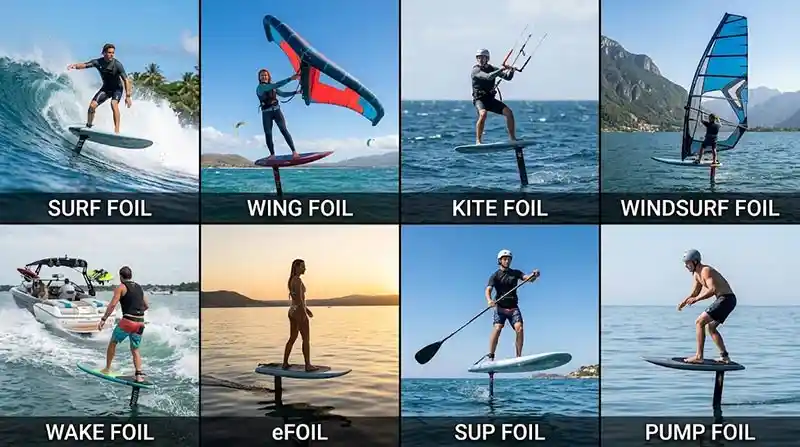
| Foil Discipline | Primary Propulsion | Typical Characteristics |
|---|---|---|
| Surf Foil | Waves | Wave-powered foil riding |
| Prone Foil | Waves and paddling | Compact board and efficient takeoff |
| Downwind Foil | Swell and wind-generated bumps | Long-distance glide and pumping |
| Wing Foil | Wind | Handheld wing and foil board |
| Kite Foil | Wind | Kite-powered high-efficiency riding |
| Windsurf Foil | Wind | Sail-powered foil riding |
| Wake Foil | Boat wake or tow | Riding behind a boat |
| eFoil | Electric motor | Independent powered foiling |
| SUP Foil | Paddle, waves, or swell | Stand-up paddle foiling |
| Pump Foil | Rider movement | Human-powered pumping |
Wave-Powered Water Foiling
Surf Foil
Surf foil is one of the most recognizable forms of wave-powered hydrofoiling.
Instead of riding directly on the surface of a breaking wave, the rider uses the wave’s energy to accelerate the board and foil. Once the foil generates sufficient lift, the board rises above the water and the rider continues moving on the underwater wing system.
Surf foiling allows riders to use wave energy differently from conventional surfing. A hydrofoil can continue generating lift and forward motion while traveling through sections where a traditional surfboard may lose speed.
Foil selection is particularly important in surf foiling. A larger front wing can provide earlier lift at lower speeds, while a smaller or higher-aspect-ratio wing can prioritize speed and maneuverability for more advanced applications.
Prone Foil
Prone foiling begins with the rider lying on a compact foil board and paddling into a wave or swell.
Once sufficient speed is reached, the rider stands and transfers onto the foil. After takeoff, pumping and body movement can help maintain speed and extend the ride.
Prone foil boards are generally designed around low weight, compact dimensions, efficient paddling, and rapid foil takeoff. Because the rider cannot rely on a large board to provide stability during takeoff, the relationship between board design and foil characteristics becomes particularly important.
Downwind Foil
Downwind foiling uses wind-generated bumps, ocean swell, or moving water to create the energy required for takeoff and sustained flight.
Once the foil is flying, an efficient foil can maintain speed over relatively long distances. This makes glide performance particularly important.
High-aspect-ratio front wings are commonly associated with this type of riding because of their potential for efficient glide and reduced induced drag. However, the foil must also provide sufficient control and structural stiffness for the conditions in which it will be used.
Wind-Powered Water Foiling
Wing Foil
Wing foil combines a handheld wing with a foil-equipped board.
The rider holds the wing directly rather than connecting it to the board with a rigid mast or boom. Wind flowing through the wing generates forward force, while the hydrofoil converts the resulting board speed into lift.
Wing foil has become one of the most versatile foil disciplines because the same basic equipment concept can be used for cruising, freeride riding, jumping, wave riding, and racing.
The foil itself must be matched to the rider’s weight, wing size, board characteristics, wind conditions, and intended riding style.
For manufacturers, this creates a wide range of potential foil specifications. A beginner-oriented foil may prioritize low-speed lift and stability, while an advanced wing foil system may prioritize efficiency, reduced drag, maneuverability, and high-speed control.
Kite Foil
Kite foil uses a traction kite to provide propulsion.
The kite generates the forward force while the hydrofoil creates lift and reduces the board’s interaction with the water. Once the foil reaches sufficient speed, the rider can travel efficiently with relatively little board drag.
Kite foil equipment often emphasizes efficiency and glide. Foil area, aspect ratio, fuselage geometry, mast stiffness, and board dimensions are selected according to wind strength, kite size, rider weight, and riding objectives.
Windsurf Foil
Windsurf foil combines a traditional windsurfing sail with a hydrofoil system.
The sail supplies propulsion while the foil lifts the board above the water. Once the board is flying, the reduced water contact changes the balance and handling characteristics compared with conventional windsurfing.
A windsurf foil therefore needs to provide sufficient structural stiffness to handle the combined loads generated by the sail, rider, board, and underwater foil. Click to see 6 points about windsurf foiling.
Para Wing Foil
Para wing foiling uses a lightweight parafoil-style wing as the propulsion source.
The concept sits between several established forms of wind-powered foiling, combining the compact handling characteristics of a handheld wing with characteristics associated with soft kite or parafoil systems.
The foil remains the primary underwater lifting system, while the para wing supplies the energy required to reach and maintain flight. For more guidance about parawing foiling.
Wake- and Tow-Powered Water Foiling
Wake Foil
Wake foil uses the energy generated by a moving boat.
Instead of relying on wind or breaking waves, the rider follows the wake and uses the available water movement to accelerate the hydrofoil. Once sufficient speed is achieved, the board rises above the water.
Wake foiling places particular demands on acceleration, stability, and low-to-medium-speed foil performance. The appropriate front wing and stabilizer combination depends on the wake characteristics, boat speed, rider weight, and intended riding style.
Tow Foil
Tow foiling uses a boat, personal watercraft, or other towing system to provide the initial acceleration required for takeoff.
Because the tow vehicle supplies the propulsion, the rider can focus on foil control and riding technique. This approach is also useful for testing foil performance under controlled conditions.
Different tow foil applications may require very different wing sizes and geometries. High-speed towing generally favors smaller, efficient wings, while lower-speed applications may require greater lifting area.
Electrically Powered Water Foiling
eFoil
eFoil is an electrically powered form of hydrofoiling.
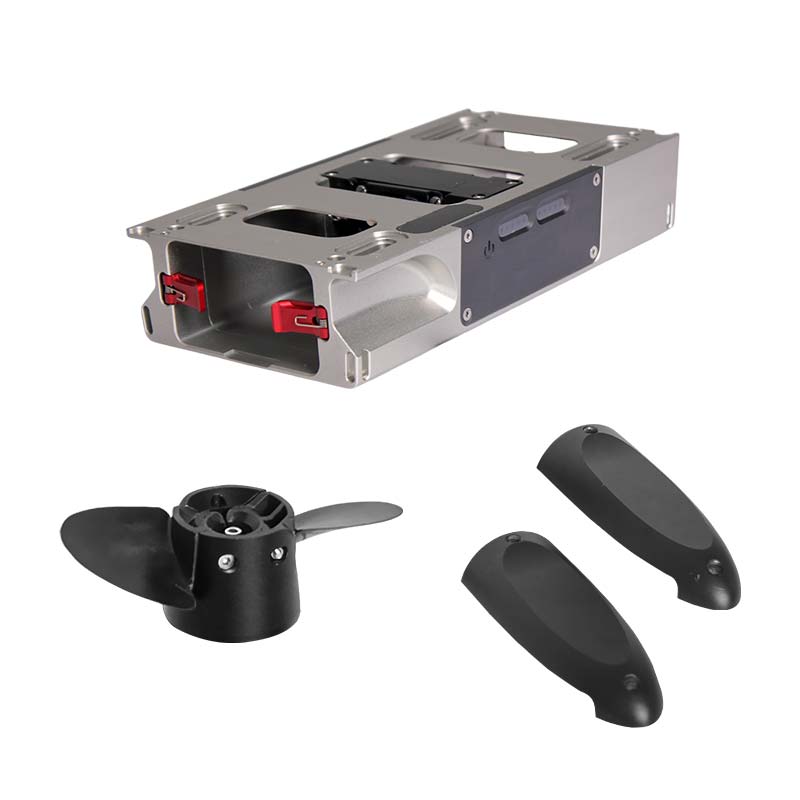
An eFoil typically integrates an electric motor, propeller, battery system, electronic speed controller, and handheld control system into a foil-equipped board.
The electric propulsion system provides the speed needed for the hydrofoil to generate lift. This means an eFoil does not require wind, breaking waves, or a tow vehicle.
However, the basic hydrofoil principles remain the same. The front wing still generates hydrodynamic lift, the rear wing contributes to stability, and the mast and fuselage transfer structural loads through the foil system.
Because propulsion is supplied independently of environmental conditions, eFoil systems require careful integration of structural, electrical, thermal, and hydrodynamic design.
Human-Powered Water Foiling
SUP Foil
SUP foil combines stand-up paddleboarding with hydrofoil technology.
The paddle provides propulsion during the initial acceleration phase, while waves, swell, or other moving-water conditions can provide additional energy for sustained foiling.
SUP foil boards are generally designed with enough volume and stability for the rider to paddle and stand effectively. However, advanced equipment can become smaller and lower in volume as rider skill improves.
The foil itself must provide an appropriate balance between lift, stability, glide, and maneuverability.
Pump Foil
Pump foil relies primarily on the rider’s body movement to maintain and generate foil speed.
Instead of continuously relying on wind, waves, a kite, or an electric motor, the rider uses controlled changes in board pitch and vertical movement to generate pumping motion through the foil.
Pump foiling places strong demands on foil efficiency and control. A foil with suitable lift characteristics can help the rider maintain flight while using repeated pumping movements to conserve and regenerate speed.
For this reason, pump foil equipment is often designed around efficient glide, predictable pitch response, and low drag.
Related Post: 13 Most Common Pump Foil Mistakes
How Different Water Foil Disciplines Influence Hydrofoil Design
Although all of these sports use the same basic hydrofoil principle, they do not require identical foil systems.
A surf foil needs predictable lift and maneuverability at wave speeds. A racing foil may prioritize low drag and high-speed efficiency. A wing foil setup needs a balance between early takeoff and maneuverability. An eFoil requires the foil to work together with an electric propulsion system.
This means there is no single “best” hydrofoil design.
Instead, the foil geometry, material system, board configuration, and manufacturing process must be developed around the intended application.
This is also why hydrofoil manufacturing requires more than simply producing a lightweight carbon fiber part. The front wing, rear wing, mast, and fuselage must work together as a structurally and hydrodynamically integrated system.
Hydrofoil Materials: Carbon Fiber, Wood Core, Foam Core, Aluminum, and Titanium
Material selection plays a major role in hydrofoil performance. A foil must be light enough to handle efficiently, but it also needs sufficient stiffness and strength to maintain its designed geometry under repeated loading.
The requirements are particularly demanding for the front wing and mast. The front wing needs to maintain its hydrodynamic profile while generating lift, whereas the mast is exposed to bending and torsional loads between the board and the underwater foil assembly.
For this reason, manufacturers typically select different materials for different components rather than building the entire foil from one material.
Carbon fiber composites are widely used for performance-oriented front wings, rear wings, masts, and fuselages. Lightweight wood and foam cores can be combined with carbon fiber skins to create stiff sandwich structures. Aluminum and titanium alloys provide alternative solutions for metal components, particularly where machining, durability, modularity, or cost are important considerations.
Carbon Fiber for Hydrofoil Components
Carbon fiber is one of the most important materials in high-performance hydrofoil manufacturing because of its high stiffness-to-weight ratio.
A hydrofoil does not simply need to be strong. It also needs to maintain a precise shape under load. Any significant deformation of the front wing can change its hydrodynamic characteristics, while excessive bending or twisting of the mast can affect control and handling.
Carbon fiber composites allow manufacturers to control stiffness through fiber type, fiber orientation, laminate thickness, resin system, and structural geometry.
For example, unidirectional carbon fiber can be oriented along the primary load direction, while ±45-degree reinforcement can contribute to resistance against shear and torsional loads. Woven carbon fiber can also be used where balanced reinforcement and surface characteristics are required.
The final performance therefore depends not only on the carbon fiber itself but on the complete laminate design.
Why Carbon Fiber Is Used in Hydrofoil Wings
Carbon fiber is particularly suitable for hydrofoil wings because the material can provide high structural stiffness without requiring excessive mass.
A front wing must resist bending while maintaining its designed foil section. It must also withstand repeated loading as the rider accelerates, turns, jumps, lands, or encounters changing water conditions.
Using carbon fiber as the primary reinforcement allows engineers to place material where it contributes most effectively to structural performance.
However, a high-quality carbon fiber hydrofoil is not simply a thicker carbon fiber component. Excessive laminate thickness can increase weight without producing the most efficient structural solution. Proper fiber orientation, core selection, geometry, and curing conditions are all important.
Core Materials for Hydrofoil Wings
Many composite hydrofoil wings use a sandwich structure rather than a solid laminate.
A typical construction consists of carbon fiber skins on the outside and a lightweight core between them.
The core can be made from different materials depending on the required mechanical properties, weight target, manufacturing method, and product positioning.
Two important categories are wood core and foam core.
Paulownia Wood Core
Paulownia wood is a lightweight natural material that can be used as a core in composite hydrofoil wings.
Its relatively low density makes it attractive for lightweight sandwich construction. When combined with carbon fiber skins, the wood core provides structural thickness while keeping the overall component weight under control.
The use of Paulownia also requires appropriate preparation and processing. The core needs to be accurately shaped to follow the geometry of the wing and properly integrated with the surrounding composite structure.
The final performance depends on the complete sandwich construction rather than the core material alone.
Foam Core
Foam cores are another common option for composite hydrofoil wings.
Depending on the application, manufacturers can select different structural foam systems according to density, compressive strength, resin compatibility, water resistance, temperature resistance, and processing requirements.
A foam core can provide a consistent lightweight structure and can be machined or shaped to match complex wing geometry.
The choice between wood and foam is not simply a question of which material is lighter. Core properties, manufacturing requirements, bonding conditions, impact resistance, structural loads, and target production volume all need to be considered.
Carbon Fiber Skin and Core Construction
The combination of carbon fiber skins and a lightweight core creates a sandwich structure.
The basic concept is simple: the outer skins carry much of the tensile and compressive loading, while the core maintains separation between the skins and contributes to the overall stiffness of the structure.
Increasing the structural depth of a component can significantly improve its resistance to bending without requiring the entire volume to be filled with dense composite material.
This approach is particularly useful for hydrofoil wings because the component needs to be both lightweight and sufficiently stiff to preserve its hydrodynamic shape.
The design of the laminate around the core is therefore critical. Fiber orientation, skin thickness, core thickness, local reinforcement, and connection areas all need to be considered during product development.
Aluminum Hydrofoil Components
Aluminum is widely used in water sports hydrofoil systems because it provides a practical combination of strength, machinability, durability, and manufacturing cost.
Aluminum components are particularly suitable for applications where precision-machined interfaces are required.
For hydrofoil systems, aluminum can be used for the mast, fuselage, mounting structures, and other metal components.
Unlike carbon fiber composite parts, aluminum components can be manufactured through conventional metalworking processes such as extrusion and CNC machining.
Aluminum Mast Manufacturing
An aluminum mast can begin with an aluminum extrusion or other suitable semi-finished material, depending on the design.
The material is then processed to achieve the required profile and dimensions. Critical connection areas may require CNC machining to produce accurate interfaces and mounting features.
After machining, anodizing can be applied to aluminum surfaces.
Anodizing creates a controlled oxide layer on the aluminum surface and can improve surface durability and corrosion resistance. It can also provide a consistent finished appearance.
For a hydrofoil mast, dimensional accuracy is particularly important because the mast connects the board to the underwater foil assembly. The mounting interface must work correctly with the board and fuselage while maintaining the required alignment.
CNC Machining for Aluminum Hydrofoil Components
CNC machining is commonly used for aluminum hydrofoil components that require precise dimensions and interfaces.
For example, a fuselage may require accurately machined areas for:
- Front wing connection
- Rear wing connection
- Mast connection
- Fastener holes
- Mounting interfaces
- Alignment features
The machining process converts the original aluminum material into a component with the required geometry and tolerances.
Compared with manually produced metal parts, CNC machining provides a more repeatable manufacturing process, which is particularly valuable when components need to be interchangeable.
For OEM and ODM production, repeatability is just as important as the dimensional accuracy of an individual part. A production system must be capable of producing multiple components that consistently fit the same board, mast, front wing, and rear wing interfaces.
Aluminum Anodizing
After CNC machining, aluminum components can be anodized.
Anodizing is an electrochemical surface treatment rather than a conventional paint coating. It modifies the surface of the aluminum and can improve resistance to wear and corrosion.
This is particularly relevant for water sports equipment because hydrofoil components are repeatedly exposed to water, moisture, salt, and mechanical handling.
Proper surface preparation before anodizing is also important. The final appearance and surface quality depend on the machining condition, cleaning process, anodizing parameters, and subsequent handling.
Titanium Hydrofoil Components
Titanium alloys provide another option for hydrofoil components where high strength, corrosion resistance, and long-term durability are important.
Titanium is significantly more expensive and generally more difficult to machine than aluminum, but its material characteristics can make it attractive for selected high-performance or highly loaded components.
Titanium can be used in structural hydrofoil components and connection hardware where its mechanical and corrosion-resistant properties justify the additional material and machining cost.
Because titanium requires different cutting parameters and tooling considerations from aluminum, CNC machining of titanium components requires appropriate process control.
For water sports applications, titanium can be particularly useful where long-term exposure to marine environments is a major consideration.
Composite Mast Manufacturing
Carbon fiber and glass-fiber composites provide an alternative to metal masts.
The main advantage of a composite mast is the ability to engineer the stiffness and strength through fiber orientation and laminate design rather than relying solely on the properties of an isotropic metal material.
For a composite mast, the fiber direction can be designed around the expected load paths.
Longitudinal reinforcement can contribute to bending stiffness, while angled reinforcement can improve resistance to torsional loads.
The resulting structure can be optimized for weight, stiffness, and riding characteristics.
Depending on the design, composite mast manufacturing can involve processes such as pultrusion or hot compression molding.
Composite Pultrusion
Pultrusion is a continuous composite manufacturing process in which continuous reinforcement fibers are pulled through a resin system and then through a heated forming die.
The process is particularly suitable for long components with a relatively consistent cross-sectional geometry.
Carbon fiber and glass fiber can both be used in pultruded composite structures.
For hydrofoil applications, the suitability of pultrusion depends on the mast design and required cross-sectional geometry. A pultruded profile can provide consistent fiber alignment and repeatable production, while additional machining or secondary processing may be required for connection areas.
Pultrusion should not be confused with aluminum extrusion. Aluminum extrusion is a metal forming process, whereas composite pultrusion uses continuous reinforcement fibers and a polymer resin system to create a composite profile.
Hot Compression Molding for Carbon Fiber Hydrofoils
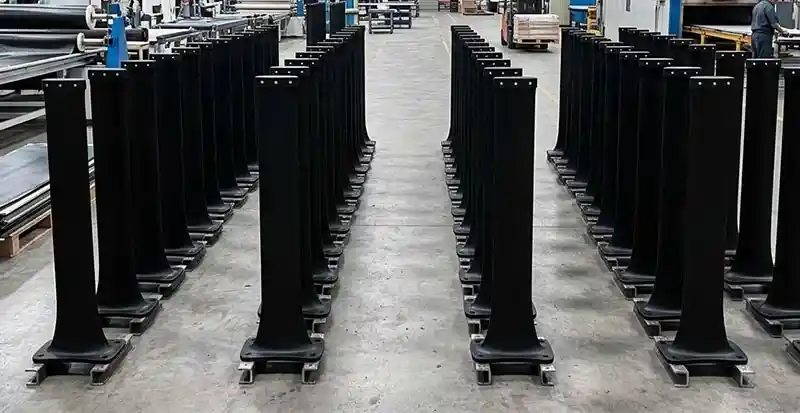
Hot compression molding is one of the key manufacturing processes for carbon fiber composite hydrofoil components.
It is particularly suitable for front wings, rear wings, and certain composite mast or fuselage structures where a controlled shape, repeatable production, and high structural consistency are required.
Unlike a typical autoclave process, compression molding uses a matched mold system. The composite material is placed between the two mold surfaces, and the molds close around the material during processing.
Heat and pressure are then applied according to the requirements of the composite material system.
How Hot Compression Molding Works
A typical carbon fiber hydrofoil compression molding process can include the following stages:
- Material preparation
- Carbon fiber cutting
- Core preparation
- Ply positioning and layup
- Mold preparation
- Material loading
- Mold closing
- Heating and pressure application
- Composite curing
- Demolding
- Trimming and finishing
- Dimensional inspection
Each stage contributes to the consistency of the final component.
The fiber orientation must be controlled during layup, while the core needs to be accurately positioned within the composite structure. The mold must also maintain the required geometry during curing.
Does Compression Molding Require Vacuum Bagging?
No. Conventional matched-mold compression molding does not inherently require vacuum bagging.
This distinction is important because compression molding and autoclave curing use different process configurations.
In compression molding, the composite charge or layup is placed between matched mold surfaces. When the mold closes, mechanical pressure is applied directly through the mold. The two mold surfaces provide the enclosed forming environment required to consolidate the material.
An autoclave process is different. A typical prepreg autoclave setup uses a single-sided mold, with the laminate covered by a vacuum bag. Vacuum is applied through the bagging system, and the entire assembly is then subjected to controlled temperature and external pressure inside the autoclave.
Therefore, the two processes should not be described as if they were interchangeable:
Compression molding: matched molds + heat + mechanical pressure
Autoclave molding: typically single-sided mold + vacuum bagging + vacuum + autoclave pressure + heat
The absence of vacuum bagging in compression molding does not mean that the process is uncontrolled. Mold pressure, temperature, material charge, fiber orientation, curing parameters, and tooling accuracy all need to be carefully controlled.
Carbon Fiber Hydrofoil Wing Manufacturing Process
For a carbon fiber front wing or rear wing using a core material, manufacturing begins with material preparation and continues through molding, trimming, finishing, and inspection.
Carbon Fiber Cutting
Carbon fiber material must first be prepared according to the component design.
Different plies may have different shapes and fiber orientations. Automated cutting equipment can be used to produce repeatable ply shapes while minimizing material waste.
Accurate cutting is important because even relatively small deviations in ply shape or orientation can affect the final laminate.
For production manufacturers, automated cutting also improves repeatability across multiple production batches.
Core Preparation
The selected core material is shaped according to the internal geometry of the front wing or rear wing.
For Paulownia wood cores, machining and shaping must produce the required thickness and contours while maintaining the integrity of the material.
For foam cores, CNC machining or other shaping processes can be used depending on the material and geometry.
The core must fit accurately within the surrounding carbon fiber structure.
Carbon Fiber Layup
The prepared carbon fiber plies are positioned according to the laminate design.
Fiber orientation is one of the most important aspects of composite manufacturing. Different orientations provide different structural characteristics.
For example:
- 0-degree fibers primarily support loads along their length.
- 90-degree fibers provide transverse reinforcement.
- ±45-degree fibers contribute significantly to shear and torsional performance.
The actual layup schedule depends on the component design and expected load conditions.
A professional composite manufacturer does not simply add more carbon fiber to increase strength. The objective is to place the correct reinforcement in the correct location while controlling weight and maintaining the required structural performance.
Mold Closing and Curing
After the carbon fiber and core materials have been positioned, the layup is placed into the matched mold.
The mold closes and applies pressure to the composite structure.
Heat activates the resin curing system, while pressure consolidates the material against the mold surfaces.
The temperature, pressure, and curing time must be controlled according to the selected material system and tooling requirements.
Once curing is complete, the mold is opened and the component is removed.
Trimming and Finishing
After demolding, excess composite material may remain around the edges of the component.
These areas are trimmed to achieve the required final dimensions.
Additional machining or finishing may be required around mounting and connection areas.
Surface finishing is also important for hydrofoil wings because the surface condition can influence hydrodynamic performance.
A consistent surface helps the finished foil maintain the intended geometry and appearance.
Manufacturing Carbon Fiber Masts and Fuselages
The manufacturing process for carbon fiber masts and fuselages differs from that of carbon fiber wings because these components have different load paths and structural requirements.
A mast must resist bending and torsion while transferring loads between the board and underwater foil assembly.
A fuselage must maintain accurate relationships between the front wing, rear wing, and mast connections.
For both components, fiber orientation and local reinforcement around connection areas are particularly important.
Hot compression molding can be used for suitable composite mast and fuselage designs. The matched mold provides the external geometry while heat and pressure consolidate and cure the composite structure.
After molding, secondary machining may be required to achieve precise mounting interfaces.
This combination of composite molding and precision machining allows manufacturers to take advantage of the weight and stiffness characteristics of carbon fiber while maintaining accurate mechanical connections.
Carbon Fiber vs. Aluminum Hydrofoil Components
Carbon fiber and aluminum are not simply competing materials. They offer different advantages and are often selected according to the application.
Carbon fiber composites provide a high stiffness-to-weight ratio and allow the structural properties to be tailored through fiber orientation and laminate design.
Aluminum provides good strength, machinability, relatively straightforward CNC processing, and a well-established surface treatment process through anodizing.
For hydrofoil wings, carbon fiber sandwich construction is particularly attractive because the wing needs to maintain a precise hydrodynamic shape while controlling weight.
For masts and fuselages, both carbon fiber and aluminum can be viable depending on the target performance, manufacturing volume, cost, modularity, and product positioning.
Titanium offers another option when its higher cost is justified by its mechanical and corrosion-resistant properties.
The most appropriate material is therefore determined by the component rather than by a simple ranking of one material as universally better than another. I’ve put together a post about aluminum hydrofoils. Feel free to check it out via the link if you’re interested.
Hydrofoil Manufacturing Requires More Than Material Selection
A high-quality water foil is the result of coordinated design, material selection, manufacturing, and quality control.
The front wing must work with the rear wing. The mast must provide the required stiffness and connection strength. The fuselage must maintain accurate alignment between the components. The board and foil mounting system must also work together.
For composite components, the manufacturing process must control fiber orientation, core positioning, resin distribution, curing conditions, dimensional accuracy, and surface quality.
For aluminum and titanium components, machining accuracy, connection tolerances, surface treatment, and assembly fit are equally important.
This is why professional hydrofoil manufacturing requires both composite manufacturing expertise and precision mechanical processing.
From Hydrofoil Design to Finished Product
A typical professional hydrofoil development process begins before any material enters production.
The process can include:
Product concept → CAD design → Hydrodynamic development → Structural design → Material selection → Mold design → Prototype production → Testing → Process optimization → Mass production → Final inspection
For OEM and ODM projects, this workflow can be adapted to the customer’s product requirements.
A manufacturer may need to work from an existing CAD model, physical sample, technical drawing, or product specification. The production process can then be developed around the required material system, component geometry, surface finish, production volume, and target performance.
For carbon fiber hydrofoil components, mold design is particularly important because the mold determines the final external geometry and directly affects production repeatability.
For metal components, CNC programming and fixture design play a similar role in achieving consistent dimensions across production batches.
What Makes a High-Performance Water Foil?
A high-performance water foil is not defined by carbon fiber alone.
Its performance comes from the interaction between hydrodynamic design, structural stiffness, material selection, manufacturing accuracy, and overall system integration.
Important factors include:
- Front wing geometry
- Rear wing geometry
- Aspect ratio
- Foil section
- Wing area
- Mast stiffness
- Fuselage geometry
- Component alignment
- Overall weight
- Surface quality
- Connection accuracy
- Structural durability
For composite components, manufacturing consistency is especially important. Two parts made from the same nominal carbon fiber material can perform differently if their fiber orientation, laminate thickness, core positioning, curing conditions, or final geometry are inconsistent.
The goal of professional manufacturing is therefore not simply to produce a carbon fiber component. It is to repeatedly produce components that match the intended design.
Quality Control in Hydrofoil Manufacturing
Quality control should cover both the raw materials and the finished components.
For carbon fiber wings, inspection can include dimensional measurement, visual surface inspection, laminate consistency, core positioning, and inspection of critical connection areas.
For composite masts and fuselages, structural integrity, dimensional accuracy, connection geometry, and alignment are particularly important.
Metal components such as aluminum fuselages and masts require dimensional inspection after CNC machining. Critical mounting interfaces should be checked to ensure that the finished components meet the required specifications.
Surface treatment should also be inspected after anodizing.
For OEM and ODM manufacturing, quality control becomes even more important because production consistency must be maintained across repeated batches rather than only on individual prototypes.
Hydrofoil OEM and ODM Manufacturing
The growing variety of water foil sports has created demand for different foil sizes, geometries, materials, and construction methods.
An OEM or ODM hydrofoil manufacturer may therefore need to support multiple product configurations, from carbon fiber front wings and rear wings to aluminum or titanium fuselages and masts, as well as composite components.
The production process should be selected according to the component.
Carbon fiber sandwich wings may be manufactured using hot compression molding. Composite masts and fuselages can use suitable composite molding or pultrusion processes depending on their design. Aluminum components can be CNC machined and anodized, while titanium components require dedicated machining processes.
For a B2B customer, this manufacturing flexibility can be more valuable than a single standardized production method.
A capable supplier should be able to evaluate the product structure, material system, required tolerances, production volume, and surface requirements before recommending the appropriate manufacturing process.
Conclusion
Water foil technology has evolved from early hydrofoil experiments into a broad family of modern water sports, including surf foil, wing foil, kite foil, SUP foil, wake foil, pump foil, and eFoil.
Although the riding experience differs between disciplines, the underlying engineering principles remain closely related. The front wing generates the primary lift, the rear wing contributes to stability, while the mast and fuselage connect and support the underwater foil assembly.
Material selection is equally important. Carbon fiber combined with Paulownia wood or foam core can provide lightweight and stiff sandwich structures for front and rear wings. Aluminum and titanium provide practical metal solutions for masts and fuselages, while carbon fiber and glass-fiber composites allow manufacturers to engineer stiffness and weight through fiber orientation and laminate design.
Manufacturing technology must match the material and component. Aluminum parts can involve CNC machining and anodizing, composite structures can use pultrusion or hot compression molding, and carbon fiber hydrofoil wings can be produced using matched-mold compression molding without inherently requiring vacuum bagging.
Ultimately, high-quality hydrofoil production depends on the complete system: accurate design, appropriate materials, controlled manufacturing processes, precise machining, surface treatment, and consistent quality inspection.
For manufacturers serving the water sports industry, the ability to combine composite manufacturing with precision metal processing provides the flexibility required to develop and produce different types of hydrofoil components for surf foil, wing foil, kite foil, SUP foil, wake foil, eFoil, and other emerging applications.